TikTok Shop Affiliate Program: How to Set Up, Launch & Scale (2026)
The Affiliate Launch Framework: 6 phases from unit economics to 50+ creators. Commission strategy, graduation, and 7 mistakes that kill programs early.

475,000 sellers. $15.1 billion in US GMV. 1,785 creators who crossed $1M last year — tripling from 529 the year before (FastMoss).
The TikTok Shop affiliate program isn't emerging. It's arrived.
And most brands are still setting it up wrong.
Not because the platform is complicated. It's not. TikTok Seller Center walks you through Open Collaboration and Target Collaboration in about fifteen minutes. The setup is the easy part.
The hard part is everything that happens after you click "go live." Commission rates that bleed margin. Creator rosters that churn at 58% in 90 days. Product listings that no creator ever discovers. Affiliate programs that cost more than paid ads — because nobody ran the math before launch.
We've built affiliate programs across 500+ creators and 8 brands. The pattern is always the same: brands that treat affiliate as a feature to toggle on fail. Brands that treat it as a system to build win.
This is the system.
Quick Answer: A TikTok Shop affiliate program connects brands with creators who promote products for commission on sales. Brands set rates (typically 10-20%) in TikTok Seller Center via Open Collaboration (any qualifying creator) or Target Collaboration (invite-only). With 8-12% conversion rates — 3-4x traditional ecommerce — and $15.1B in US GMV, TikTok Shop affiliate is the fastest-growing creator commerce channel in 2026 (Momentum Works).
The Setup Problem Nobody Talks About
Every guide on how to set up a TikTok Shop affiliate program tells you the same thing. Go to Seller Center. Pick your products. Set commission. Go live.
That's like telling someone to open a restaurant by turning on the stove.
Here's what actually happens when brands follow that advice:
Brand: "We recruited 200 creators last month."
Me: "How many posted?"
Brand: "...twelve."
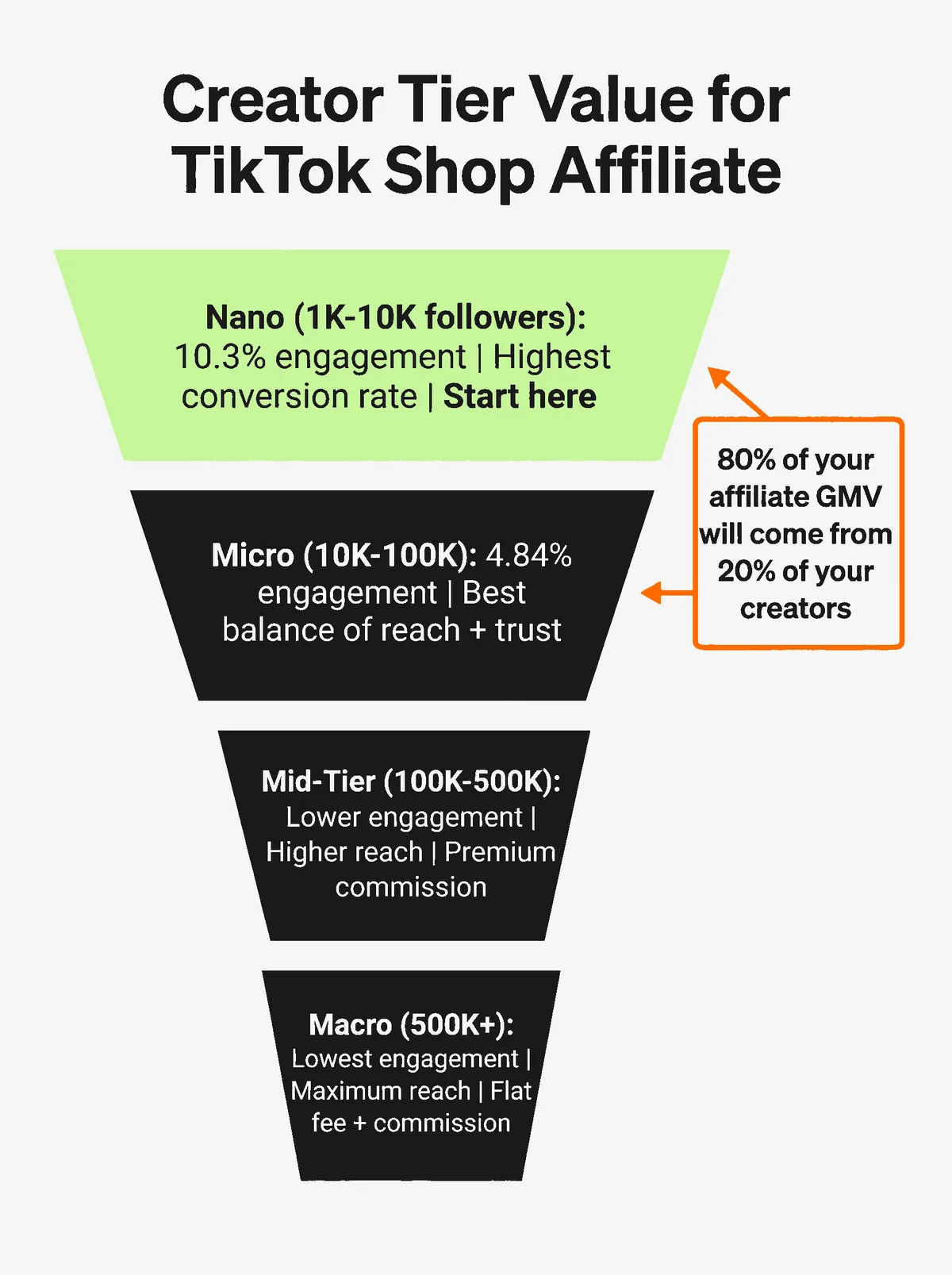
That's not an outlier. That's the norm. Open Collaboration churn sits at 58% within 90 days (agency aggregated data). Of the creators who stay, 20% generate roughly 80% of your affiliate GMV. Run those numbers. You recruit 200 creators. 84 disappear in three months. Of the 116 remaining, about 23 drive meaningful revenue.
The problem isn't creator quality. It's program design.
Most brands set commission based on gut. They don't model unit economics before launch. They skip product listing optimization — so creators can't even find their products in the affiliate marketplace. They provide no briefs, no samples, no direction. Then they wonder why their TikTok Shop affiliate marketing spend looks worse than paid ads.
The top reason creators leave programs? Not low commission. It's "no new ideas" — 38% of churned creators cite lack of creative direction as their primary reason for disengaging. Another 27% leave because earnings didn't meet expectations. And 19% leave over slow or unclear payouts. That's 84% of churn driven by problems that have nothing to do with the platform and everything to do with how you run the program.
This is a system design problem. And it requires a system design solution.
The Affiliate Launch Framework
After building affiliate programs for brands running $25M/month in combined GMV, the pattern became clear. The brands that scale don't follow a checklist. They follow a sequence — and the sequence matters more than any individual step.
We call it the Affiliate Launch Framework. Six phases, executed in order. Skip one and the rest break.
Phase 1: Unit Economics Lock
Before you touch Seller Center, you need to know your numbers. Not approximately. Exactly.
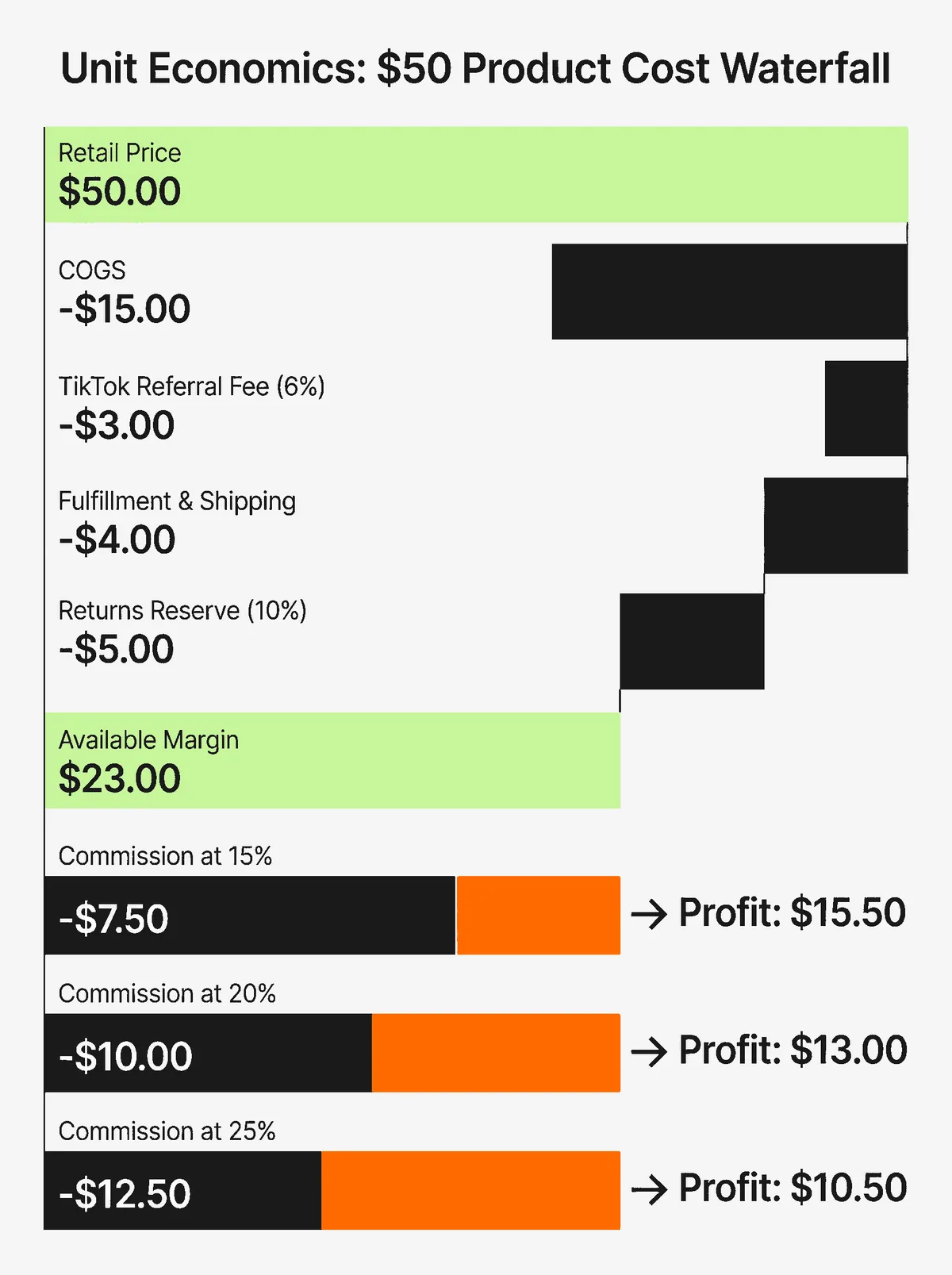
Here's the math on a $50 product:
COGS: $15 (30%). TikTok referral fee: $3 (6% — this is an all-in rate covering marketplace commission and payment processing for US sellers) (Printify). Fulfillment: $4. Returns reserve at 10%: $5.
One lever sellers underuse: the fulfillment line itself. Brands that switch eligible SKUs into Fulfilled by TikTok can drop per-unit shipping from $4 to as low as $2.86 on multi-unit orders, which often unlocks the room to run a 15-20% commission tier on day one.
That leaves $23 in available margin. Your commission comes out of this pool — and so does your profit.
→ At 15% commission ($7.50): net profit $15.50 per unit. 31% margin.
→ At 20% ($10): net profit $13. 26% margin.
→ At 25% ($12.50): net profit $10.50. 21% margin.
But those numbers lie. Because they don't account for the return rate's compounding effect.
Use this formula: Effective commission = Commission rate ÷ (1 − Return rate)
At 20% commission with a 20% return rate, your true effective commission is 25% — not 20%. Fashion brands with 25% return rates and 20% commission? True cost: 26.7%. The margin disappears fast.
There's a second-order effect most sellers miss entirely. Each 1% increase in return rate reduces your TikTok Shop Health Score by 8-12 points (TikTok Seller Center). And each 1% drop below 90% customer satisfaction reduces For You Page placement by 15-25%. High returns don't just eat margin. They throttle your entire program's visibility. Your affiliate creators get less reach, which means fewer sales, which means higher churn. It's a death spiral with a 30-day delay.
The rule: Don't launch until your unit economics work at your target commission rate with your actual return rate factored in. If affiliate commission pushes you below 15% net margin after all fees, restructure first.
Phase 2: Product Optimization
Creators don't find your TikTok Shop affiliate program through outreach alone. They find it through the affiliate marketplace — and the marketplace has an algorithm.
TikTok surfaces products based on five ranking signals: category relevance to the creator's content history, commission rate competitiveness within the category, product rating (4.5+ stars get prioritized), sample availability, and recent sales velocity.
That means your product listings are a discovery lever. Optimize them before you go live.
Four requirements:
→ Titles: Benefit-forward, search-friendly. Not "SKU-4829 Face Cream 50ml." Think "Hydrating Vitamin C Moisturizer — 24hr Glow, SPF 30."
→ Images: Minimum 4 high-quality photos. Multiple angles plus lifestyle shots. Products with video previews see 40-60% higher affiliate creator selection rates.
→ Ratings: Target 4.5+ stars before launching affiliate. Creators filter by rating. Below 4.0 and quality creators skip you entirely.
→ Samples: Enable sample requests on every product you plan to put in Open Collaboration. Creators are 2.5-3x more likely to select products when samples are available. Budget 20-30 units for month one.
Phase 3: Open Collaboration Launch (Days 1-14)
Now you go live. Navigate to Seller Center → Growth → Affiliate Marketing → Create Campaign. Select Open Collaboration first.
Start with your top 3-5 SKUs. These should be your best-sellers with the strongest reviews and clearest product-market fit. Don't launch your entire catalog — that dilutes creator attention and makes performance data harder to read.
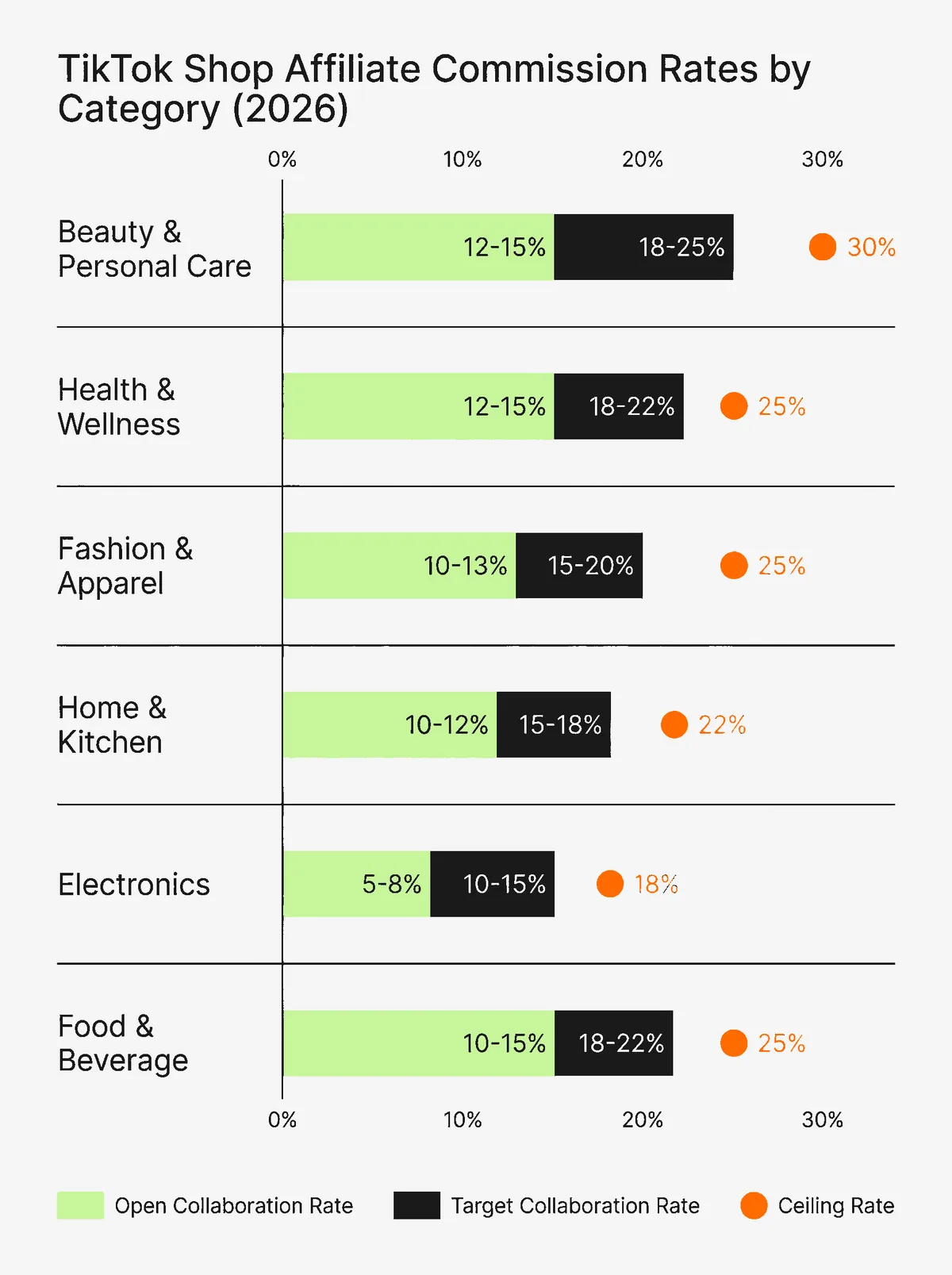
Set commission using these benchmarks as your floor:
| Category | Open Rate | Target Rate | Ceiling |
|---|---|---|---|
| Beauty & Personal Care | 12-15% | 18-25% | 30% |
| Health & Wellness | 12-15% | 18-22% | 25% |
| Fashion & Apparel | 10-13% | 15-20% | 25% |
| Home & Kitchen | 10-12% | 15-18% | 22% |
| Electronics | 5-8% | 10-15% | 18% |
| Food & Beverage | 10-15% | 18-22% | 25% |
The platform-wide average affiliate commission across all TikTok Shop categories is 13.02% (Dashboardly). Setting below that means you're invisible. Setting at the "competitive" tier for your category puts you in the top 30% of affiliate marketplace visibility.
Auto-approve creators for the first 14 days. You need volume to generate signal. Attach a one-page brief: 2-3 hook suggestions (not scripts — creators perform better with direction, not dictation), your product's strongest proof point, and a short "don't" list (no medical claims, no fake scarcity, no competitor bashing). End with a clear CTA the creator can adapt.
For a detailed breakdown of commission rates by category and tier, see our guide on TikTok Shop affiliate commission rates.
Phase 4: Signal Reading (Days 14-21)
This is where most brands make their worst mistake. They see slow week-one results and panic. They slash commission, kill campaigns, or over-recruit.
Don't touch anything for 14 days. The TikTok Shop affiliate channel has a maturation curve. Week one is noise. Week two starts showing signal.
At day 14, pull four metrics:
→ GPM (GMV per mille): Revenue per 1,000 video impressions. This measures content quality, not creator size. A nano-creator with 2,000 views and $400 GPM outperforms a macro-creator with 500,000 views and $20 GPM.
→ Creator activation rate: What percentage of enrolled creators actually posted? Below 30% means your brief or commission isn't compelling enough. Below 70% is a leading indicator of program problems.
→ Conversion rate: 8-12% is the benchmark for TikTok Shop affiliate (Dashboardly). Below 4%? The creator's audience isn't aligned with your product.
→ Per-creator GMV distribution: Confirm the 80/20 split. If one creator is driving 60%+ of your revenue, that's concentration risk — not a win.
Phase 5: Target Graduation (Days 21-30)
By day 21, you have enough data to identify your top performers. Rank creators by GPM — not follower count, not total views. GPM tells you who converts.
Your top 5-10 creators get upgraded. Move them from Open to Target Collaboration at 18-22% commission — 30-50% above your open rate. This locks them in. Target Collaboration churn runs at 34% versus 58% for Open. The exclusivity signal drives retention.
Send personalized invitations. Include product samples for their next 2-3 videos. Enable Shop Ads authorization so you can run Spark Ads on their best-performing content.
Cut creators below 4% conversion and below-category-average GPM. They're eating sample budgets without producing returns.
Here's the second-order effect: when you graduate top creators to Target, you're not just retaining them — you're freeing Open Collaboration to keep generating discovery. Open becomes your pipeline. Target becomes your roster. They feed each other.
Phase 6: Scale System (Month 2+)
After 30 days, you've validated the channel. Now you build the machine.
The scaling sequence:
Month 2: 20-30 core affiliates posting consistently. Commission tiering live (12% base → 15% at 10 sales → 18% at 50 → 22% at 200+). Spark Ads running on top 10 performing videos. Weekly management: 2-3 hours.
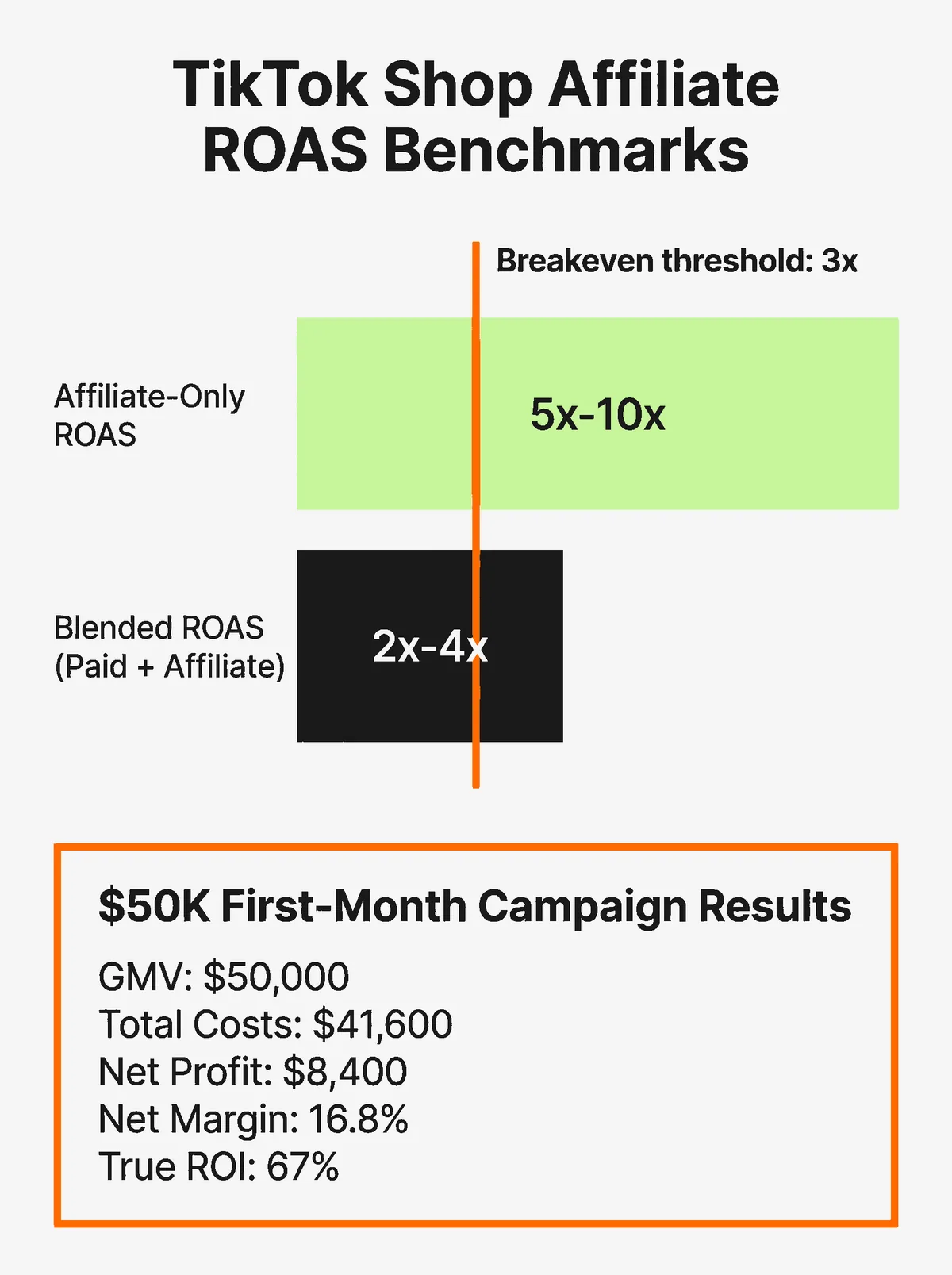
Month 3: Blended ROAS (paid + affiliate) stabilizes at 3-4x. Outbound recruitment adds 5-10 creators per week. You've hit the GMV Max threshold — 15-20 minimum videos, with 50+ optimal for the algorithm to find winning combinations (TikTok Seller Center).
Month 6: 50+ affiliates generating daily content. Affiliate becomes your second-largest acquisition channel. Weekly management drops to 3-4 hours because the system self-selects.
Month 12: Affiliate is your lowest-cost acquisition lever. Commission escalation models drive 2.1x higher 90-day retention versus flat commission structures. Your creator roster compounds — each retained creator produces better content over time.
One threshold most guides skip: livestream affiliate. Video affiliate accounts for roughly 50% of TikTok Shop GMV. But live commerce grew from 10% to 14% in 2025 and is accelerating, with top sessions generating $1-3M in a single day. Once your video affiliate program is stable, adding livestream creators is the natural next expansion — different economics, higher conversion, different creator profile. That's a separate playbook.
The Commission Math That Changes Everything
Commission is the first number creators see. Set it wrong and you either overpay for mediocre creators or watch top talent walk to competitors.
But here's the contrarian take most brands miss: higher commission doesn't always mean higher sales.
Beyond a category-specific ceiling, bumping the rate doesn't attract meaningfully better creators. What actually moves the needle is creative direction. Creators with high content coherence — videos that follow proven hooks, story structures, and CTAs for their category — earn 6.9x more per video regardless of the commission rate they're on. The difference between a $500/month creator and a $5,000/month creator isn't the percentage. It's the pattern.
This is why samples beat commission bumps every time. A creator with your product in hand at 15% outperforms a creator without product at 25%. The economics of authenticity outweigh the economics of incentive.
The 30-Day Commission Lock Rule: When you increase commission, it takes effect immediately. When you decrease, there's a 30-day grace period — existing affiliates keep the old rate (TikTok Seller University). Use this asymmetry strategically. Raise rates during recruitment spikes. Schedule decreases once volume targets are hit.
One more hidden floor: if you're running Spark Ads alongside your affiliate program, Shop Ads commission must be at least one-third of your standard affiliate rate (TikTok Seller University). At a 21% Target rate, your Spark Ads floor is 7%.
For a deeper breakdown of how commission interacts with finding and vetting the right creators, see our guide on how to find and recruit TikTok Shop creators at scale.
First-Month P&L: What a Real TikTok Shop Affiliate Program Looks Like
Theory is worthless without proof. Here's a first-month P&L from a beauty brand running the Affiliate Launch Framework.
Revenue: $50,000 GMV from affiliate sales.
Costs:
→ COGS (30%): $15,000
→ TikTok referral + processing (8.2%): $4,100
→ Affiliate commission (15% avg): $7,500
→ Fulfillment: $5,000
→ Returns reserve (10%): $5,000
→ Spark Ads spend: $3,000
→ Sample costs (30 units): $2,000
Net profit: $8,400. Margin: 16.8%. First-month ROI: 67%.
That's affiliate-only ROAS of 6.7x on commission spend. Blended (including ads and samples): 3.4x. Both above the 3x breakeven threshold where affiliate gets interesting (TikAdTools).
But the real number is bigger. TikTok Shop affiliate content doesn't just drive TikTok Shop sales. It drives sales on Amazon, your DTC site, and Meta. The cross-channel lift — what brands call the Halo Effect — typically understates true affiliate ROI by 30-50%. A $50K TikTok Shop month often means $15-25K in unmeasured lift across other channels.
That's why brands scale affiliate aggressively once they see the first-month data. The unit economics don't just work. They compound.
7 Mistakes That Kill TikTok Shop Affiliate Programs Before They Start
After watching dozens of brands launch — and fail — these are the seven patterns that guarantee a dead program.
1. Commission below category floor. Under 10% won't attract creators worth recruiting. You'll fill your roster with volume-chasers who post once and vanish. Start at the category "standard" tier at minimum.
2. No unit economics model. Brands that launch without knowing their true margin at target commission rates are guessing. Guessing at scale means burning cash. Run the math from Phase 1 before you touch Seller Center.
3. Affiliate-unfriendly listings. Generic titles, bland images, no video previews. Creators browse the marketplace the way shoppers browse Amazon — they skip anything that doesn't look professional in two seconds.
4. Open Collaboration only. Open catches volume. Target catches quality. Running only Open means your best creators have no incentive to stay — and competitors offering Target terms will poach them.
5. No briefs, no samples. Creators aren't mind readers. A one-page brief with 2-3 hook directions and 20-30 product samples in month one is the minimum viable investment. Creators who've held the product make better content. Period.
6. Evaluating at day 7. The affiliate channel has a 30-day maturation curve. Week one is noise. Cutting campaigns in week two is the most expensive mistake in TikTok Shop affiliate marketing — you're killing the signal before it forms.
7. Set-and-forget management. Affiliate isn't passive income. Three to four hours per week reviewing top performers, cutting underperformers, and escalating rates for your core roster. That discipline is what separates $10K months from $100K months.
Compliance: The Rules Most Sellers Learn the Hard Way
TikTok Shop affiliate content operates under two regulatory layers: TikTok's platform policies and FTC disclosure requirements. Ignoring either one can get products delisted or accounts suspended.
FTC disclosure: Every affiliate video requires commercial relationship disclosure. TikTok's branded content toggle handles this automatically when creators use the affiliate link — but some creators forget. Monitor your top creators' content. Missing disclosures expose both you and the creator.
TikTok content policies: Health and beauty categories face the strictest enforcement. No medical claims. No before/after comparisons for supplements. No unverified efficacy statements. "This cured my acne" is a policy violation that can delist your product overnight. Include specific "don'ts" in every brief.
Prohibited practices: No misleading pricing. No fake urgency ("only 3 left!" when you have 3,000 units). No counterfeit or IP-infringing products.
The fix is simple. Add a three-line compliance section to every campaign brief: what creators MUST do (use affiliate link, toggle branded content, disclose partnership), what they MUST NOT say (medical claims, fake scarcity, competitor disparagement). Prevention costs nothing. Remediation costs everything.
From First Campaign to Full Affiliate Engine
The brands winning on TikTok Shop in 2026 aren't spending more. They're building better systems.
They know their unit economics before they launch. They optimize product discovery before they recruit. They read signal before they optimize. They graduate top performers before they scale. And they compound retention — because a creator who stays 6 months produces exponentially better content than one who stays 6 weeks.
That's what the Affiliate Launch Framework builds. Not a single campaign. An engine.
SFN AI accelerates each phase. Pattern Mining identifies which hooks, story structures, and CTAs correlate with high GMV in your category — so your briefs contain proven angles, not guesses. Coherence Scoring measures how closely each creator's video matches the winning pattern on a 0-100% scale, so you know which content will convert before you promote it. And Content Ideas generates personalized video concepts for each creator daily based on their unique style — no manual brief writing required.
Or build it manually. The framework works either way. The phases are the same. The math is the same. Automation just compresses the timeline from months to weeks.
Start with Phase 1. Run the unit economics. If the math works, launch Open Collaboration on your top 3-5 SKUs. Read the signal at day 14. Graduate your top creators at day 21. Scale from there.
That's the path from first TikTok Shop affiliate program to full engine.
Start building your affiliate program →
Related: TikTok Shop Affiliate Commission Rates: What Brands Should Offer | How to Find and Recruit TikTok Shop Creators at Scale | How to Write TikTok Shop Affiliate Briefs That Creators Actually Use
Founder of SFN AI. We watch TikTok Shop 24/7 so creators and the brands that run them get the playbook.