Fogdream had 432 creators and six flat weeks. Then 44% of the quarter landed in two days.
432 creators, six weeks of nothing, then 44% of the window's GMV in 48 hours. How a views-based milestone ladder and a reversed brief restarted Fogdream's roster.
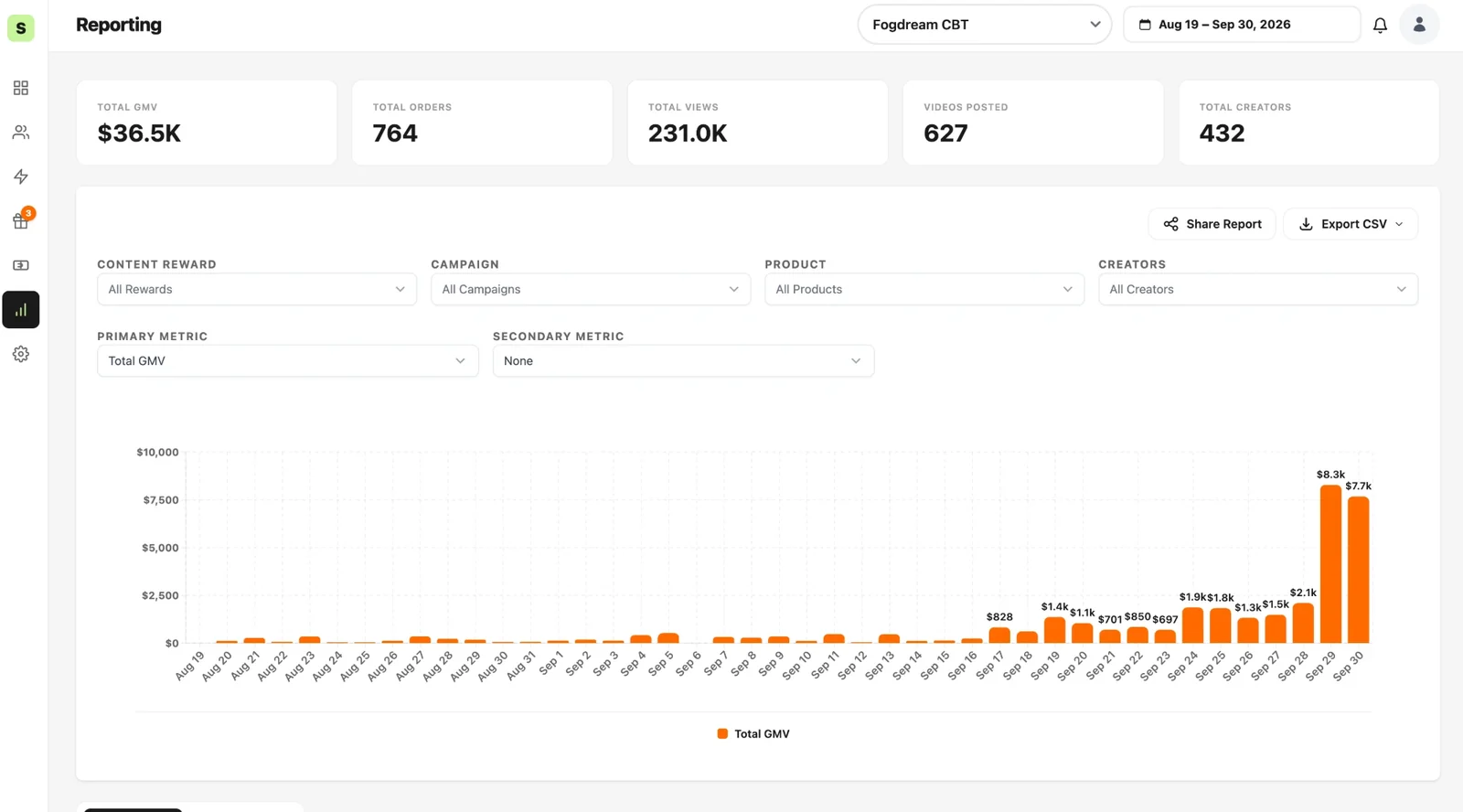
Source: app.sfn.ai / Reporting · Fogdream CBT · Aug 19 to Sep 30, 2026 · actual reported GMV
THE PROBLEMSix weeks of a roster that would not start
Fogdream sells a folding pan. The handle twists and lies flat so the whole thing slides into a drawer, and the pan is divided into sections so you can cook several things at once.
From Aug 19 to Sep 16, their reporting line is flat along the bottom of the chart. Six weeks. Hundreds of creators attached to the program and almost nothing moving.
The instinct in that situation is to recruit. It is almost always the wrong instinct, because an inactive roster does not become active by getting bigger, it just becomes a bigger inactive roster. So before changing anything we went and looked at what the existing videos were actually doing.
In the thirty days to the start of September, 235 videos went out from 137 creators on a single SKU. The mean earned $6.82 a video. The median earned nothing. So did the 90th percentile. Only 7.2% of videos earned anything at all.
A median of zero is survivable. A 90th percentile of zero is a different diagnosis entirely. It means this was not a roster with a few weak creators dragging an average down. Nine videos in ten earned nothing, and the whole result sat in a handful of outliers.
Then the two numbers that sat side by side and explained it.
Videos were averaging 243 views. Almost nothing was being seen. And when something was seen, it converted at $28.12 of GMV per thousand views, which is a perfectly healthy number for a pan at this price.
So the offer was not broken. The creative was not broken. Distribution was the entire problem, and every instinct the program had was pointed at the wrong one.
THE EVIDENCEOne creator, seven videos, and the whole argument
One creator on the roster made the case better than any model could.
They posted four videos between late July and mid August. Those averaged about 110 views and earned nothing.
The fifth did 20,153 views. That is 83 times the brand average. It produced five orders and $281.02, which was roughly 14% of everything the program had tracked to that point, out of one video. Two follow-ups inside the next 48 hours paid again. Across seven videos they finished at $404.91 and seven orders, and went to number one on the brand.
They were at zero on the Thursday. Nothing about them changed. One video got distribution and the offer did the rest.
THE STRATEGYPay for reach, not persuasion
If reach is the constraint, then paying on sales is paying for the wrong thing. So the contest was ranked on views, and the reasoning was arithmetic rather than preference.
Rank a contest on GMV when the hit rate is 7.2% and you have zeroed out 93% of your entrants by the end of week one. They check the scoreboard, see nothing next to their name, and stop filming. Worse, with more than half the program's GMV sitting in five videos, a GMV-ranked contest mostly pays the creator who was already winning. You spend the budget confirming an existing result instead of buying a new one.
Ranked on views, every entrant has a live position on the scoreboard from their first post. The metric matches the thing the plan is actually buying.
A cadence ladder pays for showing up: 5, 15 and 30 qualifying days, capped so it cannot run away. A reach ladder pays per video as it travels: 1,000 views, 5,000 views, 20,000 views, with no base guarantee, so the cost scales with delivery and self-limits. Cadence alone buys more 243-view videos. Reach alone leaves the dormant two thirds of the roster untouched. Both, and the floor rises while the ceiling gets chased.
A qualifying day is one video on a distinct calendar day that clears the gate. Counting days rather than videos is deliberate: it removes the exploit where a creator posts thirty videos in ten days, collects, and leaves.
THE ANGLESWhat the roster was told to film
Three angles, each scored as a multiple against its own baseline rather than on raw view counts, which are not comparable across patterns.
The lead was a silent cooking transformation at 20.5x: faceless, hands only, no script, trending audio. Open on the finished plated dish filling most of the frame, reverse-reveal the pan it came out of, let a text overlay name the occasion, end on the pan clean. It needs no voiceover and no script, which is what matters when you are rolling a format out to hundreds of creators who have been sitting on their hands.
Behind it, a gift unboxing arc that opens on the moment of giving rather than on the product, with gifting language in the hook and not a single spec. And a recipe tutorial at 4.6x where the food is the hero for the first thirty to forty seconds and the pan only arrives once the dish has landed. That last one exists so the silent demos do not cannibalise each other.
Because the reward pays on reach, the creative direction pushes watchable openings instead of price anchors and urgency closes. That is deliberately the wrong brief for a conversion campaign, and exactly the right one for a program whose only problem is that nobody is watching.
THE RESULTThe line breaks on Sep 17 and never comes back down
Nothing, then $828 on Sep 17. Then $1.4K, $1.1K, a wobble, $1.9K, $1.8K, $2.1K as the rungs start landing. Then Sep 29 at $8.3K and Sep 30 at $7.7K.
Those last two days are roughly $16.0K of a $36.5K window. Forty-four percent of the whole period, in the final 48 hours, from a roster that had produced close to nothing for six straight weeks. Over the window: 627 videos, 231.0K views, 764 orders, and an average order value of $47.80, the highest of any program we have published.
The roster did not change. The creator count did not change. The product did not change, and neither did the offer, which had been converting fine the whole time at $28.12 per thousand views. What changed is that filming today became worth something today, and the thing being paid for was finally the thing that was missing.
A reach-based ladder only works if the margin carries it. We ran that arithmetic before the campaign went live rather than after, and sized the rungs to a blended rate the product could absorb. An incentive you cannot afford is not a strategy, it is a bill.
