How Keep turned a flat roster into $471.5K by sequencing the quarter, not the content
Keep US ran four promo moments on one sequenced creative strategy. Daily run rate up roughly 3.1x and $471.5K in reported GMV across Aug 17 to Oct 7, 2026.
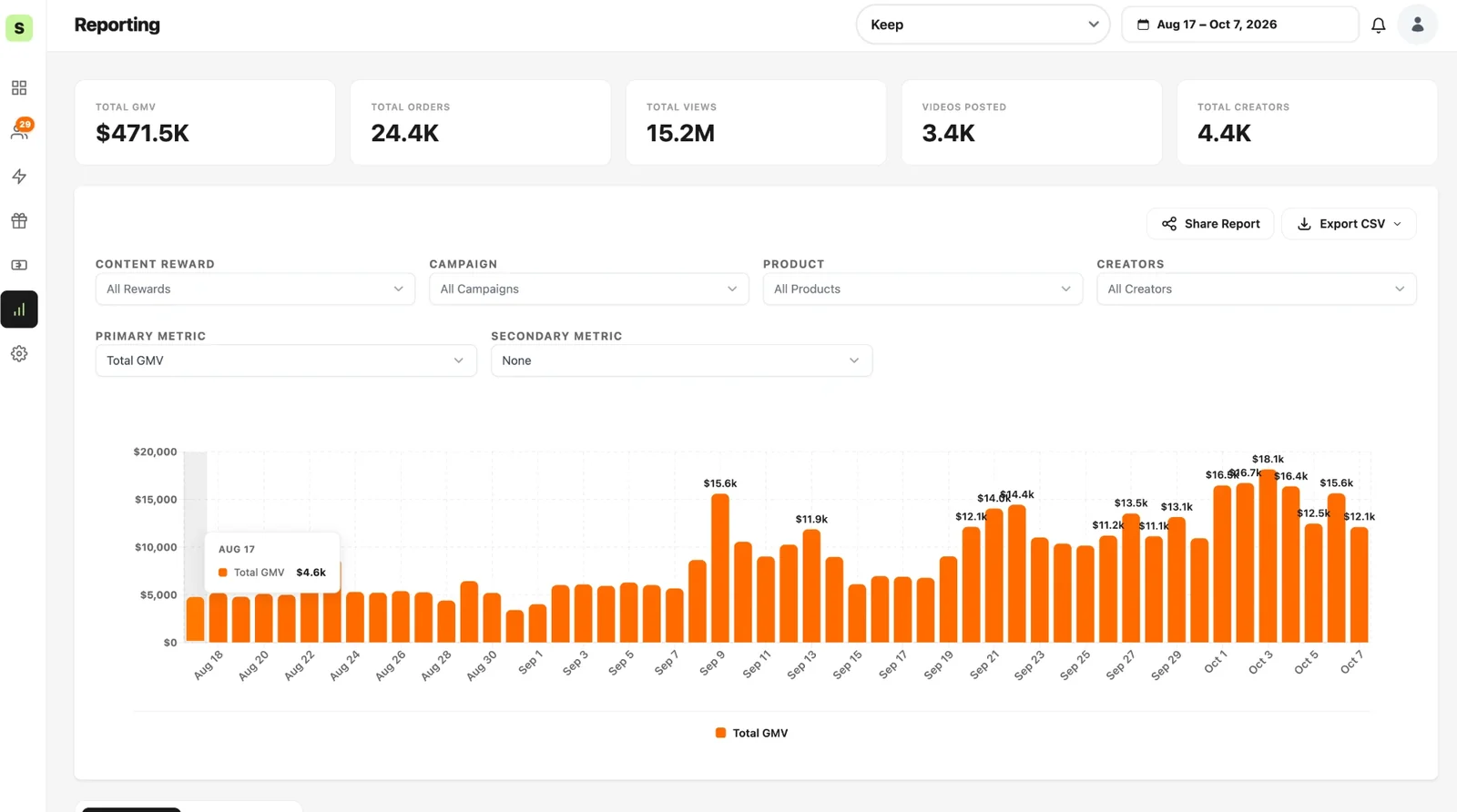
Source: app.sfn.ai / Reporting · Keep · Aug 17 to Oct 7, 2026 · actual reported GMV
THE SETUPA roster that was already working, pointed at nothing in particular
Keep US sells home-gym gear. Push-up stands, figure-8 bands, a hand grip strengthener, a peanut ball. Accessible training equipment for people who are never going to own a squat rack.
When we sat down to plan their quarter, the roster was not the problem. Creators were posting. Content was arriving. The numbers underneath it were the problem, and they were the kind of numbers that look fine until you ask a second question.
Videos per creator sat at 2.7, with no reward layer running at all. One creator was 35% of total GMV, which is not a roster, that is a single point of failure wearing a roster costume.
And then there was the thing the averages were hiding.
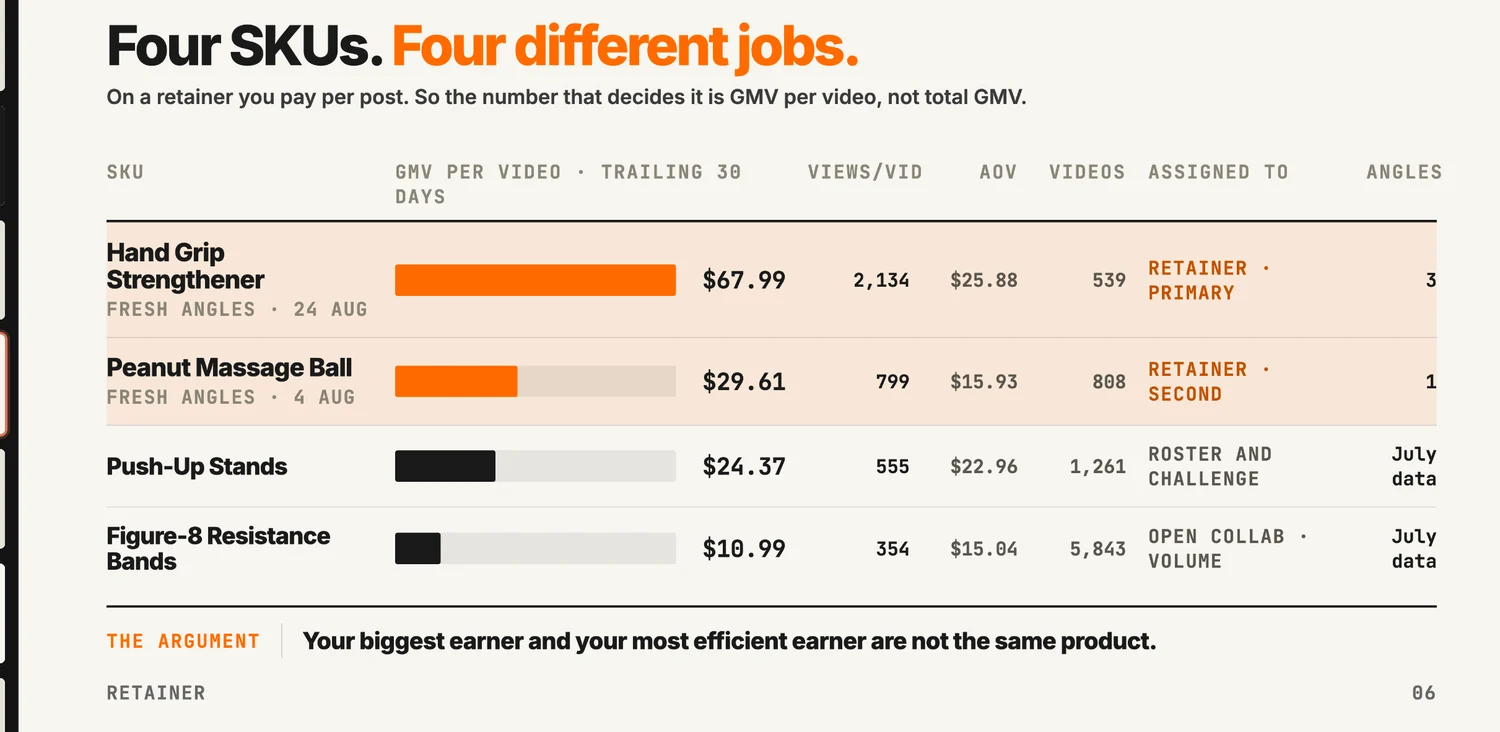
The grip strengthener earned $67.99 of GMV per video over the trailing thirty days. The figure-8 bands earned $10.99. And yet the bands carried 5,843 videos in that window against the grip strengthener's 539, which is ten times the content on a sixth of the return per post. Keep's biggest earner and Keep's most efficient earner were not the same product.
It gets sharper when you stop averaging. Only 11.8% of the bands' videos earned anything at all, against 31.6% on the grip strengthener, and 85.1% of the bands' GMV sat in their top five videos. That is not a good product having a quiet month. That is an average being carried by a handful of outliers, which makes the average useless for deciding anything. On every SKU Keep sold, the median video earned nothing.
So the real question was never how do we get more content. It was: which product can we pay a creator up front to make videos for, and which one do we only ever pay on results?
Their brief put the whole quarter on push-up stands. We kept their campaign completely intact and changed what the other three products were for. The challenge builds the roster on the push-up stands. The grip strengthener carries the testing, because it hits often enough for a result to mean something. The bands carry reach, and they are paid on results only, because a product that hits 11.8% of the time is the last thing you prepay for.
THE STRATEGYTikTok Shop is a retargeting engine, so we ran the quarter in waves
Here is the thing almost nobody acts on. When someone engages with shoppable content, the algorithm learns, and then it shows them more shoppable content. Which means a roster making nothing but conversion content is fishing in the same pond every single day. The pond does not grow. It gets more expensive.
Keep had four moments between the plan and the end of November. Labor Day, a thirty-day check-in challenge, Halloween, and BFCM. Every one of them existed to make the next one work. So payouts were gated to funnel phase against each promo date, not to sales:
| Timing | Phase | What the roster is filming |
|---|---|---|
| 3 weeks out | TOF | hooks, trends, awareness ... fill the pool |
| 2 weeks out | MOF | before and after, demos, testimonials |
| 1 week out | BOF | the offer, urgency |
| Promo days | BOF | the discount runs into an audience that already saw the product |
Underneath every moment, a milestone ladder runs continuously for the whole roster. That is the floor: content never stops arriving. Contests stack volume into the days before a promo. The six strongest creators on the roster get enrolled across every campaign, so the pools always have a quality floor underneath them.
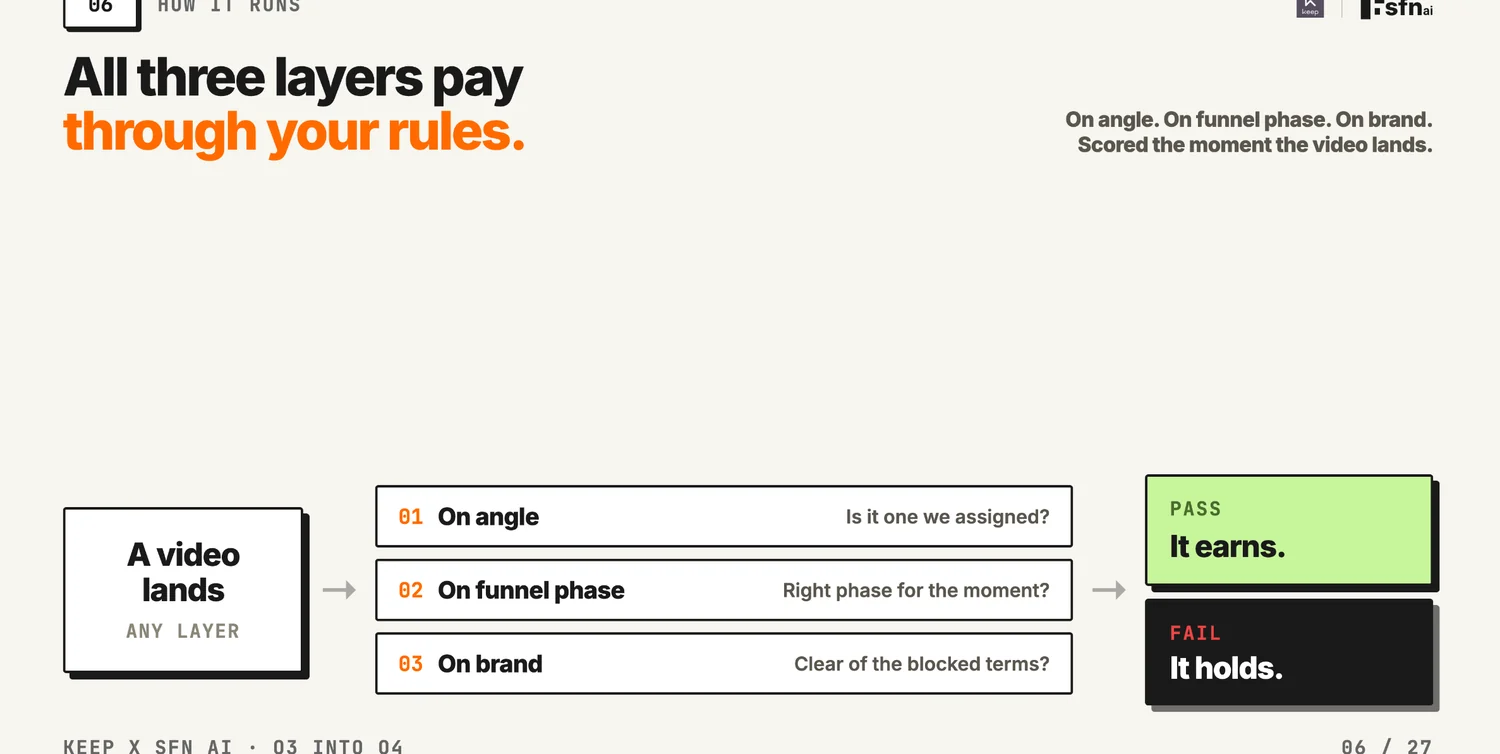
Two motions, one gate. Every video scored zero to 100. On-angle, on-phase and on-brand earns. Off holds, with the reason attached.
THE ANGLESWhat the roster was actually told to film
An angle is not a template and it is not a vibe. It is a proven content framework pulled from videos that already sold, scored on how much evidence sits behind it, and filed by funnel stage. Keep went into the quarter with 94 live angles across four products: 21 top of funnel, 53 middle, 22 bottom.
The highest-scoring angle on the board was a middle-of-funnel hook on the grip strengthener that opens on a safety warning about how your forearms look, then turns into an immediate self-assessment. It scored 92 in two consecutive runs, drawn from 14 real videos, with roughly 9x the GMV and 8x the reach of that product's own baseline. Not a guess. The same pattern surfaced twice, independently.
Behind it, a shared-experience angle about skinny wrists that bonds first and sells second, scoring 88 off the largest evidence base of anything Keep had, which is exactly what makes it the least likely to be noise. And on the bands, an angle that names one specific fitness frustration out loud and then solves it step by step on camera, scoring 82 with roughly 30x the reach of baseline.
Top of funnel ran differently on purpose. An aspirational physique hook plus a live demo on the push-up stands, scoring 85, which became the spine of the check-in challenge. A delayed-reveal curiosity loop on the grip strengthener. And a music-driven silent demo, cut to a trending beat drop, no voiceover, no script, validated on two separate products. That last one matters less for its score than for what it costs a creator to make. When you are rolling a format out to a roster this size, the lowest production barrier wins.
The single highest-GMV middle-funnel pattern Keep had was seasonal, built on summer. We held it. It was late August. A great angle pointed at the wrong month is a wasted angle, and it is worth more in January than it was worth that week.
HOW IT RANFive campaigns, and the names were the brief
The angles became campaigns. Not themes, campaigns, each one configured against a single product with its own pool.
| Campaign | Shape | Product | Runs |
|---|---|---|---|
| Forearm Season | Milestone | Hand grip strengthener | Always on |
| Push Day, Every Day | Milestone | Push-up stands | Always on |
| No Talking, Just Reps | Milestone | Figure-8 bands | Always on |
| Labor Day Push | Contest | All three | Sep 1, promo Sep 5 to 7 |
| The 30-Day Check-In | Contest | All three | Sep 8 to Oct 7 |
Read those names again. Forearm Season is the 92-scoring angle compressed into two words, so a creator is standing inside the idea before they have read a single rule. No Talking, Just Reps is the silent-demo format, and the name is the entire brief: it removes the biggest reason a creator skips a product, which is not knowing what to say about it.
The milestone ladder underneath pays on qualifying days, not views and not sales. Five days earns $30, fifteen earns $100, thirty earns $225, and they stack to $355. A qualifying day is one video, posted on a distinct calendar day, carrying the day number, and clearing the quality gate. Two videos on one day count once.
Keep's brief paid out once, at 135,000 views and 30 videos, for $200. Their own modelling expected 10 creators in 100 to reach it, which means the median participant films daily for a month and earns nothing. The ladder pays from day five instead. That is what keeps a cohort filming through the middle of the month, which is where the view target is actually won.
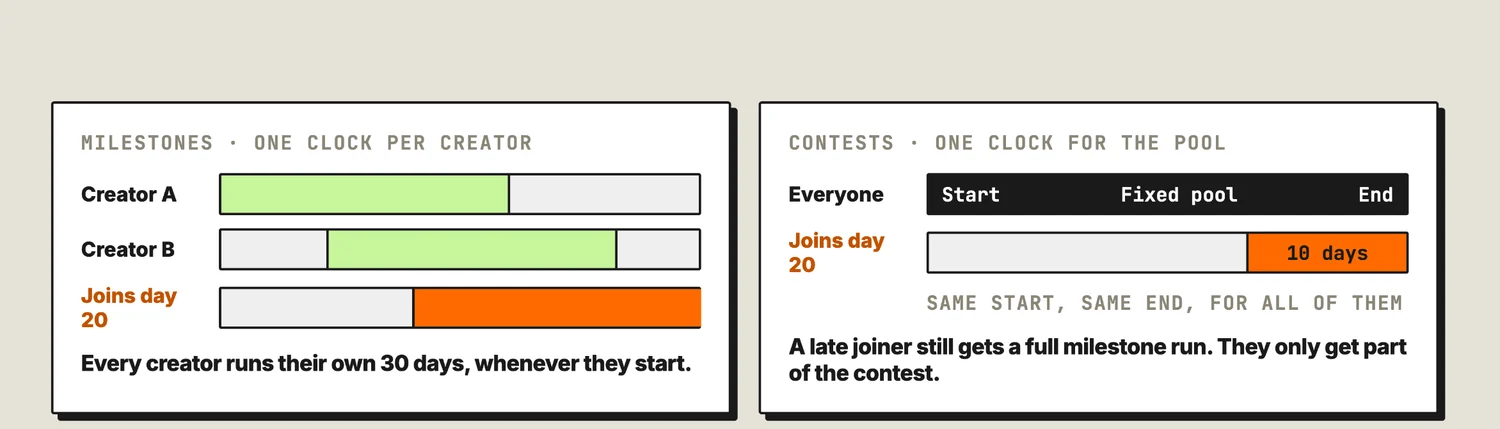
That difference is the whole reason both exist. The milestone ladder means a creator who finds the program late is never too late to start earning, so the roster keeps growing all quarter. The contest clock is fixed for everyone, which is what concentrates volume into the days before a promo.
The contests pay nine places, not three: three for attributed GMV, three for views, three for qualifying days. A creator with a small audience and perfect consistency can still place. Ask fifty creators to compete for one prize and forty-nine of them stop filming in week two.
Angle testing runs on a fixed rule rather than a feeling. Six creators at twenty videos a month is 120 videos, which is two angles tested at fifty videos each. Below fifty the result is noise. An angle that wins graduates into the brief for the whole roster. An angle that loses stops at video fifty and the next one starts. Two verdicts a month, every month.
Sampling got the same treatment. Approving a sample is arithmetic, not taste: a creator's GMV per thousand views over their trailing 30 days, times their typical views, times posts per sample, measured against the product price. Clear the price and the sample ships automatically. Fall below it and it is declined before the box moves, because that creator cannot mathematically produce a single sale whatever their follower count says. Only the ambiguous middle reaches a human.
Two more things we changed before launch. Attribution runs to campaign end plus fourteen days on every moment, because a thirty-day challenge with a fourteen-day window scores its own back half as a failure. And the KPIs were agreed per moment rather than applied uniformly: the challenge is measured on views, qualifying days and completion rate, while return on the reward line is held back for BFCM, where it belongs. Judge a pre-volume campaign on ROI in week three and a good quarter looks like a bad one.
Keep's shop blocks weight loss, slim down, burn fat and before-and-after body framing. A thirty-day results challenge drifts into exactly that language by default, because creators reach for transformation framing when they hit day thirty. That is why it shipped as a check-in rather than a transformation, and why every campaign frames on reps and consistency. One creator had already been flagged twice in a single day while we were writing the plan.
THE RESULT$471.5K, and the shape of it matters more than the total
Across Aug 17 to Oct 7, Keep's reporting shows $471.5K in GMV, 24.4K orders, 15.2M views and 3.4K videos posted.
The curve is the part worth reading. The first three weeks run flat at roughly $4.6K a day. That is the roster as it was. The first contest lands and the line jumps to $15.6K in a day. It settles, climbs again through late September as the challenge compounds, and then closes at its strongest: $16.5K, $16.7K, $18.1K, $16.4K on consecutive days at the start of October.
Those dates are not a coincidence. The Labor Day promo ran Sep 5 to 7. The 30-Day Check-In opened Sep 8 and closed Oct 7, which is the exact stretch the line climbs hardest and the exact day the window ends.
Opening daily run rate to closing daily run rate is roughly 3.1x. Peak day against opening day is roughly 3.9x. Nothing about the roster changed. The same creators, the same four products, the same commission. What changed is that every one of them woke up knowing what to film, and the calendar decided which kind of content was worth paying for that week.
And the asset at the end of a quarter like this is not the GMV. It is the roster that now knows the products, the angles that finally have real verdicts on them instead of priors, and a reward ladder people trust enough to keep filming for. That is what January runs on.
