TikTok Shop Affiliate Commission Rates: What Brands Should Offer (2026 Data)
Complete TikTok Shop commission rate benchmarks by category, plus what Shop Ads commission actually means, the one-third rule, and 2026 unit economics.

You're about to launch your TikTok Shop affiliate program. You open Seller Center, navigate to Open Collaboration, and stare at the commission rate field.
What do you type? Setting the right affiliate program TikTok commission rate is the most consequential decision you'll make.
Too low, and no creator touches your product. Too high, and you're bleeding margin on every sale. The wrong number here doesn't just cost you money — it determines whether creators choose your product over the 47 others in their Marketplace feed.
Here's what makes this decision harder in 2026: TikTok Shop's fee structure has gotten more complex. Platform referral fees, payment processing, fulfillment costs, return rate inflation, and the new Shop Ads commission rate all stack on top of your affiliate commission. Most brands set their rate based on what competitors offer. That's a reliable path to insolvency.
The only sustainable commission rate is one derived from your own unit economics — worked backward from your target net margin. This guide gives you the exact framework to find that number, category-specific benchmarks to pressure-test it, and a tiered structure that attracts creators without destroying your P&L.
What Shop Ads Commission Actually Means
Shop Ads commission is the separate, lower rate creators earn when their video drives a sale through a boosted Shop Ads or GMV Max campaign, rather than organically. TikTok requires it to be at least one-third of your standard rate, so a 15% standard rate means a 5% floor.
How TikTok Shop Affiliate Commissions Actually Work
Before setting a rate, you need to understand the three distinct commission structures TikTok Shop offers — because each one serves a different strategic purpose. Agencies setting rates on behalf of client shops hit rules this piece does not cover, including commission precedence and double-dipping. Those are in the agency operations guide.
Open Collaboration vs. Targeted Collaboration vs. Shop Ads Rates
Open Collaboration is your broad affiliate program. You set a commission rate, list your products, and any creator on TikTok Shop can pick them up and promote them without prior negotiation. This is your discovery engine — it's how you get hundreds of creators testing your product organically. (For a deep dive on discovery methods, see our guide to finding and recruiting TikTok Shop creators at scale.) Rates here should be competitive enough to appear in creators' Marketplace feeds but not so high that you're overpaying for untested creators. Most brands set Open Collaboration rates between 10-15%.
Targeted Collaboration is your invite-only program. You select specific creators and negotiate individual commission rates. This is where you lock in your top performers — the creators who've already proven they can drive sales. Targeted rates are always higher than Open rates (typically 18-30%) because you're paying a premium for proven performance. Think of Open as casting a wide net and Targeted as spearing the fish you actually want.
Shop Ads Commission Rate is a newer feature that lets you set a separate, typically lower commission rate for orders generated through Affiliate Creatives for Ads (ACA). When a creator's video gets boosted through your GMV Max or Shop Ads campaign, they earn this rate instead of the standard rate. The key rule: your Shop Ads rate must be at least one-third of your standard commission rate. If your Open rate is 15%, your Shop Ads minimum is 5%.
The strategic play: use a 10-15% standard rate for organic reach, a 5-8% Shop Ads rate to control ad-driven costs, and 20%+ Targeted rates to retain your best creators. For the complete campaign setup walkthrough, see our step-by-step affiliate campaign guide.
The 30-Day Rate Lock Rule (and How It Affects Your Strategy)
TikTok protects creators with a rate lock mechanism that every brand needs to understand before adjusting commissions.
When you lower a commission rate, creators who are actively promoting that product get a 30-day grace period at the original rate. They keep earning the higher commission for a full month after the change. This means rate decreases are slow-acting — plan accordingly.
When you raise a rate, creators receive the higher commission instantly. No delay, no grace period. TikTok designed this asymmetry to protect creators and incentivize rate increases.
The strategic implication: set rates you can sustain long-term. Frequent rate cuts — even with the 30-day buffer — erode creator trust. Creators talk to each other. A brand known for lowering commissions gets blacklisted faster than one that never raises them.
2026 Commission Rate Benchmarks by Category
These benchmarks are compiled from TikTok Shop marketplace data, agency recommendations, and seller community intelligence. Use them as a starting point — your actual rate should be derived from your unit economics (covered in the next section).
Open Collaboration Rates
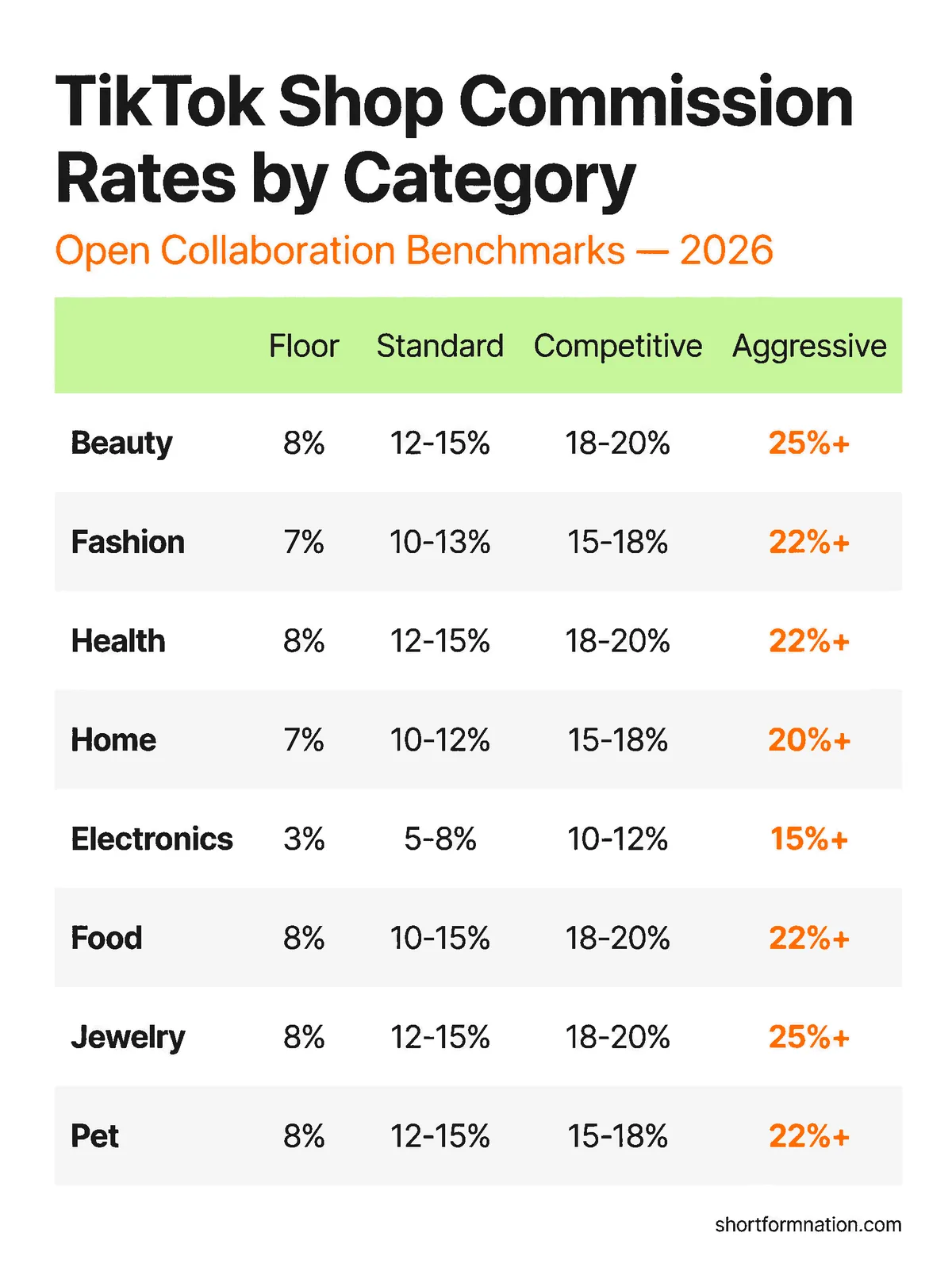
Beauty & Personal Care: Low 8% | Standard 12-15% | Competitive 18-20% | Aggressive 25%+
Fashion & Apparel: Low 7% | Standard 10-13% | Competitive 15-18% | Aggressive 22%+
Health & Wellness: Low 8% | Standard 12-15% | Competitive 18-20% | Aggressive 22%+
Home & Kitchen: Low 7% | Standard 10-12% | Competitive 15-18% | Aggressive 20%+
Electronics & Tech: Low 3% | Standard 5-8% | Competitive 10-12% | Aggressive 15%+
Food & Beverage: Low 8% | Standard 10-15% | Competitive 18-20% | Aggressive 22%+
Jewelry & Accessories: Low 8% | Standard 12-15% | Competitive 18-20% | Aggressive 25%+
Pet Products: Low 8% | Standard 12-15% | Competitive 15-18% | Aggressive 22%+
Targeted Collaboration Rates
Beauty & Personal Care: Standard 18-22% | Premium 25-28% | VIP 30%+
Fashion & Apparel: Standard 15-18% | Premium 20-22% | VIP 25%+
Health & Wellness: Standard 18-22% | Premium 22-25% | VIP 28%+
Home & Kitchen: Standard 15-18% | Premium 18-22% | VIP 25%+
Electronics & Tech: Standard 10-13% | Premium 15-18% | VIP 20%+
The cross-category average sits around 13-16% for Open Collaboration. Beauty, health, and wellness command the highest rates because margins support it. Electronics sits lowest because high AOV and thin margins leave less room for commission.
A critical comparison: Amazon Associates caps most categories at 1-10% (fixed by Amazon). TikTok Shop sellers set their own rates. This flexibility is your advantage — but it also means there's no ceiling to stop you from overpaying.
The Unit Economics Behind Every Commission Rate
The most common commission mistake? Setting rates based on competitor benchmarks instead of your own margin math. Here's how to calculate the maximum rate your business can actually sustain.
The Full Cost Stack: Referral Fees + Processing + Fulfillment + Commission
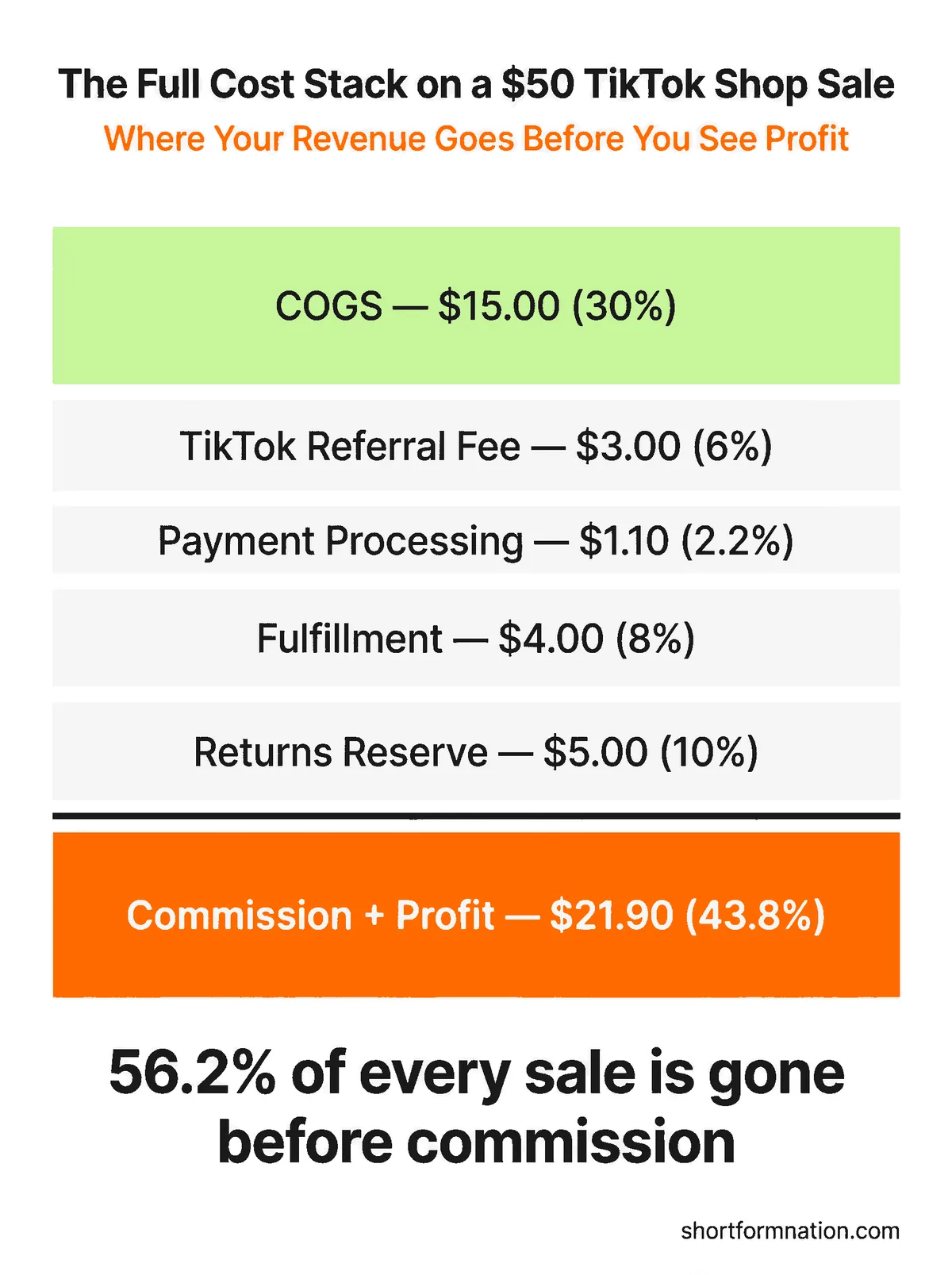
Every TikTok Shop sale gets hit with multiple fees before you see a dollar of profit. Here's the complete cost stack for a $50 product:
COGS: $15.00 (30%) | TikTok Referral Fee: $3.00 (6%) | Payment Processing: $1.10 (2.2%) | Fulfillment: $4.00 (8%) | Returns Reserve (10%): $5.00 (10%) | Subtotal before commission: $28.10 (56.2%) | Remaining for commission + profit: $21.90 (43.8%)
If you want a 15% profit margin ($7.50), your maximum sustainable commission is $14.40 — or 28.8%. At 30% COGS, this $50 product can support an aggressive commission strategy. At 50% COGS, that same product maxes out at about 14% commission before you start losing money.
The formula: Maximum commission = Selling price - COGS - Referral fee (6%) - Processing (~2.2%) - Fulfillment ($3.50-$6) - Returns reserve - Target profit margin.
The fastest way to widen that margin without raising your selling price is to compress the fulfillment line. Fulfilled by TikTok drops shipping cost to as low as $2.86 per unit on multi-unit orders, which can recover 2-4 points of margin and make a higher commission tier viable.
Return Rate Inflation — The Hidden Commission Killer
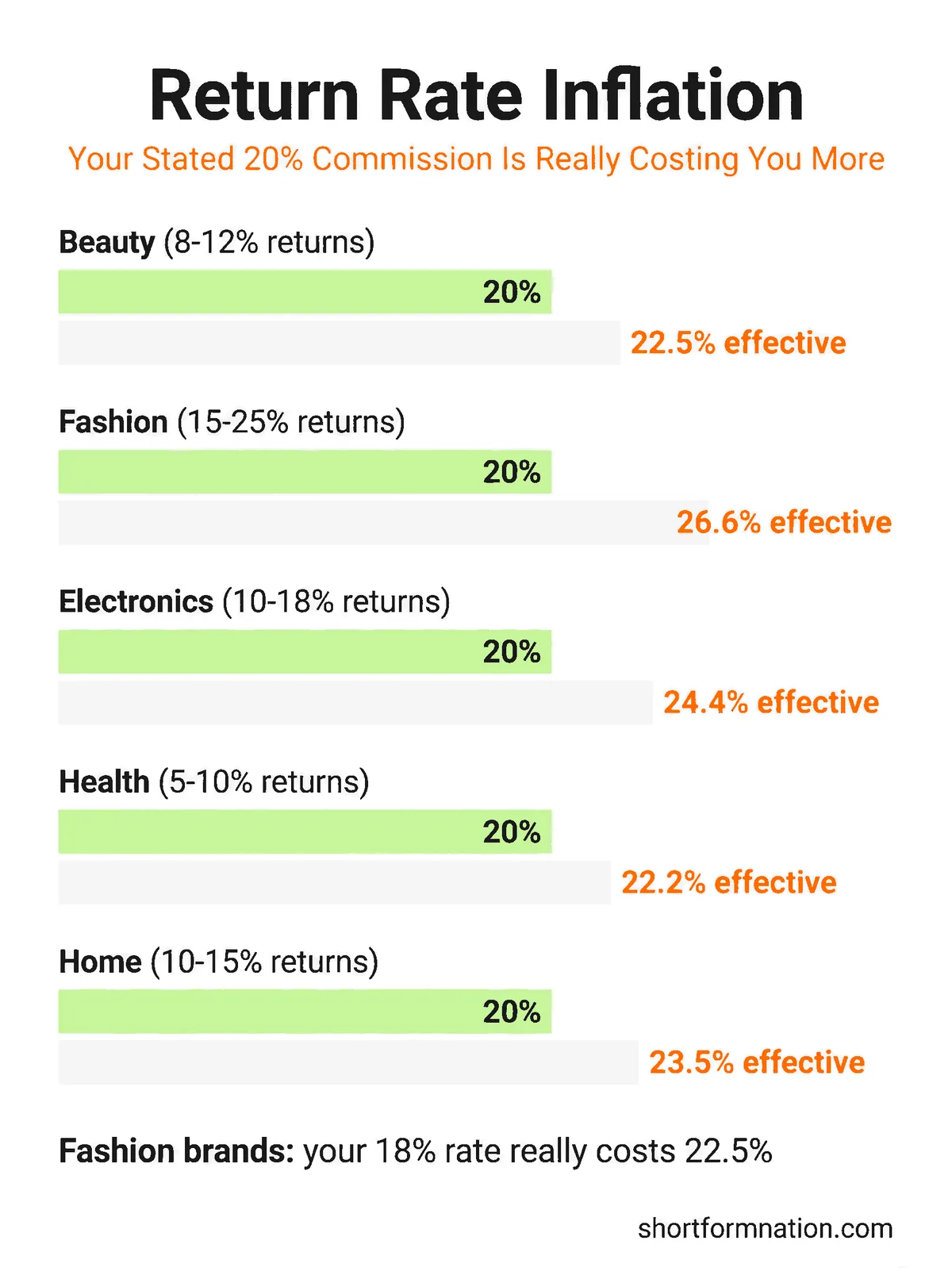
This is where most brands get blindsided. Your stated commission rate and your effective commission rate are two different numbers — and the gap is return rates.
Beauty & Personal Care: 8-12% returns → 20% commission becomes ~22.5% effective
Fashion & Apparel: 15-25% returns → 20% commission becomes ~26.6% effective
Electronics & Tech: 10-18% returns → 20% commission becomes ~24.4% effective
Health & Wellness: 5-10% returns → 20% commission becomes ~22.2% effective
Home & Kitchen: 10-15% returns → 20% commission becomes ~23.5% effective
The math: Effective commission = Stated rate ÷ (1 - Return rate). A fashion brand offering 20% commission with a 25% return rate is actually paying 26.6% of net retained revenue — not 20%. That 6.6-point gap is pure margin destruction.
The COGS Threshold: When Your Commission Becomes Unsustainable
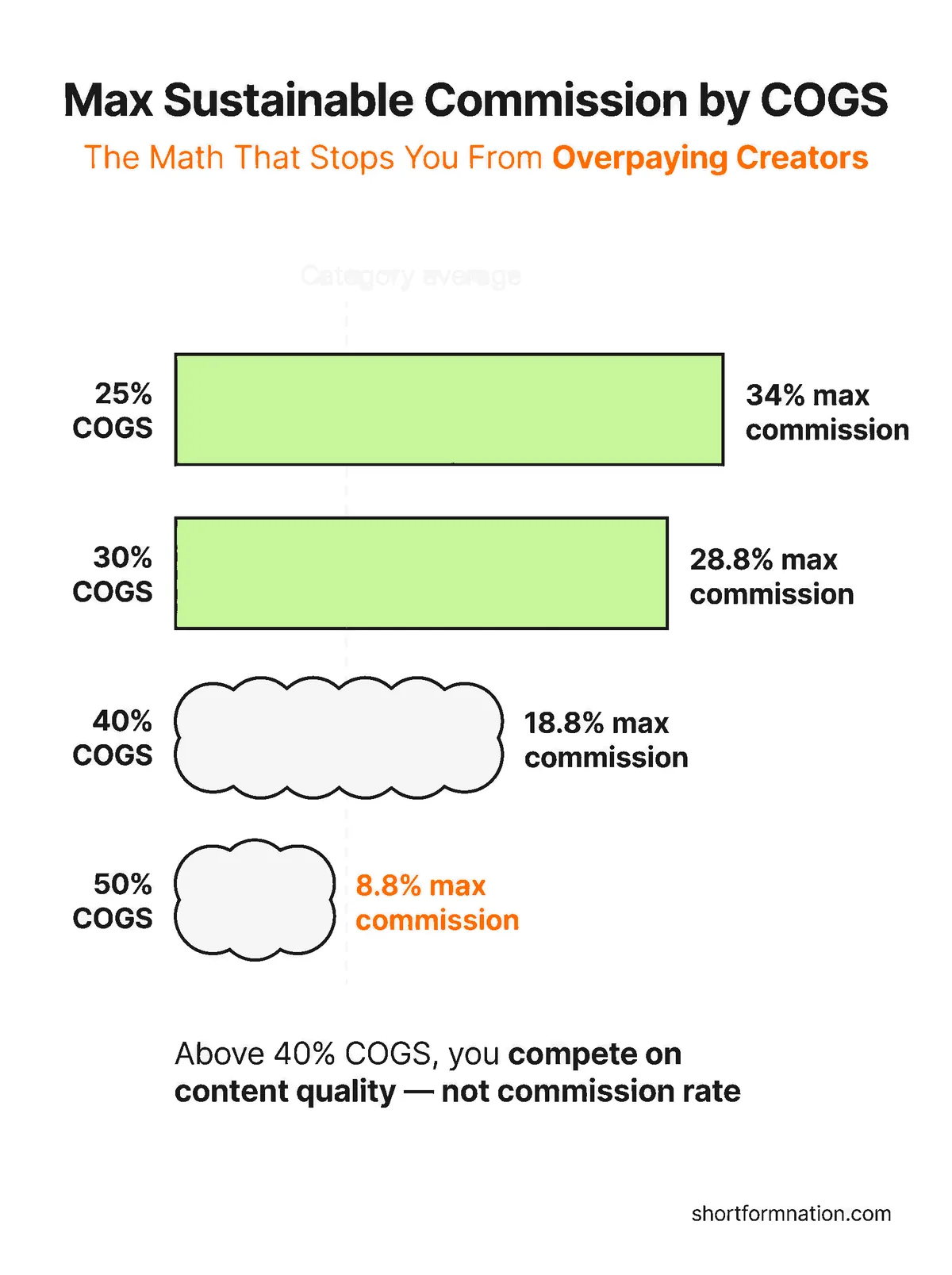
Brands with healthy TikTok Shop margins consistently maintain COGS below 40% of selling price. Here's the breakeven math at different COGS levels for a $50 product:
25% COGS → Max sustainable commission: 34% | 30% COGS → Max: 28.8% | 40% COGS → Max: 18.8% | 50% COGS → Max: 8.8%
The Tiered Commission Framework
Flat-rate commissions leave money on the table. A tiered structure lets you pay the right amount for the right creator at the right stage.
Tier 1 — Open Collaboration Base Rate (10-12%)
Who: Any creator on the platform. No vetting, no negotiation. Purpose: Discovery and volume. You're casting a wide net to find which creators naturally connect with your product. Below 10% in most categories, and creators will scroll right past your product.
Tier 2 — Proven Performers (15-20%)
Who: Creators who've driven 3+ sales through Open Collaboration. Purpose: Reward performance and signal that you value the relationship. Invite these creators to Targeted Collaboration at 15-20%. Track which Open Collaboration creators are converting and invite them to Targeted within 2 weeks of their first batch of sales.
Tier 3 — Top-Tier Creators & Exclusives (20-30%+)
Who: Your top 10 performers. Purpose: Retention, exclusivity, and long-term partnership. Consider adding flat fees ($100-$500/video) on top of commission for your absolute best performers. The emerging 2026 trend is hybrid compensation: a guaranteed flat fee per video plus 15-20% commission. For the full framework on retainers vs commission vs hybrid — including the 60/30/10 budget allocation model — see our creator payment models guide.
Commission Strategy by Brand Stage
Launch Phase — Buying Velocity With Higher Rates
When you're new to TikTok Shop, set Open Collaboration at the Competitive column for your category (15-20%). You're buying initial sales velocity, creator content, and product reviews. Love & Pebble activated their Creator Affiliate Program immediately upon onboarding — the result: a 1,194% increase in sales and 409% decrease in CPA. New to TikTok Shop affiliate? Start with our campaign setup guide.
Growth Phase — Optimizing for Profitability
Lower your Open Collaboration rate to the Standard column (10-15%). Build out your Targeted Collaboration program at higher rates for proven performers. You should be running all three tiers simultaneously.
Scale Phase — Volume-Based Rate Structures
Implement performance-based escalation: 0-10 sales at 12%, 11-50 sales at 15%, 51-200 sales at 18%, 200+ sales at 22%. Critical rule: never reduce rates on existing creators.
How Top-Performing Brands Set Their Rates
Top Fox (Luxury Glasses) built a targeted affiliate network reflecting their brand aesthetic. The result: $141K in 28 days with a 3.8/5 shop health score. Their strategy: network quality over commission quantity.
Rebellious Fashion leveraged a tiered affiliate commission strategy to drive significant multi-hundred-percent growth through their TikTok Shop creator network.
Common Commission Mistakes That Kill Margins
The flat-rate trap. Setting one commission rate across Open and Targeted Collaboration. Zero incentive for creators to perform better. Always differentiate your tiers.
Ignoring return rates. Your stated 20% commission is actually 26.6% if your category runs 25% returns.
Not segmenting creators. A nano-creator with 10K followers and a macro-creator with 500K shouldn't earn the same rate. Our creator payment models guide covers the exact decision framework for which creators deserve retainers vs commission-only.
Racing to the bottom. Commission wars are a losing game. Compete on content quality, product-market fit, and creator support instead.
Setting too low in your category. Below 8% in most categories means you're invisible in the Marketplace.
Dropping rates on existing creators. Even with TikTok's 30-day grace period, rate cuts destroy creator trust permanently.
How to Monitor and Adjust Rates Over Time
Quarterly reviews are the minimum. Pull affiliate dashboard data and evaluate: cost per acquisition by tier, return rate trends, GMV contribution by tier, and creator churn rate.
Seasonal adjustments matter. The Smart Promotion Program (launched March 2026) offers a 3.5% GMV fee for promotional subsidies.
TikTok's own recommendation engine provides data-driven commission suggestions based on top 30% performing products in your category.
How SFN AI Gives You the Commission Intelligence Edge
SFN AI solves this with Creator Intelligence — real-time performance data on every creator in your roster. You can see exactly which creators drive the highest GMV per video, which ones have the lowest return rates, and which ones consistently execute on content briefs (measured by Coherence Scoring).
A creator with a 90%+ coherence score earns 6.9x more per video than one with low coherence — regardless of commission rate. The real lever isn't how much you pay; it's how well your creators execute. SFN AI's Angle system delivers proven content frameworks to creators daily, meaning your commission investment converts at a higher rate.
The result: you can compete at standard commission rates (10-15% Open) while outperforming brands that offer 25%+ — because your creators produce better content, more consistently, with higher conversion rates and improve your affiliate payout TikTok performance.
Ready to stop guessing on commission rates and start making data-driven decisions? Get started with SFN AI — the intelligence layer for TikTok Shop brands that want to scale creator programs without scaling costs.
Last Updated: March 2026
Founder of SFN AI. We watch TikTok Shop 24/7 so creators and the brands that run them get the playbook.