TikTok Shop Creator Payment Models: Retainers vs Commission vs Hybrid (2026 Guide)
Commission vs retainer vs hybrid... which TikTok Shop payment model fits your stage? Real cost math, a 60/30/10 portfolio framework, and contract templates.

Why Your Best Creators Are Ignoring Your Offers
Performance-based compensation is now the most common influencer payment model — 53% of all brand-creator deals in 2026, according to Impact.com's performance marketing report. That sounds like commission-only is winning.
It's not.
Here's what that stat doesn't tell you: 74% of brands are simultaneously moving budget into structured creator programs with guaranteed income components. The same brands paying commission are also layering retainers on top for their best performers. Commission-only is the baseline. It's not the strategy.
The creator economy crossed $40 billion in the U.S. this year, according to eMarketer. Every halfway-decent TikTok Shop creator with consistent sales history is fielding 30-40 brand offers at any given time. When a creator opens their partnership dashboard and sees your 15% commission next to another brand's $150/video retainer plus 15% commission — you lose. Every time.
And it's getting worse. Average UGC creator costs dropped 44% year-over-year to $198 per deliverable, according to ppc.io's 2026 pricing data. AI-generated content is flooding the low end of the market. The creators still standing — the ones actually driving GMV — know their value. They're not taking commission-only deals anymore.
This guide gives you the decision framework. Three payment models. When to use each one. The real math behind what you'll actually pay. And a scorecard for deciding which creators deserve guaranteed income.
Quick Answer: TikTok Shop brands use three creator payment models in 2026 — commission-only (10-30% per sale), retainer + commission ($30-150/video plus 15-20%), and performance-tiered retainers ($500-2,000+/month with escalation brackets). The optimal allocation is 60% of budget on commission-only for volume, 30% on retainer hybrids for proven creators, and 10% on premium partnerships for your top revenue drivers. The right model depends on creator tier, not creator follower count.
The Three TikTok Shop Creator Payment Models
Every creator payment conversation starts with the same question: commission or retainer? Wrong question. There are three distinct models, and each solves a different problem.
Commission-Only (Open & Targeted Affiliate)
Commission-only means the creator earns money only when they drive a sale. No guaranteed income. No commitment from you. Pure performance.
TikTok Shop offers two flavors. Open Collaboration sits at 10-15% per sale — available to any creator who opts in through the marketplace. No vetting. No application. You turn it on and creators find you. Targeted Collaboration runs higher: 18-25%+ per sale. You hand-pick creators and invite them directly.
When it works: High-volume creator discovery. Testing unknown creators without financial risk. Building a broad base of content producers who might become future retainer candidates.
When it breaks: The moment you need consistency. Commission-only creators treat you like one option among dozens. They post when they feel like it. They skip your product when a competitor offers guaranteed income. You're renting attention, not buying commitment.
This model should absorb 60% of your creator budget. It feeds volume and surfaces hidden talent. But it will never be your revenue engine. For a deeper breakdown of commission rate strategy by category, see our complete commission rates guide.
Retainer + Commission Hybrid
This is the workhorse. You pay a flat fee per video — typically $30-150 depending on creator tier — plus a reduced commission on sales they drive. The creator gets guaranteed income. You get guaranteed output.
Ashley Wright, CEO of Social Tale, a TikTok Shop agency managing 8-figure brand accounts, runs this model almost exclusively for mid-tier creators. His standard: $30-150 per video retainers plus 15-20% commission. The creator priority shift is immediate — retainer creators post 4+ times per month instead of 1-2, take briefs more seriously, and plan shoots around your product calendar.
The 2026 twist: hybrid compensation is accelerating. Nearly 80% of influencer collaborations are now priced below $300, according to Storyboard18. Brands are doing more deals at lower individual price points — spreading retainer investment across more creators rather than concentrating it in a few expensive partnerships.
When it works: Proven creators with consistent posting history and demonstrated conversion capability. You've tested them on commission-only first, seen the results, and decided they're worth locking in.
When it breaks: When you skip the testing phase and hand retainers to creators based on follower count instead of sales data.
Performance-Tiered Retainer (Escalating)
This is the premium tier. Monthly retainer — $500-2,000+ — that increases at volume thresholds. You're creating incentive ladders.
Example structure: $800/month base. Escalates to $1,200/month if they hit 4+ posts per month. Jumps to $1,500/month if their monthly GMV contribution exceeds $50K. Exclusivity clauses often come with this model — and exclusivity costs 3-5x the standard rate.
When it works: Your top 5-10 creators. The ones driving 20%+ of your TikTok Shop GMV. You're locking in revenue anchors and preventing competitors from poaching them.
When it breaks: When you apply it to creators who haven't proven Tier 2 performance first. Performance-tiered retainers without performance data are just expensive guesses.
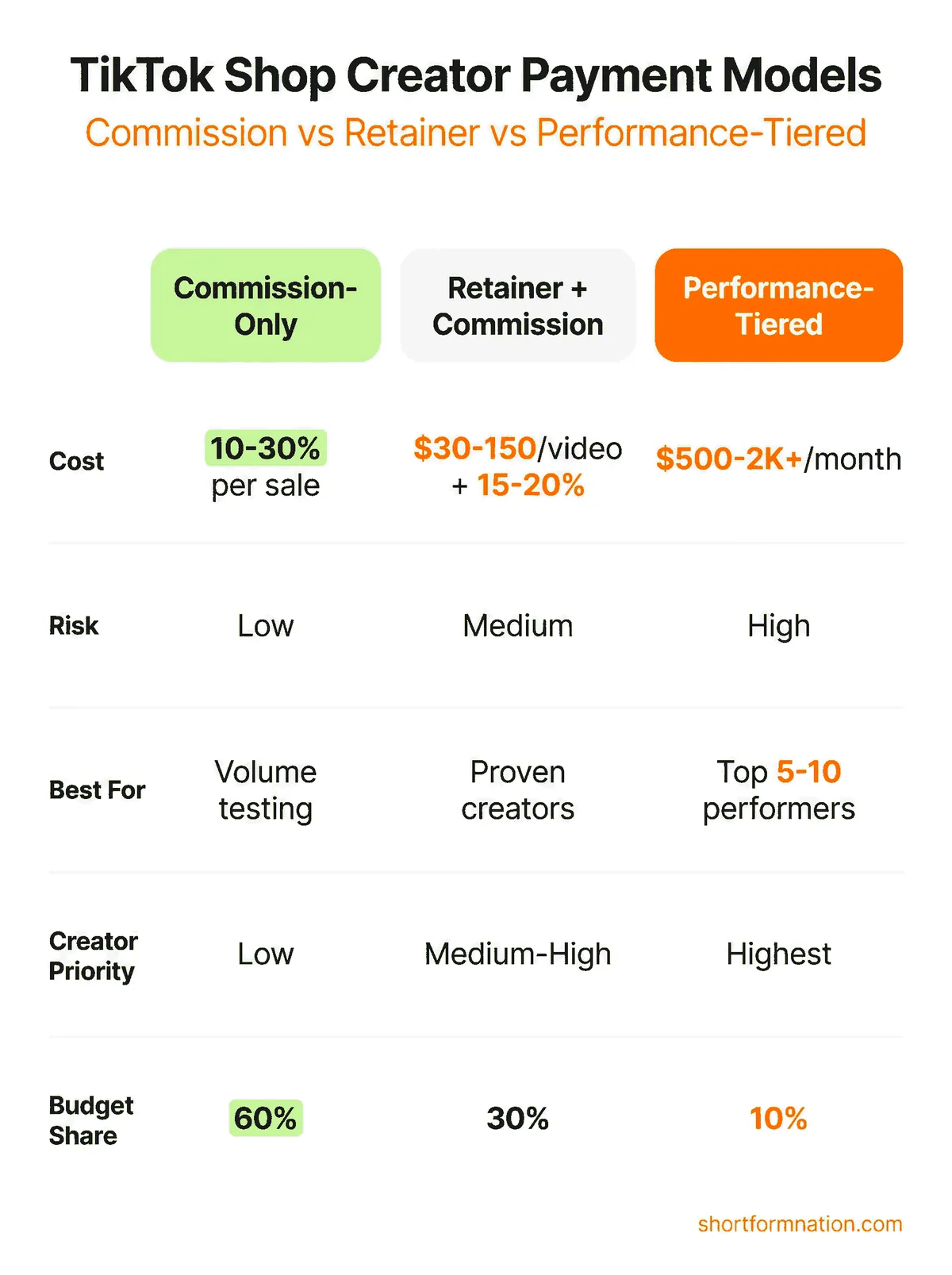
Payment Model Comparison: Commission-Only costs variable 10-30% of sales, low risk, best for volume testing, low creator priority. Retainer + Commission costs $30-150/video + 15-20%, medium risk, best for proven creators, medium-high creator priority. Performance-Tiered costs $500-2,000+/month escalating, high risk, best for top performers and exclusivity, highest creator priority.
| Model | Cost | Risk | Best For | Creator Priority |
|---|---|---|---|---|
| Commission-Only | Variable 10-30% of sales | Low | Volume testing | Low |
| Retainer + Commission | $30-150/video + 15-20% | Medium | Proven creators | Medium-High |
| Performance-Tiered | $500-2,000+/month escalating | High | Top performers & exclusivity | Highest |
But knowing the models isn't enough. You need to know which model to assign to which creator — and when to promote them up the ladder. For a step-by-step walkthrough of setting up these collaboration types in TikTok Seller Center, see our campaign setup guide.
The Decision Framework: Which Model for Which Creator
The mistake most brands make is applying one payment model to every creator. You end up overpaying weak performers and underpaying your revenue drivers. Segmentation fixes this. The decision changes shape when the same creator appears across several client shops. See how to manage multiple TikTok Shop clients.
Tier 1: Commission-Only Pool (60% of Budget)
This is your always-on baseline. Open Collaboration at 10-15%. Available to any creator who wants to promote. No management overhead. No briefs. No relationship management.
Tier 1 is for volume and discovery. Some creators will make 1 post. Some will make 50. You only pay when they drive sales.
But here's what makes Tier 1 strategically important: it's your talent pipeline. Every retainer creator started as a commission-only experiment. The data you collect at this tier — sales per video, content quality, posting frequency — feeds the promotion decisions for Tier 2.
Tier 2: Retainer + Commission (30% of Budget)
A creator earns Tier 2 status when they've demonstrated three specific signals on commission-only.
Signal 1: Sales consistency. They've driven 3+ sales across multiple videos — not a single viral hit, but repeated conversion.
Signal 2: Content-brand alignment. Their videos match your product positioning. The hooks work. The CTAs convert. The production quality doesn't need fixing.
Signal 3: Posting frequency. They're already posting 4+ times per month with your product. Creators who post consistently already have production workflows in place — a retainer just guarantees they keep pointing those workflows at your brand.
At this stage, you approach them with a retainer offer. $30-150 per video, depending on historical conversion rate — not follower count. Plus 15-20% commission. You negotiate a content calendar: 4-8 videos per month.
The judgment call isn't whether to offer a retainer. It's which Tier 1 creators have actually earned it. For guidance on writing briefs that retainer creators will actually follow, see our affiliate briefs guide.
Tier 3: Premium Partners (10% of Budget)
Your top 5-10 creators — the ones driving 20%+ of your GMV — belong here. These are revenue anchors. They've proven sales capability at scale.
Tier 3 gets performance-tiered retainers: $500-2,000+/month with escalation brackets. You add exclusivity clauses if the creator's reach allows. Exclusivity costs 3-5x normal rates — but it prevents your best performer from making content for your direct competitor.
This tier is 10% of your creator budget but often generates 60-70% of your attributed GMV. The math justifies the cost. For an in-depth look at how to find and vet creators for these premium partnerships, see our creator recruitment guide.
The 60/30/10 Framework: Tier 1 gets 60% allocation via commission-only for volume, discovery, and talent pipeline. Tier 2 gets 30% allocation via retainer + commission for consistency and guaranteed output. Tier 3 gets 10% allocation via performance-tiered for revenue concentration and exclusivity.
| Tier | Budget Allocation | Model | Purpose |
|---|---|---|---|
| Tier 1 | 60% | Commission-only | Volume, discovery, and talent pipeline |
| Tier 2 | 30% | Retainer + commission | Consistency and guaranteed output |
| Tier 3 | 10% | Performance-tiered | Revenue concentration and exclusivity |
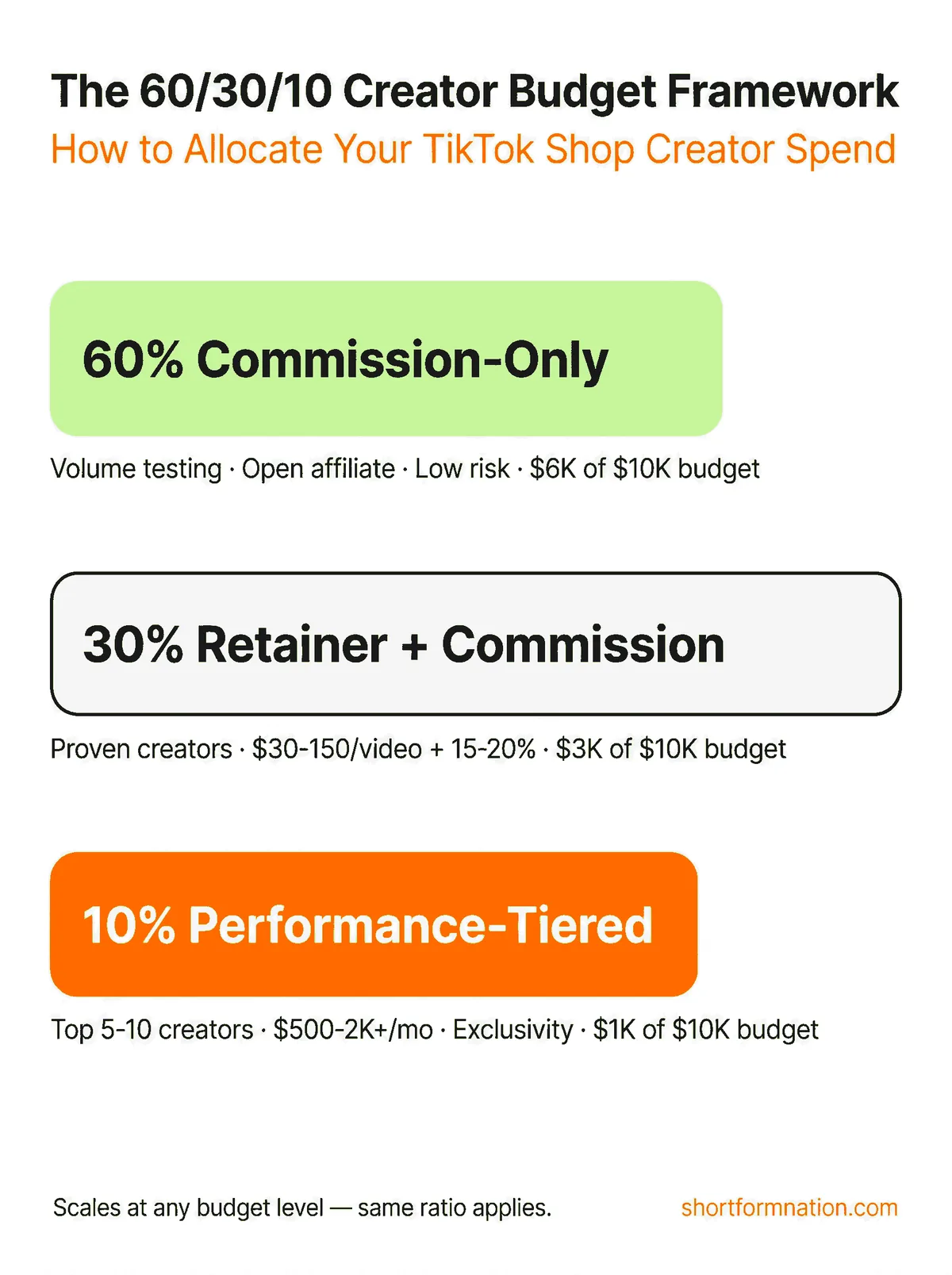
This scales linearly. $10K/month? Allocate $6K to Tier 1, $3K to Tier 2, $1K to Tier 3. $100K/month? Same split — just higher per-creator payouts at each tier. The ratio holds because the function of each tier doesn't change with scale.
The Real Math Behind Creator Payment Models
Commission rates are deceptive. The number on the contract isn't the number you actually pay. Platform fees, fulfillment, returns, and clawbacks all eat into your margin — and most brands don't model them until it's too late.
True Cost of Commission (After Platform Fees, Returns, Clawbacks)
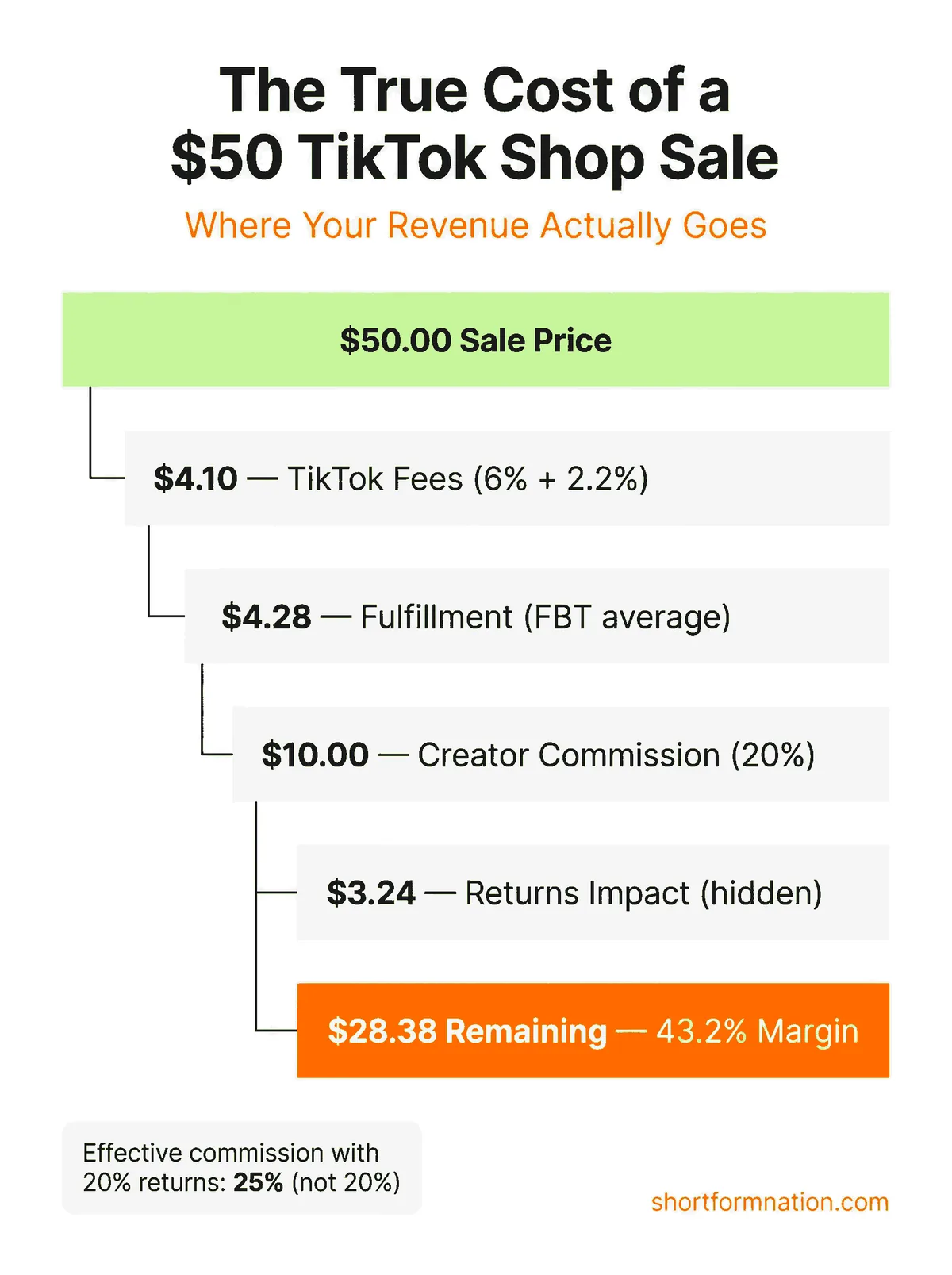
TikTok Shop's cost stack includes a 6% referral fee plus 2.2% payment processing fee, on top of fulfillment costs and creator commission. Here's the real math on a $50 beauty product with standard FBT fulfillment ($4.28/unit average): Sale price $50.00, minus TikTok fees (6% + 2.2%) $4.10, minus Fulfillment (FBT) $4.28, minus Creator commission (20%) $10.00, leaving net margin of $31.62 (63.2%).
Looks manageable. But there's a hidden variable: returns.
Fashion products average 15-25% return rates on TikTok Shop. Beauty runs 8-12%. When a customer returns the product, you already paid the creator's commission on the original sale.
Effective commission rate = Stated commission ÷ (1 - Return rate)
With a 20% return rate: effective commission = 20% ÷ (1 - 0.20) = 25% effective. That's a 25% increase in your real creator cost — invisible unless you model it.
Retainer ROI Calculation
Retainers require upfront capital. Here's how to model whether the investment pays back.
Retainer ROI = (GMV from retainer creator - retainer cost - commission) ÷ (retainer cost + commission)
Real example from a mid-tier beauty brand: Creator retainer $150/video × 4 videos/month = $600/month. Historical GMV per video: $2,000. Monthly GMV: $8,000. Commission (15% on $8,000): $1,200.
Retainer ROI = ($8,000 - $600 - $1,200) ÷ ($600 + $1,200) = 344%
Compare to commission-only at 20% on the same $8,000 GMV: $1,600 in commission costs — 27% more expensive. And with commission-only, you lose the guarantee. The creator might post 2 videos instead of 4. GMV drops to $4,000. Your cost per acquisition doubles.
The ROI case for retainers isn't just about per-unit cost. It's about volume certainty.
The Hidden Cost of Underpaying
Ashley Wright shared a case study from a client managing $2M+ annual TikTok Shop GMV. The client cut sample costs 60% to reduce creator spend. Their logic: fewer free products, lower cost per creator.
What actually happened: GMV crashed from $120K/month to $45K/month over two months.
The kicker — TikTok Shop has a 30-60 day lag between operational changes and revenue impact. You cut samples in Month 1. Creators deprioritize you in Month 2. GMV drops in Month 3. By then, the budget decision feels permanent and the damage is done.
The real cost of underpaying isn't what you spend. It's what you lose when your best creators prioritize brands that pay better.
How to Know Which Creators Deserve Retainer Investment
Most brands throw retainers at the wrong creators. The mistake: paying based on follower count instead of conversion data. A creator with 500K followers driving 2 sales per month is worth less than a creator with 50K followers driving 10.
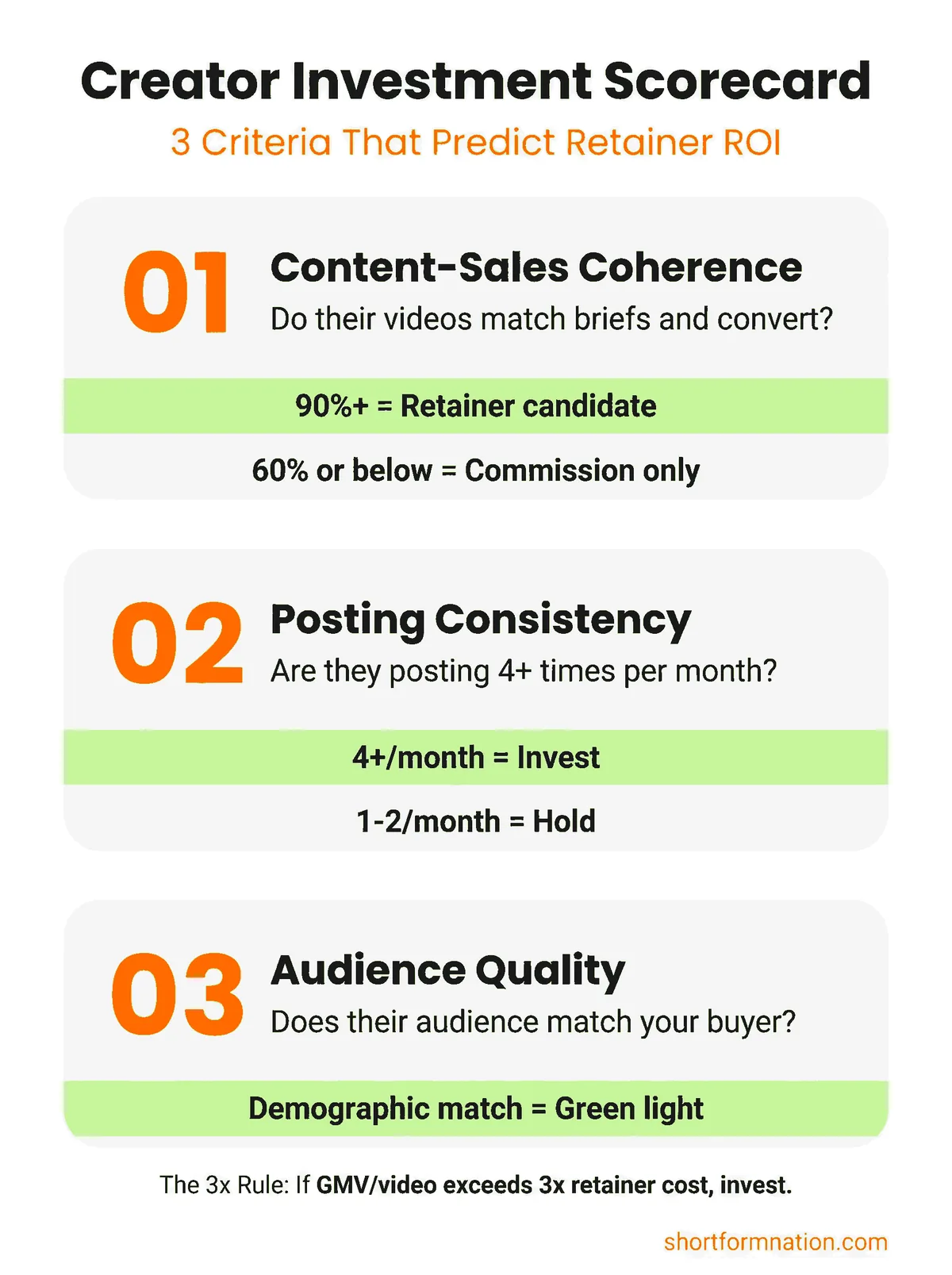
You need a scorecard — not a 50-column spreadsheet. Three criteria that actually predict retainer ROI.

The Creator Investment Scorecard
Criterion 1: Content-Sales Coherence. Do their videos follow your briefs and actually convert? This is the strongest predictor of retainer ROI. Creators who closely follow recommended content patterns earn dramatically more per video than those who freestyle. The gap between high-coherence and low-coherence creators is 5-7x in earnings per video — the single biggest signal you can measure.
Criterion 2: Posting Consistency. Pull their posting history for the last 3 months. Are they posting 4+ times per month with your product? Consistent posters already have production workflows. A retainer just guarantees those workflows stay pointed at your brand.
Criterion 3: Audience-Buyer Match. Does their audience actually buy? Pull TikTok Shop viewer demographics from your Seller Center dashboard for each creator's videos. Cross-reference against your customer base. High overlap = retainer candidate. Low overlap = commission-only, regardless of follower count.
Where Intelligence Tools Fit
Running this scorecard manually works — you can track GMV per creator in a spreadsheet, review content quality by watching videos, and estimate audience quality from TikTok analytics. It takes 30-45 minutes per creator decision. At 20 creators, that's manageable. At 200, it's a full-time job.
SFN AI's TikTok Shop intelligence platform automates the coherence measurement — the hardest part to do manually. The Coherence Score breaks down into Scripts, Hooks, Story, CTA, and Pre-ship, exactly the dimensions that predict retainer ROI. You can pair that with tools like FastMoss for content volume tracking and Kalodata for audience demographic matching.
Together, these give you all three scorecard criteria in one workflow. But you can start without any of them — the manual 3x Rule works at smaller scale. For the complete analytics framework for measuring creator performance across all three tiers, see our TikTok Shop affiliate analytics guide.
The 3x Rule (Manual Shortcut)
Track creator GMV per video. If their average GMV per video exceeds 3x their retainer cost, they're a justified investment. Below 1.5x, renegotiate or shift back to commission-only.
Example: $75/video retainer. 3x threshold = $225 GMV per video minimum. If they average $300+, invest. If they average $100, commission-only.
Five Payment Mistakes Killing Your Creator Program
Every one of these is avoidable. Every one costs real money.
Mistake 1: Flat rates for every creator. You pay all creators 20% commission. Your best performers realize they're earning the same rate as your worst ones. They leave — or demand more. Build tiered rate cards within each model.
Mistake 2: Retainers without content minimums. You pay $100/video with no contractual posting floor. Some months: 8 videos. Some months: 1. Every retainer agreement should specify minimum cadence — "$100/video, minimum 4 videos/month."
Mistake 3: Commission-only exclusivity. You tell a creator "don't promote competitors" while paying them 15% commission with zero guaranteed income. Exclusivity requires guaranteed income. Without it, the clause is unenforceable and the relationship is fragile. Exclusivity belongs in Tier 3 only.
Mistake 4: Cutting rates based on last month's GMV. Revenue on TikTok Shop lags operational changes by 30-60 days. TikTok's 30-day commission lock period means rate cuts don't even take effect for a full month. Set rates quarterly, not monthly. Use leading indicators — Creator Activation Rate, Content Volume, Repeat Creator Density — instead of trailing GMV.
Mistake 5: Rates you can't sustain. Model retainer costs against historical creator GMV before making the offer. Work backward from your target margin. If you have to cut rates later, you destroy the relationship and lose the creator to a competitor who planned better.
What's Changing in Creator Compensation
Three forces are reshaping how brands pay TikTok Shop creators in 2026.
AI UGC is compressing the low end. The number of creators identifying as AI influencers increased 42% year-over-year, according to Impact.com. But here's the counterweight: 86% of brands say they don't want to work with AI influencers. AI-generated content is flooding the bottom of the market — driving average UGC costs down 44% — while simultaneously increasing the premium on real human creators who actually convert. Fewer retainer spots, but higher value per spot.
GMV Max changes the attribution game. TikTok's GMV Max became mandatory for Shop advertising in September 2025. It optimizes across organic, paid, and affiliate content combined — meaning creator content now feeds your paid amplification system. Early adopters report 30% higher GMV versus manual ads. This makes creator content more valuable, not less. Retainers that guarantee content volume now directly fuel your ad performance.
Micro-creator dominance is real. Micro and nano-influencers will claim 45.5% of influencer marketing spend in 2026, according to eMarketer. The economics favor volume over reach — 80% of collaborations are priced below $300. The brands winning aren't the ones with 5 expensive creators. They're the ones with 50 affordable creators on smart tiered structures.
The direction is clear: fewer flat commissions, more structured hybrid models, and intelligence-driven decisions about who gets paid what. For a direct comparison of how TikTok Shop affiliate stacks up against Amazon Associates for DTC brands, see our TikTok Shop vs Amazon Associates comparison.
Your First 30 Days: Building the Payment Tier System
You don't need to overhaul everything tomorrow. Start with segmentation and build from there.
Week 1: Audit. Pull GMV per creator for the last 90 days. Segment into rough tiers — high performers (top 10% of GMV), mid performers (top 50%), everyone else. This takes one afternoon with your Seller Center data.
Week 2: Set the commission baseline. Open Collaboration at 10-15%. Targeted Collaboration at 18-25%+ for invited creators. This is your Tier 1 — always on, always available, zero management overhead.
Week 3: Identify Tier 2 candidates. From your audit, which creators hit all three scorecard signals — sales consistency, content-brand alignment, posting frequency? Start with 3-5 retainer offers at $50-100/video + 15% commission. Small bets, real data.
Week 4: Model Tier 3. Who are your top 2-3 revenue drivers? What's their monthly GMV? Can you justify a $500-1,000/month retainer? If the 3x Rule holds, start the conversation.
By Month 2, you'll have a clear three-tier structure. By Month 3, enough data to optimize rates. By Month 6: higher creator priority, more consistent posting, better content quality, and a payment system that scales.
Stop Paying Every Creator the Same
The 60/30/10 framework works at any scale. Commission-only for volume. Retainer hybrids for consistency. Performance tiers for your revenue anchors.
The hard part isn't choosing the model. It's knowing which creators belong in which tier — and having the data to make that call with confidence instead of intuition.
SFN AI's TikTok Shop intelligence platform automates the coherence measurement that powers the Creator Investment Scorecard. Instead of watching every video manually, you get a numeric signal per creator showing whether their content matches winning patterns. The creators scoring 85%+ coherence are your retainer candidates. The ones below 60% stay on commission-only.
You can start without it. The manual scorecard and 3x Rule work at smaller scale.
Explore SFN AI's TikTok Shop Intelligence Platform →
Either way — stop paying every creator the same and start segmenting by actual value. Your best creators already know what they're worth. The question is whether your payment structure reflects it.
For the complete picture of TikTok Shop affiliate strategy — from campaign setup to creator recruitment to commission optimization — see our TikTok Shop Affiliate Marketing: The Complete 2026 Guide.
Frequently Asked Questions
What's the best payment model for new TikTok Shop creators?
Start with commission-only (10-15% Open Collaboration). It's zero risk for you and lets creators prove their value before you commit budget. Move them to a retainer hybrid only after they've demonstrated consistent sales across 3+ videos.
How much should I pay for a TikTok Shop creator retainer?
Retainer rates range from $30-150 per video for mid-tier creators to $500-2,000+ per month for top performers with exclusivity. The key metric isn't what other brands pay — it's whether the creator's historical GMV per video exceeds 3x the retainer cost. If the math works, the rate is justified.
When should I switch a creator from commission-only to retainer?
When they hit three signals: consistent sales (3+ conversions across multiple videos), content that matches your briefs without major revisions, and posting frequency of 4+ times per month. All three signals need to be present — one viral video doesn't qualify.
How does GMV Max affect creator payment decisions?
GMV Max, mandatory since September 2025, optimizes across organic, paid, and affiliate content simultaneously. This means creator content directly fuels your paid amplification. Retainers that guarantee consistent content volume now have a multiplier effect on your ad performance — making the ROI case for guaranteed creator payments even stronger.
Should I offer exclusivity to TikTok Shop creators?
Only at Tier 3 (performance-tiered retainers). Exclusivity requires guaranteed income — asking a commission-only creator not to work with competitors is unenforceable and damages trust. When you do offer exclusivity, price it at 3-5x the standard rate to compensate for the creator's lost opportunity cost.
Last Updated: March 2026
Founder of SFN AI. We watch TikTok Shop 24/7 so creators and the brands that run them get the playbook.