TikTok Shop Affiliate vs Amazon Associates: Where DTC Brands Win in 2026
TikTok Shop affiliate vs Amazon Associates... head-to-head for DTC brands. Commission math, creator quality, content shelf life, and which wins by category.


Amazon Associates paid out an estimated $9 billion in affiliate commissions last year. 47% of the global affiliate network market. Twenty years running. The biggest program in the world and it wasn't even close.
Then TikTok Shop hit $15.1 billion in US GMV in 2025 — growing 68% year-over-year — and is projected to reach $23.4 billion in 2026. That's larger than Target's ecommerce business. Paying creators 10-50% while Amazon caps most categories at 1-4%. Converting at 4.7% while Amazon sits at 2-3%.
If you're a DTC brand deciding where to put your affiliate dollars in 2026, this isn't academic. It's a capital allocation problem. And the math has changed faster than most brands have noticed.
Here's the breakdown: where each platform actually wins, where each one loses, and the framework for capturing both without lighting money on fire.
Quick Answer: TikTok Shop affiliate programs outperform Amazon Associates on commission flexibility (10-50% vs 1-10%), conversion rate (4.7% vs 2-3%), and brand control over creator content. Amazon wins on catalog breadth, consumer trust, and passive long-tail income. The optimal DTC strategy runs both — TikTok for discovery and high-margin products, Amazon for catalog depth and trust-driven conversions.
Discovery Commerce vs Search Commerce: The Fundamental Split
Most brands skip this question entirely. And it's the one that determines everything: how does the customer find the product?
Amazon: the buyer already knows. They search "vitamin C serum," compare three options, read reviews, buy. The affiliate's job is to rank for that search and capture intent that already exists. This is search commerce — pure demand capture.
TikTok Shop: the buyer had no idea they wanted this product until a creator showed it to them. Fifteen seconds. A serum demo. Before-and-after in natural light. Tap to buy without leaving the app. The affiliate's job is to create demand that didn't exist 30 seconds ago. This is discovery commerce — demand generation through content.
Why this matters if you're a DTC brand: Amazon affiliates monetize existing demand. TikTok Shop affiliates create new demand. If your brand already has search volume, Amazon affiliates capture it. If you're launching something new, entering a category, or building awareness — TikTok Shop affiliates generate the demand that Amazon affiliates later capture.
The numbers back this up. 78% of TikTok users discover products through creator content. Not search. Not ads. Not browse. The platform is built for discovery. Amazon is built for conversion of known intent.
That split shapes everything: commissions, creator ecosystems, content control, and where each platform fits in your growth stack.
For the full picture on how social commerce is reshaping this: Social Commerce Trends 2026: What's Actually Working on TikTok Shop.
Commission Structures: Flexibility vs Stability
This is where the comparison gets sharp. And where your margin math either works or doesn't.
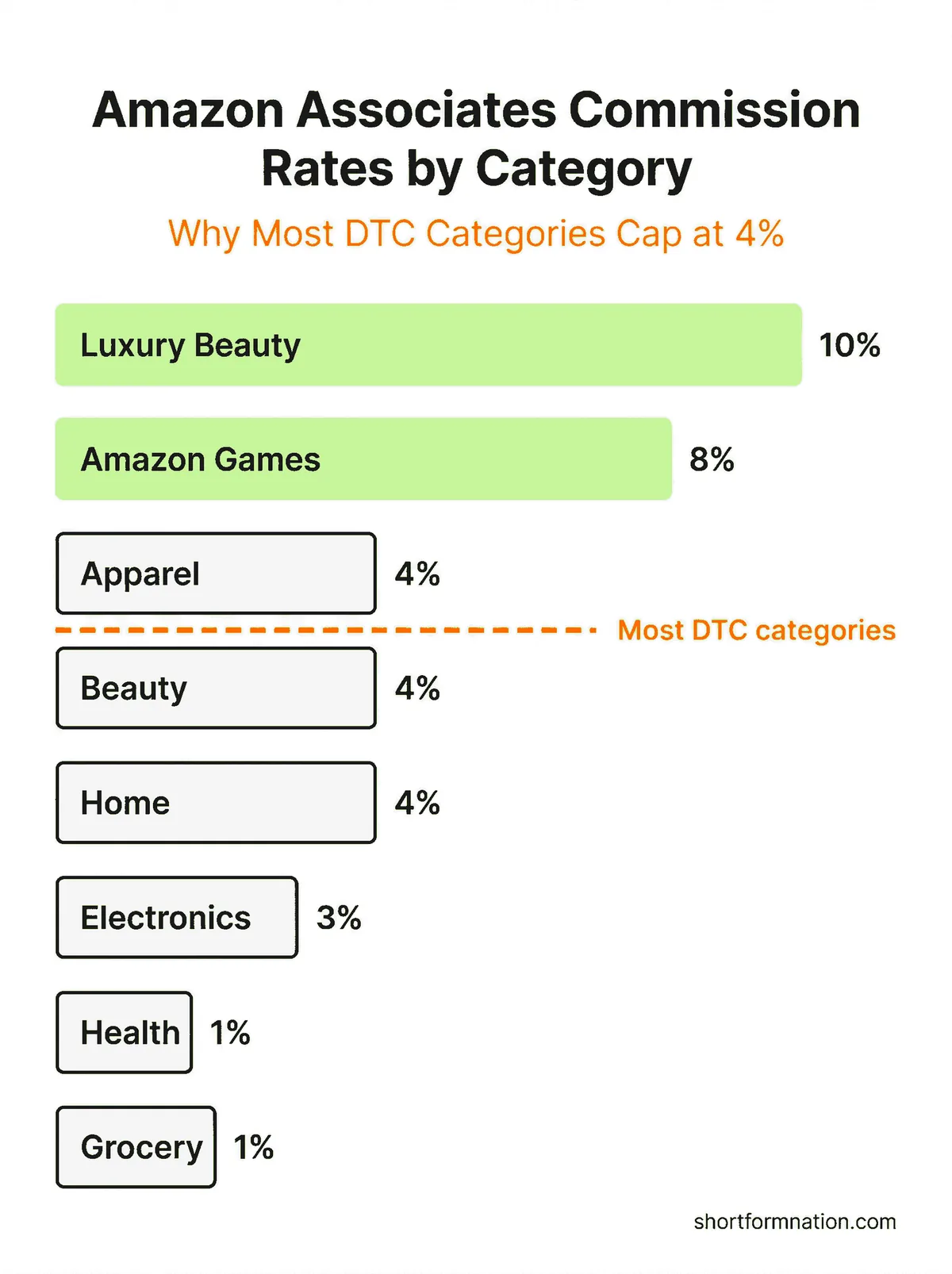
Amazon Associates runs on a fixed rate card that Amazon sets. You — the brand — have zero say. Amazon decides what creators earn. Non-negotiable:
| Category | Amazon Associates Rate |
|---|---|
| Luxury Beauty | 10% |
| Digital Music, Videos, Handmade | 5% |
| Apparel, Shoes, Jewelry, Watches | 4% |
| Home, Kitchen, Automotive | 3% |
| Grocery, Health, Personal Care | 1% |
| Electronics, Computers | 1% |
| Physical Books, Toys | 4.5% |
| Everything Else | 4% |
In 2025, Amazon added performance-based commission adjustments — a small nod to volume affiliates. The ceiling is still low. A health supplement affiliate earns 1% whether they drive $1,000 or $1 million. Same rate. No exceptions.
TikTok Shop is the opposite. You set the rates. Here's what that actually looks like:
| Collaboration Type | Commission Range | Who Sets It |
|---|---|---|
| Open Collaboration (public) | 10-15% base | Brand |
| Targeted Collaboration (invite-only) | 15-25% | Brand + Creator negotiation |
| VIP / Exclusive Partners | 25-50%+ | Brand + Creator negotiation |
| Shop Ads Rate | 5-8% (min 1/3 of standard) | Brand |
On Amazon, you're a price-taker. On TikTok Shop, you're a price-setter. Run 10% Open for broad discovery, 25% Targeted for your top performers, and 5% Shop Ads for paid amplification — all on the same product, simultaneously. Try that on Amazon.
Here's where it gets counterintuitive. A DTC beauty brand selling a $50 serum on both platforms:
| Cost Component | TikTok Shop (15% commission) | Amazon (10% Luxury Beauty) |
|---|---|---|
| COGS (30%) | $15.00 | $15.00 |
| Platform Fee | $3.00 (6%) | $7.50 (15% referral) |
| Affiliate Commission | $7.50 (15%) | $5.00 (10%) |
| Payment Processing | $1.10 (2.2%) | Included in referral |
| Fulfillment | $4.00 | $5.23 (FBA avg) |
| Total Costs | $30.60 | $32.73 |
| Gross Margin | $19.40 (38.8%) | $17.27 (34.5%) |
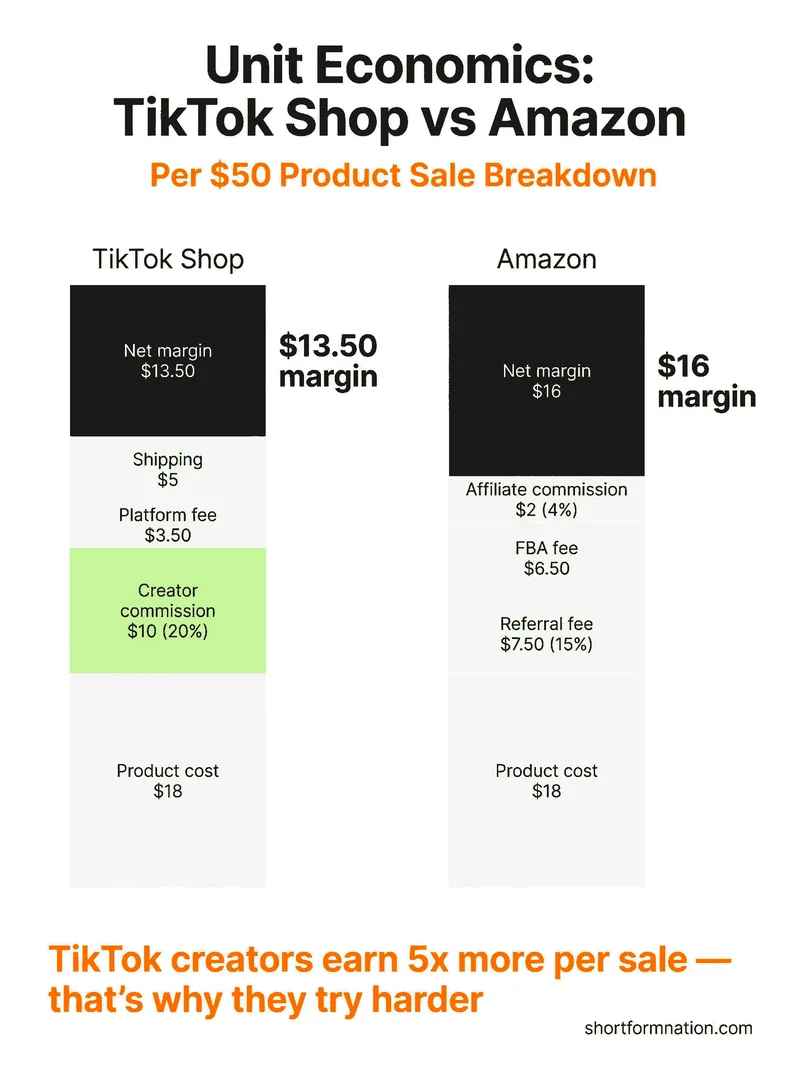
Read that again. You pay 50% more in affiliate commission on TikTok Shop — and you keep higher gross margin. Because Amazon's 15% referral fee and FBA costs stack brutally. You pay more to the creator (the person actually generating demand) and less to the platform. That's a better deal.
Worth knowing: the $4 fulfillment line in the table assumes Fulfilled by TikTok, TikTok's first-party logistics network. On multi-unit orders FBT drops to $2.86 per unit, which widens the gap vs FBA further still.
For the full commission strategy by category: TikTok Shop Affiliate Commission Rates: What Brands Should Offer.
For how commission fits into the broader compensation picture: TikTok Shop Creator Payment Models: Retainers vs Commission vs Hybrid.
But commission alone doesn't decide ROI. What decides ROI is how often that commission actually converts.
Conversion and Checkout: Where TikTok Shop Runs Away With It
One architectural decision separates these platforms. Where does checkout happen?
TikTok Shop: in the app. Creator demos the product. Viewer taps the pinned link. Buys. Never leaves TikTok. Discovery to evaluation to purchase in one session, one app, one flow.
Amazon: redirect. Creator posts a link. Viewer clicks, bounces to a browser or the Amazon app, lands on a product page, maybe buys. Every redirect bleeds users. Every app-switch is a conversion leak. Every extra step costs you money.
TikTok Shop converts at 4.7% across all creator tiers. Amazon Associates converts at 2-3%. On 100,000 clicks, that's 4,700 buyers vs 2,500. An 88% lift from the same traffic. That gap is not small.
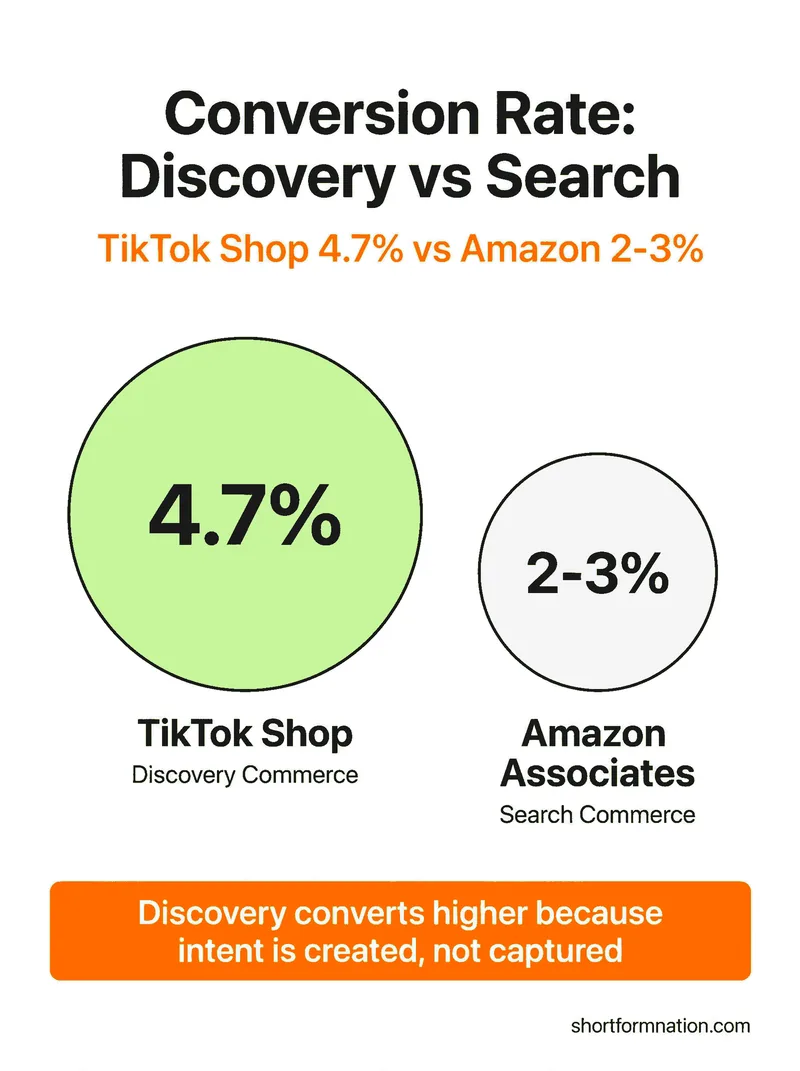
AOV tells a more nuanced story. TikTok Shop typically runs $35-60 per order. Amazon runs higher — $50-100+ depending on category. So revenue per click can be comparable even at lower TikTok AOV, because the conversion rate compensates. High-AOV products ($100+) still play better on Amazon where purchase trust is baked in. Impulse-friendly products ($15-50) were built for TikTok's native checkout.
Here's the number creators care about: earnings per 1,000 views. In beauty and fashion, TikTok Shop creators report $20-80 RPM based on creator-reported data. Amazon Associates creators in the same categories? $3-15 according to industry benchmarks. That's 3-5x the creator earnings for equivalent reach. Not close.
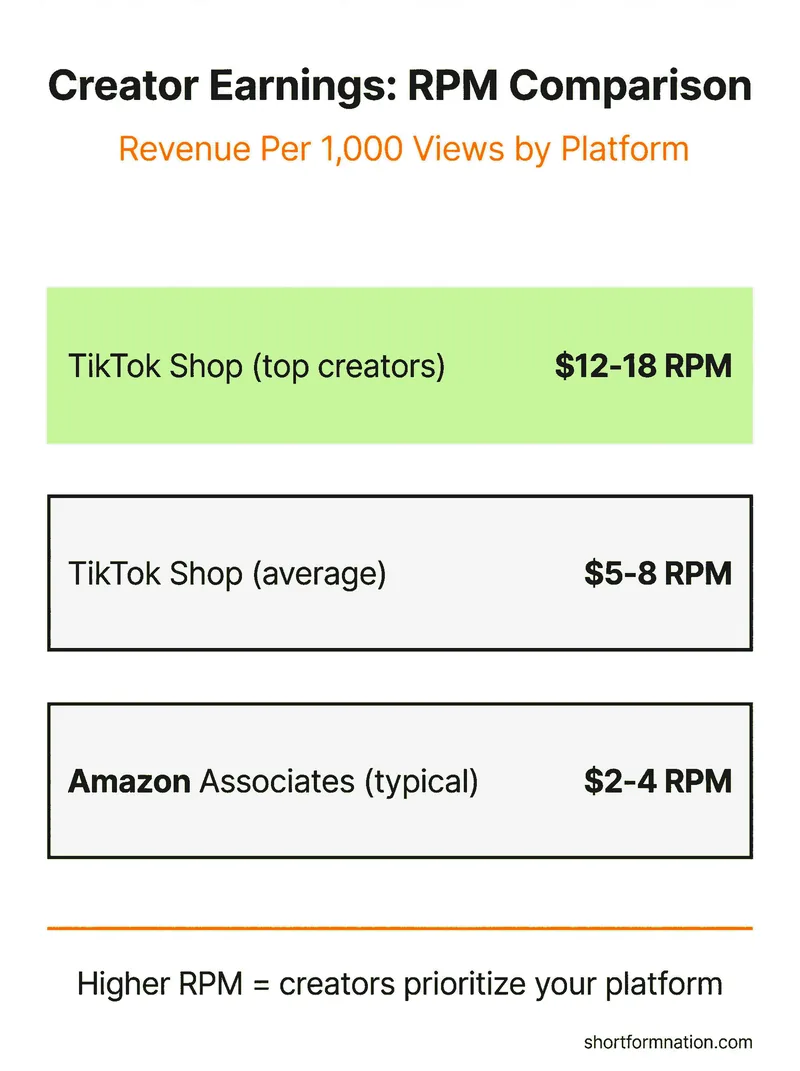
That earning gap is driving talent migration. According to industry reports, 34% of creators who were Instagram-exclusive in 2024 now run TikTok Shop campaigns. In beauty and fashion — where the commission differential is steepest — 52%.
When creators make 3-5x more on one platform, they prioritize it. Brands that only run Amazon Associates are recruiting from a shrinking talent pool.
Creator Ecosystem: Relationships vs Strangers
Amazon Associates has 3 million+ members. TikTok Shop's creator affiliate network has 7 million+. But the numbers don't tell the real story. The operating model does.
On Amazon, affiliates are strangers. They build websites, write reviews, and earn commission when someone clicks their link. The brand has no relationship with the affiliate. No recruitment tools. No content direction. No feedback loop.
TikTok Shop gives brands the whole relationship stack:
- Open Collaboration — your products show up in the TikTok Shop Marketplace. Creators browse, pick up your product, promote it. You see who's promoting you.
- Targeted Collaboration — you find specific creators, send custom commission offers, negotiate terms, ship samples. Active recruitment, not passive hope.
- Performance tracking — real-time data on which creators convert, GMV per creator, content velocity, engagement rates.
On Amazon, you hope affiliates find you. On TikTok, you hunt the affiliates you want and shape how they promote you. That's a fundamentally different game.
For the complete recruitment playbook: How to Find and Recruit TikTok Shop Creators at Scale.
Once you've recruited them, the brief shapes what they create: How to Write TikTok Shop Affiliate Briefs That Creators Actually Use.
Content Control and Brand Safety
On Amazon, content control is a concept that doesn't exist. An affiliate writes whatever they want. Publishes it wherever they want. The brand never sees it, never approves it, never shapes it. If the affiliate says "this product is fine but Brand X is better" — you eat it.
TikTok Shop is different. Brands can provide content briefs with specific hooks, product pillars, and banned keywords. Review creator content before it goes live in Targeted Collaborations. Track content quality through performance data. Cut non-compliant creators from the program.
This doesn't mean you should over-script creators. Over-scripted content tanks engagement — the data is clear on that. But there's a massive difference between "no control" and "strategic guardrails." Amazon gives you the first. TikTok gives you the second.
This matters even more in regulated categories. Supplements, skincare with medical claims, financial products — on Amazon, an affiliate can say anything. On TikTok Shop, you set the rules and enforce them.
The Halo Effect: The Advantage Nobody Talks About
This is the data point that changes the math on the entire comparison.
TikTok Shop affiliate content doesn't just drive TikTok sales. It drives sales everywhere. DTC brands running multi-channel affiliate programs report TikTok Shop content generating 30-50% incremental revenue on other platforms — including Amazon.
Think about how this works. A creator posts a viral product demo on TikTok. Some viewers buy through TikTok Shop. Others search the product name on Amazon. Others go to the brand's website. The TikTok content created the demand. Amazon and the DTC site captured the overflow.
Amazon affiliate content doesn't do this. A review blog post ranks on Google, sends traffic to Amazon, and that's it. It captures existing intent. It doesn't create new demand across other channels.
If you're measuring ROI by TikTok Shop GMV alone, you're understating true returns by 30-50%. The brands that get this allocate budgets accordingly — they invest harder in TikTok's demand-generation engine because the returns compound across their entire distribution.
This is the second-order effect most brands miss entirely. TikTok affiliate investment has a multiplier. Amazon affiliate investment has a ceiling.
When Amazon Still Wins
I'm not going to pretend TikTok Shop wins everywhere. It doesn't. Amazon Associates still owns real advantages.
Catalog breadth. Amazon lists 350+ million products. TikTok Shop has a fraction of that. If your category isn't on TikTok Shop yet, the platform literally can't help you.
Consumer trust. Two decades of purchase trust. World-class returns. Prime delivery. For big purchases ($200+) where the buyer needs assurance before clicking "buy" — Amazon's trust moat is real. TikTok Shop is still earning that trust, and return rates in fashion (15-25%) are a real issue.
Passive income. An Amazon affiliate blog post that ranks on Google earns commission for years. Zero maintenance. TikTok content has a 48-72 hour window before algorithmic decay kills it. If a creator wants passive income, Amazon is the play.
Research-heavy purchases. 57% of US consumers start product research on Amazon. When someone's deep in comparison mode — reading specs, checking compatibility, scanning reviews — Amazon's information architecture serves them. A 15-second video doesn't.
Twenty years of SEO infrastructure. The Amazon affiliate ecosystem — comparison sites, review blogs, niche content sites — has been building for two decades. Entire businesses run on it. TikTok's affiliate ecosystem is video-native and creator-driven. Different skill set entirely.
None of these advantages are going away. But they're also not growing. Amazon's strengths are defensive. TikTok's are offensive.
The Smart Play: Run Both
This was never an either/or question. The real question is allocation: how much effort and budget goes where.
Here's the framework we use at SFN AI:
TikTok Shop leads when:
- You're launching something new (discovery-first)
- The product is visual and demo-friendly (beauty, fashion, home, food)
- Price point is $15-60 (impulse-friendly)
- You want brand control over how the product is presented
- You need to create demand, not just capture it
Amazon leads when:
- The product has established search volume (demand capture)
- AOV is $100+ and trust matters (electronics, premium goods)
- The category needs specs and comparison shopping
- You want passive, long-tail affiliate income
- The product doesn't justify active creator recruitment
Run both when:
- It's a hero SKU and maximum exposure matters
- Buyers do cross-platform research (TikTok creates, Amazon captures)
- Seasonal pushes need both discovery and conversion
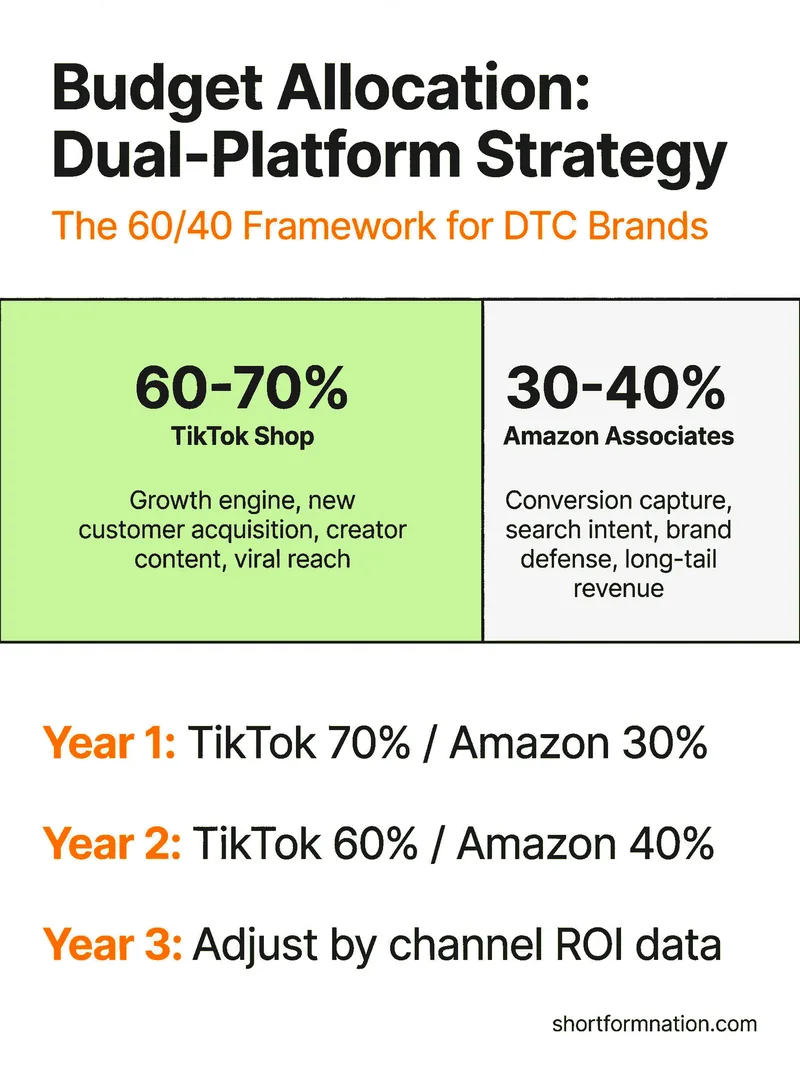
The budget split most DTC brands are landing on: 60-70% into TikTok Shop, 30-40% into Amazon. That ratio tips more toward TikTok as your creator network matures and the halo effect compounds.
For the step-by-step on building the TikTok side from zero: How to Set Up Your First TikTok Shop Affiliate Campaign.
For the complete strategic picture: TikTok Shop Affiliate Marketing: The Complete 2026 Guide.
Building Intelligence Into Your TikTok Shop Program
Here's the real gap between the two platforms. It's not commissions or conversion rates. It's the operating model.
Amazon Associates is set-and-forget. Amazon sets the rates. You check the dashboard. There are no levers to pull because Amazon didn't build any for you.
TikTok Shop is an active management system. You recruit creators, shape content direction, tier commission structures, monitor performance, iterate on what works. The brands winning on TikTok aren't the ones paying the highest commissions. They're the ones running the most intelligent programs.
More levers means more opportunity to outperform — if you have the intelligence to pull the right ones.
SFN AI is the intelligence layer that makes this scalable. Pattern Mining finds which content angles actually drive conversions in your category. Coherence Scoring measures how well creators execute on briefs — creators with high coherence scores consistently earn significantly more per video. The Angle system delivers proven content frameworks to every creator, every day. Your commission investment converts at a higher rate because your creators know exactly what to make.
If you're not ready for a platform, the frameworks in this guide work manually. Start there. Track what converts. When you're managing 50+ creators and the complexity ceiling hits, the intelligence layer compounds everything you've built.
The brands winning on TikTok Shop in 2026 aren't writing the biggest commission checks. They're building the smartest operating systems.
Once you've built your dual-platform program, the next challenge is measuring what's actually working. Our guide to TikTok Shop affiliate analytics covers the metrics that matter — and the measurement mistakes that kill most programs before they scale.
Frequently Asked Questions
Is TikTok Shop affiliate better than Amazon Associates?
For DTC brands selling visual, demo-friendly products in the $15-60 price range, TikTok Shop delivers higher ROI through better conversion rates (4.7% vs 2-3%), flexible commission structures (10-50% vs 1-10% fixed), and native checkout that eliminates redirect friction. Amazon Associates remains stronger for high-AOV products, catalog breadth, and passive long-tail income.
What commission rates does TikTok Shop offer vs Amazon?
TikTok Shop lets brands set their own rates: typically 10-15% for Open Collaboration, 15-25% for Targeted Collaboration, and 25-50% for VIP creators. Amazon Associates uses a fixed rate card where most categories pay 1-4%, with Luxury Beauty topping out at 10%. Brands have zero commission flexibility on Amazon.
Can I run TikTok Shop and Amazon affiliate programs simultaneously?
Yes — and most successful DTC brands do. The optimal approach allocates TikTok Shop for discovery-driven, high-margin products and Amazon for search-driven, trust-dependent purchases. TikTok affiliate content also generates a 30-50% halo effect on Amazon sales, making the two channels complementary rather than competitive.
Why are creators switching from Amazon to TikTok Shop?
Creator earnings per 1,000 views on TikTok Shop (beauty/fashion) run $20-80, versus $3-15 on Amazon Associates. Higher commission rates combined with native in-app checkout produce 3-5x the earnings for equivalent reach. According to industry reports, 34% of Instagram-exclusive creators added TikTok Shop campaigns between 2024-2025, with 52% migration in beauty and fashion.
Ready to stop guessing and start knowing what converts? Get started with SFN AI — the intelligence layer for brands that want to compete on content quality, not just commission rate.
Last Updated: March 2026
Founder of SFN AI. We watch TikTok Shop 24/7 so creators and the brands that run them get the playbook.