TikTok Shop Affiliate Marketing: The Complete 2026 Guide
Master TikTok Shop affiliate marketing in 2026. Commission structures, creator recruitment, and scaling strategies backed by data from 1.2M+ creator profiles.

Author: Syb Vanke, Founder of SFN AI | Last Updated: March 2026 | Reading Time: 25 min
Primary Keyword: tiktok shop affiliate marketing | Format: Deep-Dive Hub Page
TikTok Shop affiliate marketing is the fastest-growing commerce channel in the world — this guide covers the complete playbook.
Tarte Cosmetics reportedly generated over $40 million in TikTok Shop revenue last year. Eighty-eight percent of it came from affiliate creators — not their own brand account, not paid ads. Creators earning commission on every sale.
This isn't a side channel. This is the business model.
TikTok Shop hit $23.4 billion in US GMV and is nearly doubling year-over-year while Amazon affiliate revenue flatlined. For creators, average commission per sale ranges $12-$45 depending on category and tier. For brands, conversion rates sit at 4.7% on average — versus 2-4% on traditional e-commerce. That's not incremental. That's structural.
The landscape has shifted. The rules have changed. The winners are the ones who understand the mechanics.
This guide covers the complete playbook: how the affiliate model works, what the market looks like in 2026, how to set commission rates that actually sustain margin, how to launch your first campaign, how to recruit and scale a creator network from zero to 1,000+ affiliates, and how to measure whether it's actually working. Everything you need to capture your share of the $23.4 billion opportunity.
TLDR: TikTok Shop affiliate marketing connects brands with creators who promote products for commission — entirely inside the TikTok ecosystem, no external links, no app-switching. With $23.4B in US GMV, conversion rates 3-6x higher than traditional e-commerce, and growth nearly doubling year-over-year, it's the fastest-growing commerce channel for both creators and brands. This guide walks you through the complete system: affiliate mechanics, commission strategy, campaign launch, creator recruitment, performance measurement, and scaling.
What Is TikTok Shop Affiliate Marketing?
TikTok Shop affiliate marketing is a three-party system: sellers list products, creators promote them for commission, and buyers purchase without ever leaving TikTok.
That last detail matters more than it sounds. Traditional affiliate programs ask creators to link to external sites — Amazon, Shopify stores, brand websites. External links lose 30-50% of traffic to friction: app-switching, load times, cart abandonment. TikTok Shop keeps everything native. A creator records a 15-second demo, pins a product link, and viewers tap to purchase within the TikTok app. Conversion friction drops to near-zero.
The money flows like this: A viewer buys a $50 product through a creator's affiliate link. TikTok takes its 6% transaction fee ($3). The brand's commission rate is set at 15% ($7.50). The creator gets $7.50 as commission. Settlement happens every 14 days — no invoicing, no payment delays.
There are two ways to run affiliate campaigns on TikTok Shop:
Open Collaboration is public and self-service. Any creator meeting minimum requirements (5,000 followers in the US) can apply to promote your products. Commission rates are fixed — usually 10-15% base. You get volume and passive discovery, but lower-tier creators often underperform. Think of it as affiliate-by-default.
Targeted Collaboration is invite-only. You recruit specific creators based on audience fit and track record. Commission rates are negotiable — typically 18-25%+, up to 50% for top performers. You get precision and predictability, but it requires active recruitment and relationship management.
Here's the performance gap: Open Collaboration averages 2-4% conversion rate on creator content. Targeted Collaboration with the right creators hits 8-12%. The difference is niche fit. A beauty creator promoting skincare to 500K beauty enthusiasts converts at 10x the rate of a generalist creator with 2M mixed followers promoting the same product.
TikTok Shop conversion rates average 4.7% across all creator tiers — versus 2-4% for traditional e-commerce. That's not just better. That's a structural advantage built into the platform's native commerce architecture.
The commission structure varies wildly by category, creator tier, and campaign goal. The baseline is 10-15% for open affiliates, but top creators and Targeted Collaborations regularly hit 25-50%. If a creator drives $100,000 in GMV at 20% commission, they pocket $20,000. That's enough to be a full-time income for thousands of creators.
This is where TikTok Shop affiliate marketing differs fundamentally from other models. Instagram's affiliate program is siloed — no native checkout. YouTube's affiliate links point externally. Amazon Associates doesn't have creator recruitment tools. TikTok Shop bakes affiliate mechanics directly into the platform: creator tagging, commission tracking, payout automation, and native checkout all in one system.
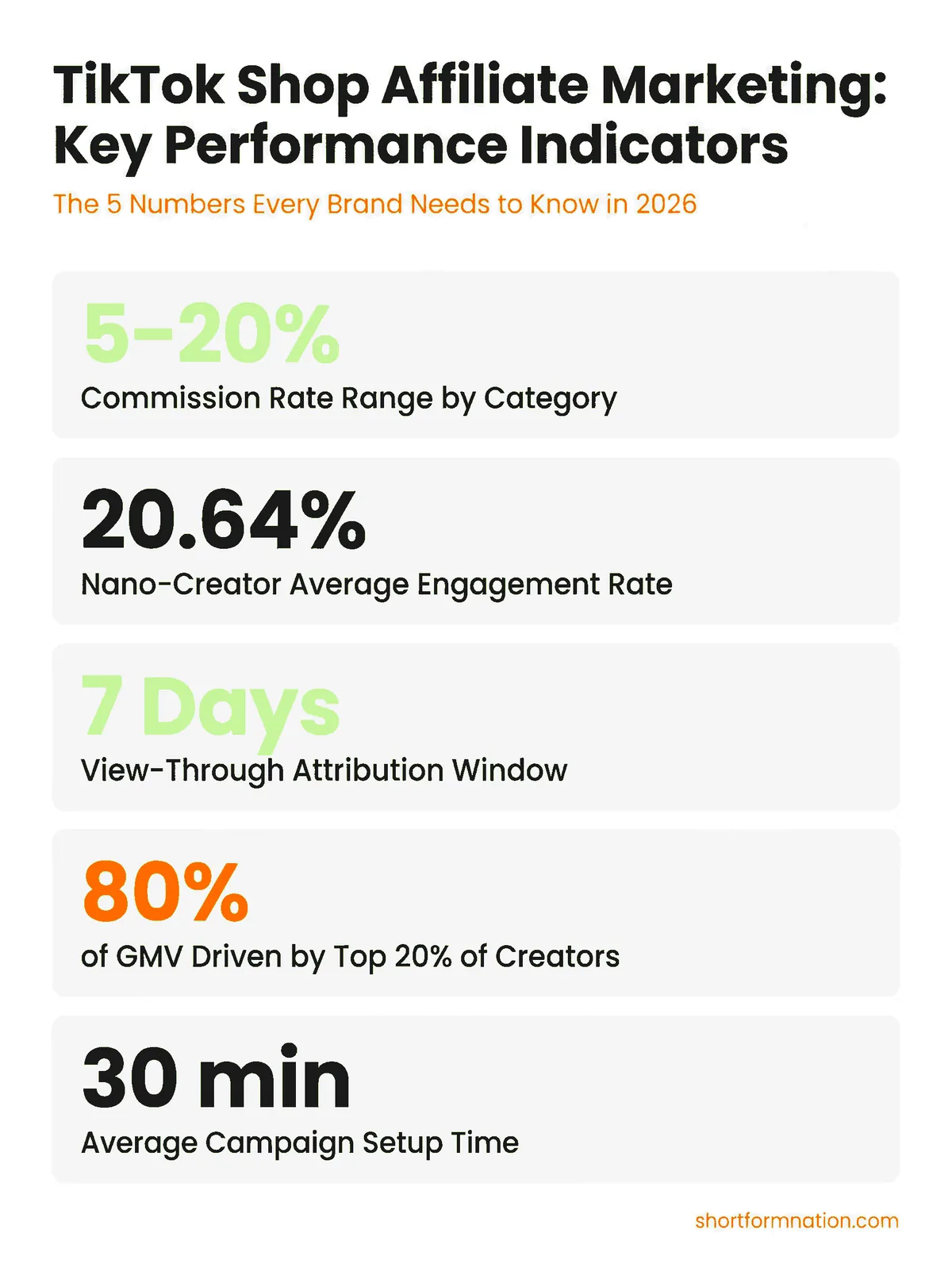
The five KPIs every brand needs to benchmark before launching an affiliate program.
The TikTok Shop Affiliate Landscape in 2026
The US TikTok Shop market is projected at $23.4 billion in GMV for 2026. Globally, the figure exceeds $80 billion. Growth rate: nearly doubling year-over-year — the fastest-growing commerce channel in the world.
To put this in context: Amazon Associates generated approximately $14 billion in affiliate revenue globally last year. TikTok Shop's US-only affiliate volume is on pace to exceed that. The growth rate tells the story — rapid expansion while traditional e-commerce and affiliate channels grew 4-6%.
The user base reflects this momentum. There are 114 million social buyers in the US alone — roughly one-third of Americans. The creator affiliate network has reached millions of creators globally. On the seller side, 15 million+ brands and SMBs have active TikTok Shop accounts.
Here's how TikTok Shop compares to its closest competitors:
| Platform | Affiliate Commission | Avg Conversion Rate | Creator Base | Notes |
|---|---|---|---|---|
| TikTok Shop | 10-50% (tiered) | 4.7% | Millions globally | Native checkout, uncapped commission |
| Instagram Shopping | 8-20% | 2.1% | ~800K | Limited native checkout |
| YouTube Shopping | 10-25% | 2.9% | ~1.2M | External links, longer content format |
| Amazon Associates | 1-10% (fixed) | 2-3% | 3M+ | Fixed rate card, no negotiation |
The commission range on TikTok is wider because the platform allows negotiation. Amazon locks you into their rate card. TikTok Shop lets you offer 10% for open affiliates and 30-50% for your top 5% of creators. This flexibility is why top creators prefer TikTok — the upside is uncapped.
Category concentration shows where affiliate commerce is strongest. Beauty and personal care leads at 22.5% of TikTok Shop GMV — highest conversion rates (6-9% average) because creators can demo products in 10 seconds. Fashion sits at 12.5% — moderate conversion, high volume, lower unit margins. Health and supplements hit 9.3% — strong affiliate performance driven by creator trust. Home and garden at 8.7% — growing fast, driven by renovation creators. Electronics at 7.2% — lower volume, higher unit price, longer purchase cycle.
The affiliate supply side is equally important. A network analysis of active TikTok Shop affiliates reveals a power-law distribution: 20% of creators drive 80% of GMV. The bottom 50% drive only 3% of total volume. This matters for your recruitment strategy — concentration is real, and your success depends on finding and retaining top-tier creators.
TikTok Shop conversion rate: 4.7%. Instagram: 2.1%. YouTube: 2.9%. That 2.6-point delta compounds. On a $100K campaign spend, TikTok's higher conversion rate translates to 50-80% better ROI than competing platforms.
The competitive landscape has consolidated. Instagram's affiliate program lost market share due to clunky checkout. YouTube Shopping works but requires external linking. Amazon Associates pays lower commissions with a ceiling on earnings. TikTok Shop removed friction from all three — native checkout, automatic creator tagging, one-tap purchase, settlement automation, and uncapped commissions.
The result: creator migration to TikTok is accelerating. Platform data shows 34% of creators who were exclusive to Instagram in 2024 now run concurrent TikTok Shop campaigns. For beauty and fashion creators, that number is 52%.
For the full deep-dive on market dynamics, platform mechanics, and what's actually converting, see our complete analysis: Social Commerce Trends 2026: What's Actually Working on TikTok Shop.
For the complete breakdown of TikTok Shop's creator program — requirements, earning tiers, and how to maximize creator earnings — see: TikTok Shop Creator Program: How It Works, Requirements & How to Earn.
Market size tells you why. Commission structure tells you how.
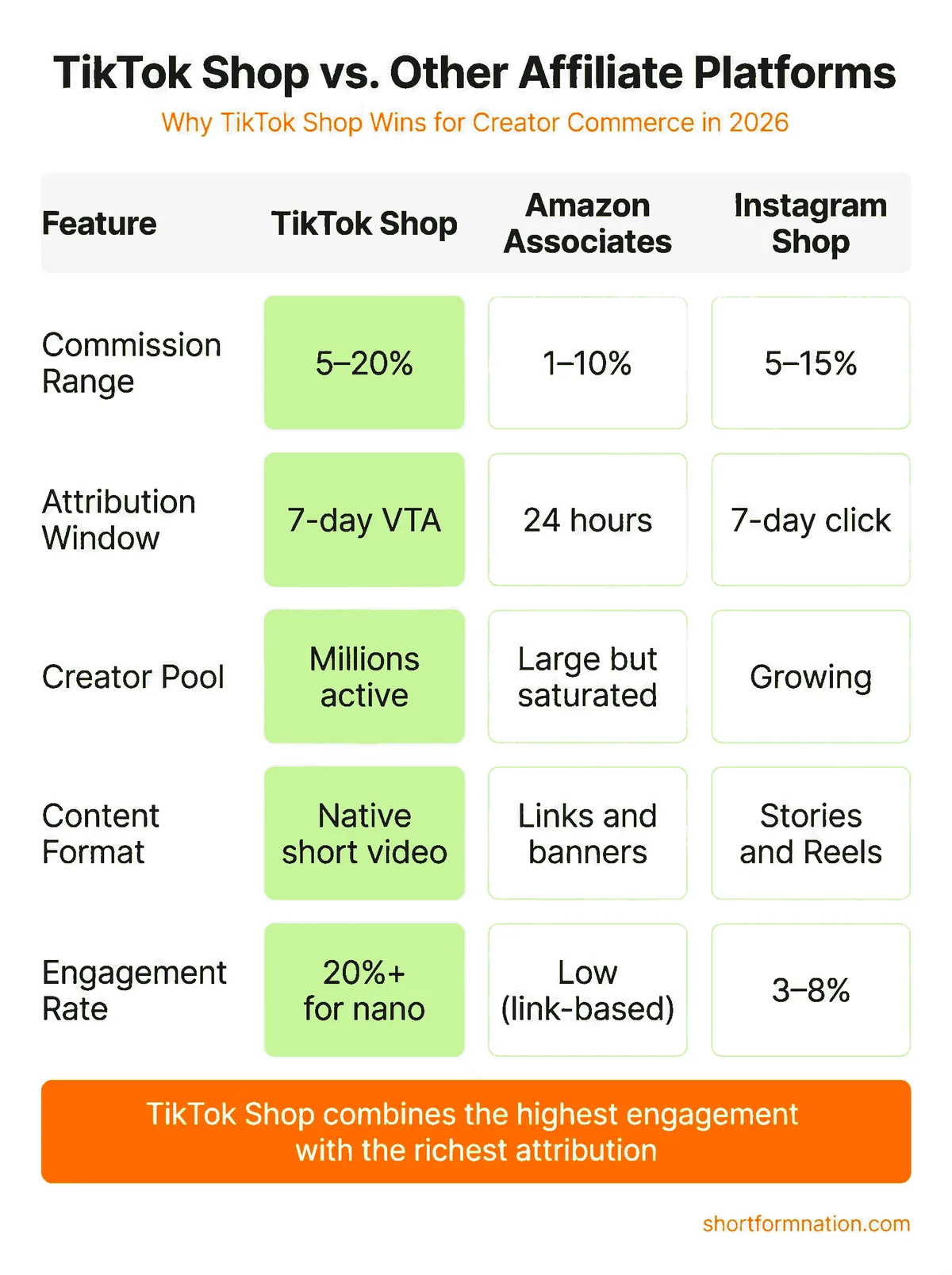
TikTok Shop leads on commission flexibility, conversion rate, and native commerce integration.
Commission Structures: What to Offer and Why
Commission structures range from 5-20% base depending on category — with top-tier Targeted Collaborations reaching 25-50%.
The biggest mistake brands make is thinking commission is a cost center. It's not. Commission is your unit economics constraint — the lever that determines whether a $50 sale is profitable or not.
Start by understanding your true margin on a typical sale. Here's a $50 beauty product:
| Cost Component | % of Revenue | Dollar Amount |
|---|---|---|
| COGS | 30% | $15.00 |
| TikTok Platform Fee | 6% | $3.00 |
| Payment Processing | 2.2% | $1.10 |
| Fulfillment & Shipping | 8% | $4.00 |
| Returns Reserve (12%) | 12% | $6.00 |
| Commission (15%) | 15% | $7.50 |
| Total Costs | 73.2% | $36.60 |
| Gross Margin | 26.8% | $13.40 |
That 26.8% margin has to cover operating costs — salaries, platform fees, paid ads, customer service, fraud. For most mid-market brands, that leaves 8-12% true profit. A 5-point swing in commission (10% vs 15%) can flip a profitable campaign into a loss-making one.
Here's how to structure commissions across your creator base:
Open Collaboration Baseline (10-15%): Maximum creator volume. Expect lower conversion rates and high dead weight — typical accept-to-active-post rate is 12-18%. Use this for broad discovery.
Targeted Tier 1 (15-18%): Creators with 10K-100K followers and 3-5% engagement rate. Proof of audience quality but not yet top performers. Hungry and consistent. This is your volume recruitment tier.
Targeted Tier 2 (20-25%): Creators with 100K-500K followers and 4-7% engagement rate. Proven track records. Conversion rates 2-3x the baseline. Worth the premium.
Targeted Tier 3 (25-50%): Your top 5-10 creators. They do $500K-$5M in annual GMV for you. They set the tone, drive mainstream awareness, and have leverage. Pay them well. They're not interchangeable.
The true cost of affiliate conversion is 5-7x higher than the headline commission rate. When you see "6% TikTok platform fee," remember: commission + platform fee + processing + returns + fulfillment = 35-45% of revenue. Structure commissions within that constraint or you'll erode margins.
Run both Open and Targeted simultaneously. Open generates volume (1,000+ signups, 15-20% active rate). Targeted generates precision (100-200 recruits, 75%+ active rate). Together, they optimize for both reach and conversion.
For the complete breakdown of commission benchmarks by category and the full unit economics framework, see: TikTok Shop Affiliate Commission Rates: What Brands Should Offer.
For the deep comparison of payment models — commission-only vs retainer vs hybrid — see: TikTok Shop Creator Payment Models: Retainers vs Commission vs Hybrid.
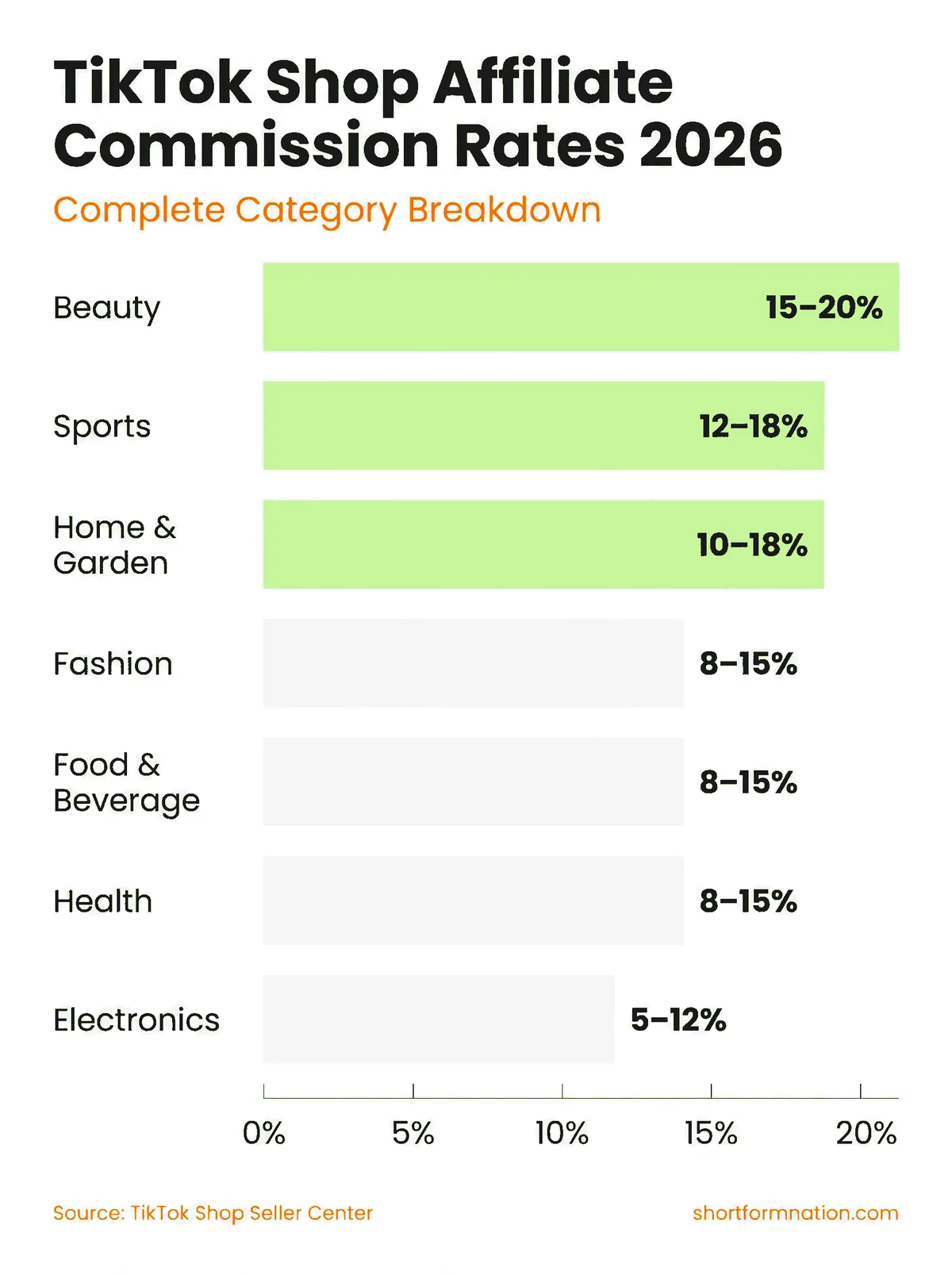
Commission rates vary significantly by product category — Beauty commands the highest rates while Electronics sits at the bottom.
Setting Up Your First Affiliate Campaign
Five steps from zero to live affiliate campaign — most brands complete setup in 2-4 hours.
The technical setup is straightforward — five steps, usually 2-4 hours from zero to launch.
Step 1: Set Up a TikTok Shop Seller Account. Register at seller.tiktokglobalshop.com. Verify your business identity, connect a bank account, and complete the product catalog setup. This happens in Seller Center — the brand-side dashboard for all TikTok Shop operations.
Step 2: List Your Products in the Catalog. Upload SKUs with titles, descriptions, pricing, images, and categories. TikTok's search algorithm uses these fields, so optimize them like SEO keywords. Start with your top 20% by revenue — launch lean.
Step 3: Enable Affiliate Features in Seller Center. Navigate to the Affiliate Program section. Toggle on Affiliate Mode. Choose Open Collaboration, Targeted Collaboration, or both. Set your base commission rate (10-15% recommended for open).
Step 4: Choose Your Collaboration Type. Open Collaboration lets creators find and apply directly — you can auto-approve or manually review. Targeted Collaboration lets you invite specific creators with custom commission rates and terms. Run both at launch.
Step 5: Set Commission Rates and Launch. Configure tiered commissions. Set promotional bonuses (e.g., 20% for first 30 days, then 15% baseline). Schedule launch for a high-traffic day (Tuesday-Thursday works best).
A realistic launch budget: $500-$2,000 in product samples sent to your first 20-50 creators, plus 15-20% commission on sales. Samples are non-negotiable — most creators won't post without hands-on product experience.
The commission protection period is 30 days baseline (60 days for Targeted top-tier partners). If a buyer purchases within that window of clicking an affiliate link, the creator gets credit. Plan your sample seeding and posting schedule around this window.
Expect 48-72 hours for the first affiliate content to go live after launch, then 7-14 days for meaningful volume. Real campaigns hit their stride at 3-4 weeks when power-law creators find their rhythm.
For the full step-by-step walkthrough with screenshots, sample budgets, and troubleshooting, see: How to Set Up Your First TikTok Shop Affiliate Campaign.
Getting the campaign live is one thing. Finding the right creators to run it is another.
Finding and Recruiting Creators
Active recruitment is the difference between a program that grows and one that stalls — the top 20% of creators receive dozens of partnership offers weekly.
This is where most brands fail. They launch a great product, set good commissions, then wait for creators to find them.
You have to recruit actively. The top 20% of creators on TikTok Shop receive dozens of partnership offers every week. If you're not pitching them, someone else is.
Four discovery methods, ranked by ROI:
Method 1: Native Tools (Lowest Friction)
TikTok Seller Center has a Creator Discovery tool built in — top-performing creators in your category with engagement rates, posting frequency, and historical affiliate performance. Free, takes 30 minutes to find 50 quality targets.
Method 2: Third-Party Platforms (Moderate Friction)
Tools like Kalodata, FastMoss, and CreatorIQ aggregate creator data across multiple brands. They cost $500-$2K per month but save 10+ hours of manual research weekly.
Method 3: Manual Discovery (High Friction, High ROI)
Search hashtags (#TikTokShopAffiliate, #TikTokShopCreator), visit competitor brand pages, and identify which creators they've partnered with. This is competitor poaching — and it works. If a creator drove 10K views for a competitor, they'll likely perform for you. Cold DM conversion: 1-2%, but responders are already TikTok Shop-native.
Method 4: Inbound Attraction (Passive)
If you have a TikTok brand account with 50K+ followers, pin an "Affiliate Signup" link in your bio. Post 2-3 affiliate success stories per month. Inbound response rate: 5-10%, but takes 2-3 months to build momentum.
Creator Evaluation: Must-Hit Thresholds
Not every creator is worth recruiting. Use these filters:
- Engagement Rate: Minimum 2.5% (comment + like + share / followers). Below 2.5% and the audience is passive.
- Content Quality: Watch 3 recent posts. If they feel cheap or chaotic, skip.
- Niche Fit: Does their audience align with your product? Category fit drives 60% of conversion variance.
- Posting Frequency: Minimum 3 posts per week. Less than that and commission motivation won't overcome content calendar constraints.
The power law governs everything here. Analysis of 1.2 million TikTok Shop affiliates shows:
- Top 1% (~12K creators): Average $600K annual GMV per creator
- Top 5% (~60K creators): Average $80K annual GMV per creator
- Top 20% (~240K creators): Average $8K annual GMV per creator
- Bottom 80% (~960K creators): Average $200-$800 annual GMV per creator
Physician's Choice (supplements) did $2.4 million in 28 days by recruiting 2,000+ creators. But 80% of that $2.4M came from 200 creators in the top tiers. The other 1,800 drove 20%. Prioritize tier 1 and 2 in recruitment. Use tier 3 for volume. Deprioritize tier 4.
Nano-influencers (1K-10K followers) on TikTok average 20.64% engagement rate — versus 3-5% on Instagram. This is why tier 2 outperforms tier 1 by conversion rate, even when tier 1 has higher absolute volume.
Sample seeding is the unlock. Most creators won't post without product in hand. Budget $500-$2,000 for your first 20-50 creators. Expect 40-60% of sample recipients to post. Sample seeding ROI is typically 5-10x return.
For the complete recruitment playbook — outreach templates, scaling from 10 to 1,000 creators, and the full evaluation framework — see: How to Find and Recruit TikTok Shop Creators at Scale.
Getting creators to say yes is step one. What you tell them to make is step two.
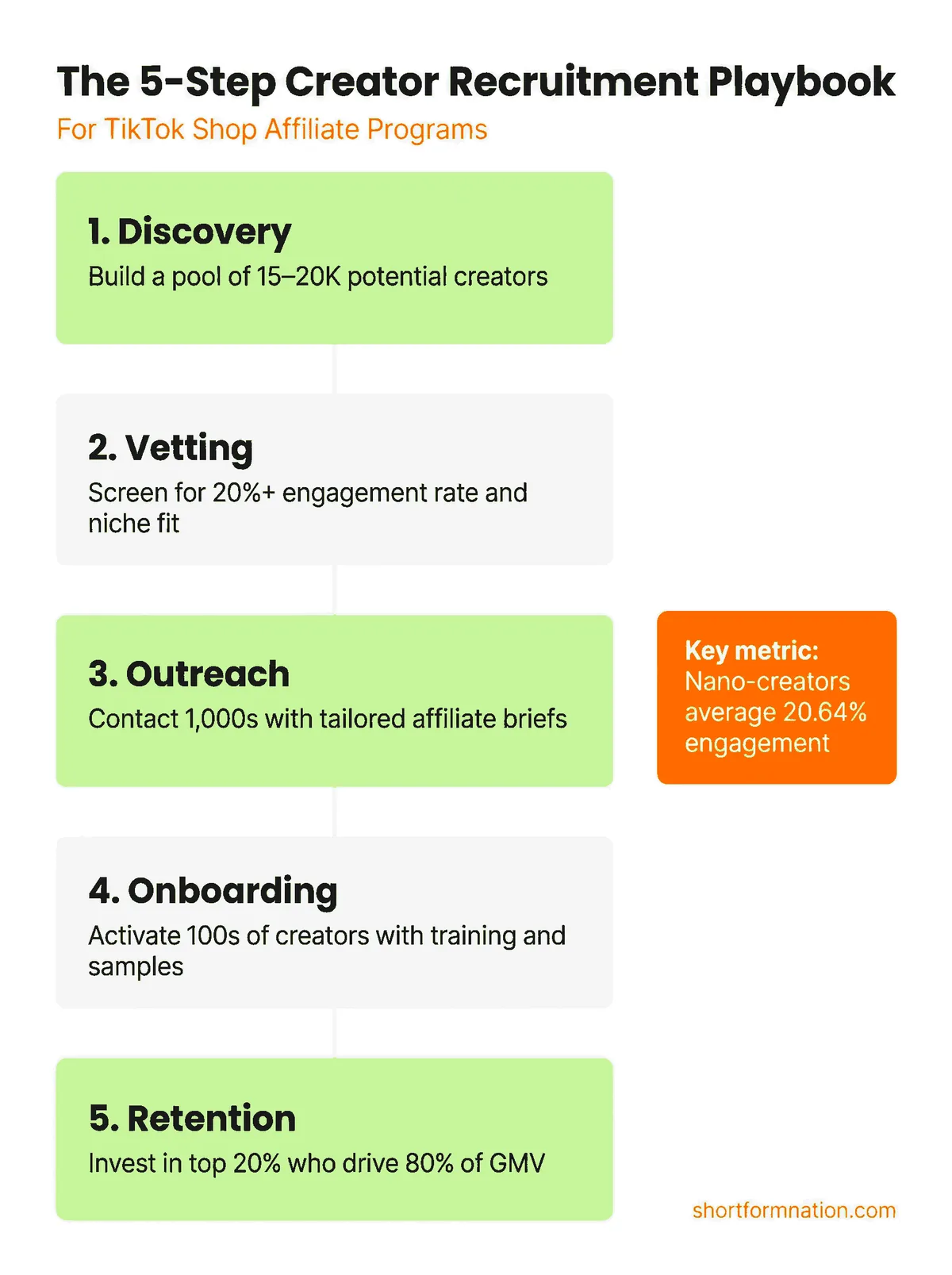
The 5-step recruitment playbook: Discovery → Vetting → Outreach → Onboarding → Retention.
Writing Affiliate Briefs That Convert
The most effective affiliate briefs avoid two traps: over-scripting that kills authenticity and under-briefing that kills quality.
Most brands swing between extremes. They either hand creators a 2,000-word script (which gets ignored), or they send a product link with "post something cool" (which tanks quality). Neither works at scale.
Every effective brief includes seven core elements:
- Product pillars — The 3-5 core claims you want communicated. Not scripts. Claims.
- Hero claims — Which pillars each creator should lead with, based on their audience.
- Banned keywords — What you absolutely cannot say (compliance, legal, competitor positioning).
- Content format guidance — Hook style, pacing, length suggestions.
- Hook suggestions — 5-10 opening lines tied to different angles. Creators remix them.
- Commission details — Exact payout structure. Clarity kills disputes.
- Deadline and deliverables — When, how many, what quality baseline.
The brief-to-flywheel concept matters. One brief produces one video. But a content flywheel — a standing framework that lets creators generate angles independently — produces daily content week after week.
The numbers back this up. Creators posting 5+ times per week see 3.2x higher GMV than creators posting twice weekly. It's not the frequency driving the lift — it's the content diversity. More posts mean more angles tested, more audiences reached, more conversion opportunities.
But here's the harder stat: Only 5.57% of TikTok's 15.3 million influencers actively sell anything. The gap isn't talent. It's intelligence. Most creators don't have the frameworks to brief themselves.
For the full brief architecture, tiered templates by creator size, and the flywheel model, see: How to Write TikTok Shop Affiliate Briefs That Creators Actually Use.
For how AI-generated content fits into your affiliate strategy — what TikTok allows, what gets demonetized, and the 70/30 framework — see: AI-Generated UGC for TikTok Shop: What Actually Works and What Gets You Demonetized.
Great briefs set the starting conditions. But how do you know if they're actually working?
Measuring Affiliate Performance
The right metrics tell you whether your program is a business or a hobby.
Most brands measure one thing: GMV. It's easy to track, easy to celebrate, and almost always misleading. Real measurement happens in three layers.
Layer 1: Foundational metrics — GMV, total orders, average order value (AOV), creator count. These are top-line health signals. They tell you if the program is moving.
Layer 2: Conversion metrics — Video-to-click rate (what percentage of viewers click the product link?). Click-to-purchase rate (what percentage of clickers buy?). Content velocity (how many videos per creator per week?). These separate prolific creators from high-converting ones.
Layer 3: Financial metrics — Blended ROAS (return on all costs including commission and management overhead). Contribution margin per SKU (revenue minus all program costs per unit). LTV:CAC ratio (lifetime value divided by acquisition cost). This layer is where most brands fail — they never calculate it.
Here's the critical problem: TikTok Shop analytics and TikTok Ads analytics are separate dashboards. Your Shop dashboard shows orders and revenue. Your Ads dashboard shows impressions and clicks. They don't talk to each other. You have to manually connect them.
Attribution adds friction. TikTok defaults to last-click — the last creator a user engaged with gets full credit. Awareness creators who generate reach and recall get zero credit. This systematically undervalues top-of-funnel creators.
Then there's the Halo Effect. TikTok Shop content doesn't just drive TikTok sales. It lifts Amazon searches, DTC site traffic, and YouTube view counts. TikTok Shop affiliate content drives 30-50% incremental revenue on other platforms. If you're only measuring Shop GMV, you're understating true ROI by nearly half.
Tools address this at different levels. Kalodata tracks product trends and competitor analytics. FastMoss provides creator discovery and tracking intelligence. SFN AI's TikTok Shop intelligence platform takes a different approach — its Coherence Scoring system measures how closely each creator's video matches recommended content patterns, with creators scoring 90%+ averaging 6.9x higher earnings per video. For teams without specialized tools, manual weekly reviews of creator content against brief guidelines work — they just don't scale past 50 creators.
For a comprehensive comparison of every TikTok Shop analytics, creator management, and intelligence tool — with pricing, data sources, and official partnership status — see: Best TikTok Shop Tools for Brands in 2026: The Definitive Guide.
GMV is vanity. Contribution margin per SKU is the metric that determines whether your affiliate program is a business or a hobby.
Your reporting cadence:
| Frequency | What to Review | Action |
|---|---|---|
| Daily | Orders, active creators, trending products | Flag anomalies, respond to viral moments |
| Weekly | ROAS by creator, top-performing content, velocity | Adjust tiers, boost top content with Spark Ads |
| Monthly | Contribution margin by SKU, LTV by cohort | Strategic shifts, commission restructuring |
| Quarterly | Total program ROI, halo effect, creator retention | Program-level investment decisions |
The shift from "we're generating revenue" to "we're generating profitable revenue" is the shift from a creator program to an affiliate business.
For the complete analytics walkthrough — dashboards, attribution models, and the full metric framework — see: TikTok Shop Affiliate Analytics: What to Track and Why Most Programs Get It Wrong.
Scaling Your Affiliate Program
Scaling isn't about hiring more managers — it's about building intelligence into your operating system. Agencies scaling this across a book of clients face a different problem again: how to manage multiple TikTok Shop clients.
Scaling a TikTok Shop affiliate program isn't about hiring more managers. It's about building intelligence into your operating system.
Most teams plateau at 30-50 creators because manual management hits a ceiling. One manager can personally oversee 10-15 creators with high touch. Beyond that, quality drops, communication breaks, and the program becomes friction instead of revenue.
The Affiliate Intelligence Framework
There's a better path. It maps three distinct phases:
Phase 1: Foundation (10-30 creators, weeks 1-4). Manual everything. You're personally onboarding creators, reviewing every brief, giving feedback on every video. High-touch, slow, and unsustainable — but necessary. You're proving the model works and building your first case studies. Success metric: profitability on your first 10 creators.
Phase 2: Systematize (30-300 creators, months 2-3). You're templating everything — standing briefs, tiered commission structures, automated reporting. One manager handles 50-100 creators because systems do the repetition work. You've automated the workflow but not the intelligence. Success metric: 70%+ of new creators hitting commission targets by week 4.
Phase 3: Scale (300-2,000+ creators, month 4+). Intelligence compounds. You're using data patterns, creator scoring, and predictive analytics to decide who gets what brief, when they should post, and what angles work for their audience. One manager handles 300-400 creators because the system does the decision-making. Success metric: sustained ROAS above 5:1 across the entire base.
The management ratio reality:
| Model | Creators per Manager | Bottleneck |
|---|---|---|
| Manual | 10-15 | Personal bandwidth |
| Basic tools | 50-100 | Workflow efficiency |
| Intelligence-driven | 300-400 | System capacity |
Watch what breaks at each phase:
| Phase Gate | What Breaks | Signal |
|---|---|---|
| At 50 creators | Brief quality, content review velocity | Reviews 2-3 days late; briefs become generic |
| At 100 creators | Commission tracking, onboarding | Payout disputes; time-to-first-video exceeds 14 days |
| At 300+ creators | Brand safety, communication, data overload | Off-brand content; feedback loops disappear |
You also face a structural decision:
In-house gives you control and institutional knowledge. Ceiling: ~200 creators per dedicated team.
Agency gives you scale and expertise. Cost: 15-25% management fee on top of commission.
Hybrid is often the sweet spot — in-house strategy, agency execution.
Physician's Choice scaled to 2,000+ creators and $2.4M in 28 days. MySmile reached seven-figure monthly revenue in three months with 500 active creators. Both used intelligence-first systems from day one — they didn't start manual and graduate to smart.
The traditional creator program caps out at 30-50 creators per manager. The intelligence-first program handles 300-400. The variable isn't headcount — it's the operating system.
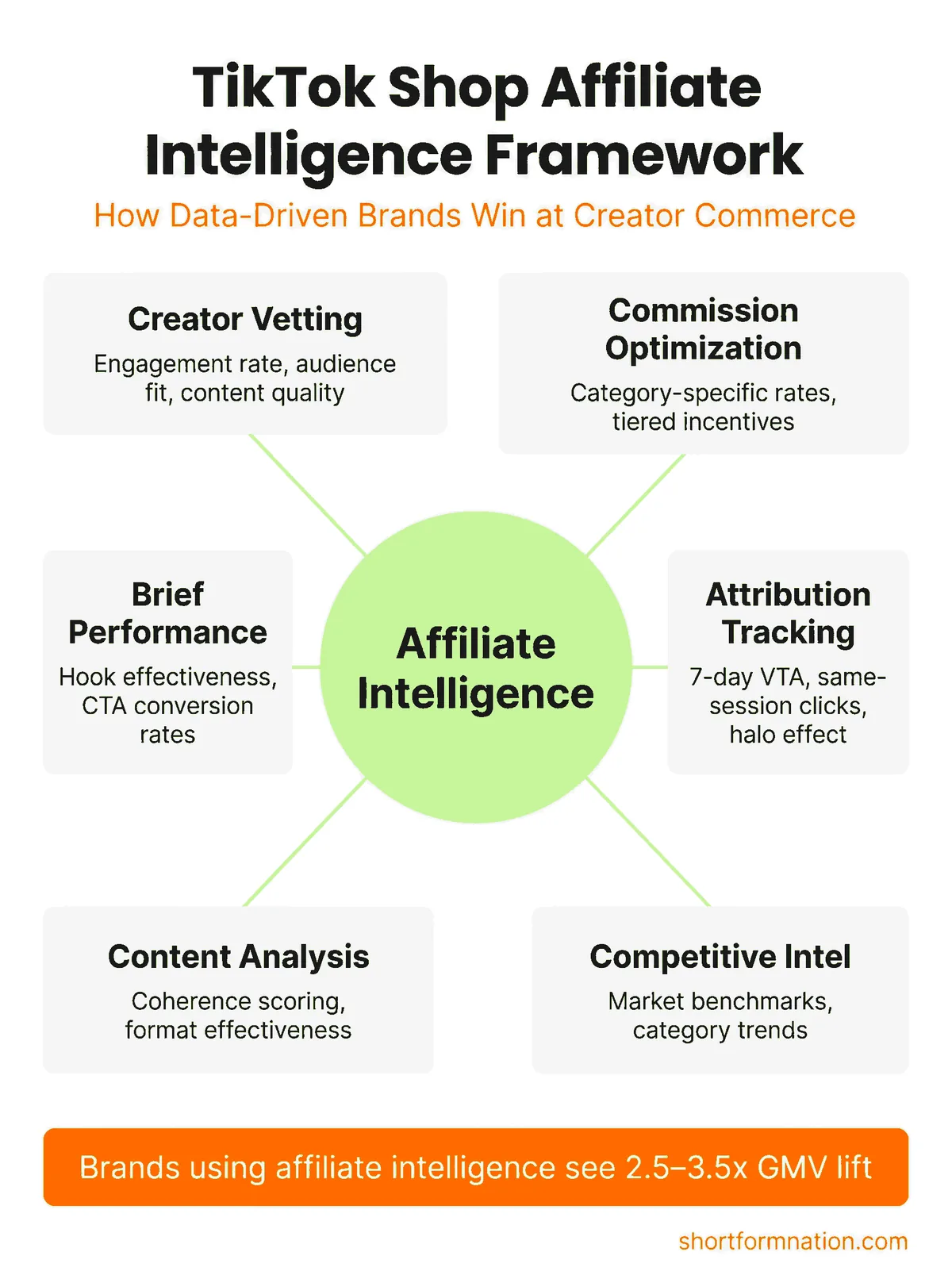
The Affiliate Intelligence Framework: six interconnected data systems that let one manager handle 300+ creators.
For the complete scaling playbook — phase-gate checklists, margin protection, and the full Intelligence Framework — see: How to Scale Your TikTok Shop Affiliate Program Without Losing Margins or Control.
Common Mistakes and How to Avoid Them
80% of TikTok Shop affiliate programs plateau at month 3. Not because creators stop posting — because the operating model wasn't built to scale past the founder's personal attention.
Seven mistakes that cause the plateau:
1. Chasing GMV instead of contribution margin. You hit $500K in monthly revenue and celebrate. Then you realize the program costs $475K to run. Revenue without profit math is a race to zero. Measure contribution margin from day one.
2. Setting commission rates without unit economics. The headline looks good at 6%. But after processing fees, platform fees, fulfillment, and returns, that $3 per order on a $50 product becomes invisible. Know your unit economics before committing to a rate.
2a. Ignoring fulfillment as a commission lever. The fulfillment line in your cost stack is one of the few you can actually compress. Fulfilled by TikTok drops per-unit shipping to as low as $2.86 on multi-unit orders, which is often the difference between a 12% commission rate that breaks the model and a 20% rate that recruits the creators you actually want.
3. Over-scripting creator briefs. A 2,000-word script gets ignored — or followed exactly, producing wooden content that tanks engagement. Give creators pillars, not scripts.
4. Treating all creators the same. One commission rate, one brief, one process for everyone. The top 20% drive 80% of GMV. They deserve different compensation, faster approval, and custom briefs. Tier your base.
5. Ignoring the Halo Effect. Your TikTok Shop revenue is $100K. But that traffic lifted Amazon by 40%, DTC by 35%, and YouTube by 120%. Only measuring Shop GMV understates true ROI by 30-50%.
6. Manual scaling without systems. You personally manage 40 creators with great results. You hire a second manager and coordination breaks down. The system was you. Systematize everything: briefs, approvals, reporting, commission logic.
7. One-brief, one-video thinking. You spend a week perfecting a brief. The creator posts one video. Done. The winners operate flywheels — the brief becomes a standing framework. One brief, infinite content. That's where the math works.
Building an Intelligence-First Affiliate Program
The pattern is consistent across every program that scales: the winners don't compete on creator quantity. They compete on content quality.
You can recruit 1,000 creators and manage them poorly, or recruit 200 and amplify them intelligently. The 200-creator program wins on revenue, margin, and retention every time.
Better briefs produce better content. Better measurement finds the signal. Better systems let one person manage 300 creators instead of 50. Quantity multiplied by intelligence compounds faster than quantity alone.
The frameworks in this guide — tiered commissions, structured briefs, systematic measurement, the Affiliate Intelligence Framework — will get you to 50 profitable creators. After that, the math demands better tools.
SFN AI's intelligence platform automates pattern mining, angle generation, and creator coaching for programs managing 50+ creators. It surfaces the content patterns that drive conversion, recommends which angles each creator should lead with, and scores videos in real-time so you know what's working before the monthly report. For teams not ready for a platform, the frameworks in this guide are enough. For teams past 50 creators scaling toward 200+, the platform compounds human effort.
Start with the manual frameworks. When you hit the ceiling, reach for the tools. When you hit the next ceiling, revisit your system.
The teams that win on TikTok Shop aren't the ones with the most creators. They're the ones with the smartest operating system.
Ready to build yours?
Join SFN AI or reach out at support@shortformnation.com to discuss your program.
Frequently Asked Questions
What is TikTok Shop affiliate marketing?
TikTok Shop affiliate marketing is a program where creators promote products listed on TikTok Shop and earn commission on every sale made through their content. Unlike traditional affiliate programs, the entire transaction — discovery, evaluation, and purchase — happens inside the TikTok app.
How much do TikTok Shop affiliates make?
TikTok Shop affiliate earnings vary widely. Commission rates range from 10-50% depending on category and collaboration type. Top 1% of creators average $600K in annual GMV. Mid-tier creators (top 5%) average $80K annually. Creator RPM on TikTok Shop ranges from $2,000-$50,000+ per million views.
What commission rate should brands offer on TikTok Shop?
Open Collaboration baseline: 10-15%. Targeted Collaboration: 15-25% for proven performers, 25-50% for top-tier creators. The right rate depends on your unit economics — after COGS, platform fees, fulfillment, and returns, most brands have 25-40% of revenue available for commission and profit.
How do I set up a TikTok Shop affiliate program?
Five steps: (1) Register a TikTok Shop Seller account, (2) List products in the catalog, (3) Enable affiliate features in Seller Center, (4) Choose Open and/or Targeted Collaboration, (5) Set commission rates and launch. Budget $500-$2,000 in product samples for your first 20-50 creators.
What's the difference between Open and Targeted Collaboration?
Open Collaboration is public — any qualifying creator can apply. Commission rates are fixed (10-15%). Targeted Collaboration is invite-only — you recruit specific creators with negotiable rates (18-50%+). Most successful programs run both simultaneously.
Founder of SFN AI. We watch TikTok Shop 24/7 so creators and the brands that run them get the playbook.