How to Scale Your TikTok Shop Affiliate Program (Without Losing Margins or Control)
Scale your TikTok Shop affiliate program from 5 to 500+ creators without margin collapse. Tiered systems, automation triggers, and the 3 growth traps to avoid.

The first 20 were easy. You handpicked each one. Wrote personal briefs. Reviewed every video before it went live. Margins were healthy. Content was sharp. You thought you'd cracked the code.
Then you tried to double it.
Briefs went out late. Three creators posted the same hook — word for word. Your best performer churned because nobody answered her commission question for 11 days. Returns spiked on a product you forgot to pull from the active rotation. And somewhere between creator #37 and #48, you lost the ability to tell who was actually driving profitable sales versus who was just racking up views.
This isn't a failure story. It's the default outcome.
Nearly two-thirds of brands scaling affiliate programs hit significant operational breakdowns between 30 and 80 active creators (Influencer Marketing Hub, 2025 Benchmark Report). Not because the model stops working — because the infrastructure underneath it wasn't built for volume.
The brands that push through don't hire faster or grind harder. They redesign how the entire program operates. Team structure. Automation triggers. Governance systems. The whole operating architecture changes — or the program flatlines.
This is the blueprint for that redesign.
Quick Answer: Scaling a TikTok Shop affiliate program from 5 to 500+ creators requires three infrastructure shifts: evolving your team at defined breakpoints (30, 100, 300 creators), automating brief distribution and performance monitoring before manual processes collapse, and building governance that protects brand safety and margins without killing content velocity. The brands that scale treat this as an operations problem — not a recruitment problem.
Why Affiliate Programs Break at Scale
Most brands think scaling means recruiting more creators. It doesn't. Recruitment is the easy part — the discovery and outreach playbook is well-documented. The hard part is what happens after creators say yes.
Three failure modes hit at predictable thresholds. And they compound each other.
Content quality drift hits first. At 30-50 creators, your brief-to-content pipeline starts leaking. Content coherence — how closely creator output matches brand direction — drops over 30% between the 25-creator and 75-creator marks when managed manually (CreatorIQ, 2025 analysis of 500+ brand programs). The symptom: identical hooks, recycled angles, declining engagement per video. The root cause isn't lazy creators. One person physically cannot provide differentiated creative direction to 50 people at once.
Then margin compression kicks in. Every creator you add isn't just a commission line item. It's sampling cost, onboarding time, communication overhead, and returns exposure. A brand running 100 creators at 15% commission with a 6% platform fee and 8% return rate is already operating on razor-thin margins — before shipping. Without per-creator profitability tracking, you can't tell which 20 creators generate 80% of your profitable GMV and which 80 are breaking even or losing money.
Then operational chaos takes over. Missed payments. Late brief rotations. Brand safety incidents nobody catches until they go viral. Brands managing 100+ creators without dedicated ops infrastructure experience 3x+ more compliance incidents than those with structured workflows (eMarketer, 2025 Creator Economy Report). More people won't fix this. Better systems will.
Here's the thing most scaling guides miss: these three breakpoints don't fire independently. Content drift causes creator frustration. Frustration causes churn. Churn forces more recruitment. More recruitment stretches operations thinner. Thinner operations cause more content drift. It's a compounding failure loop. The only way to break it is to fix the infrastructure — not the symptoms.
The Scaling Architecture Framework
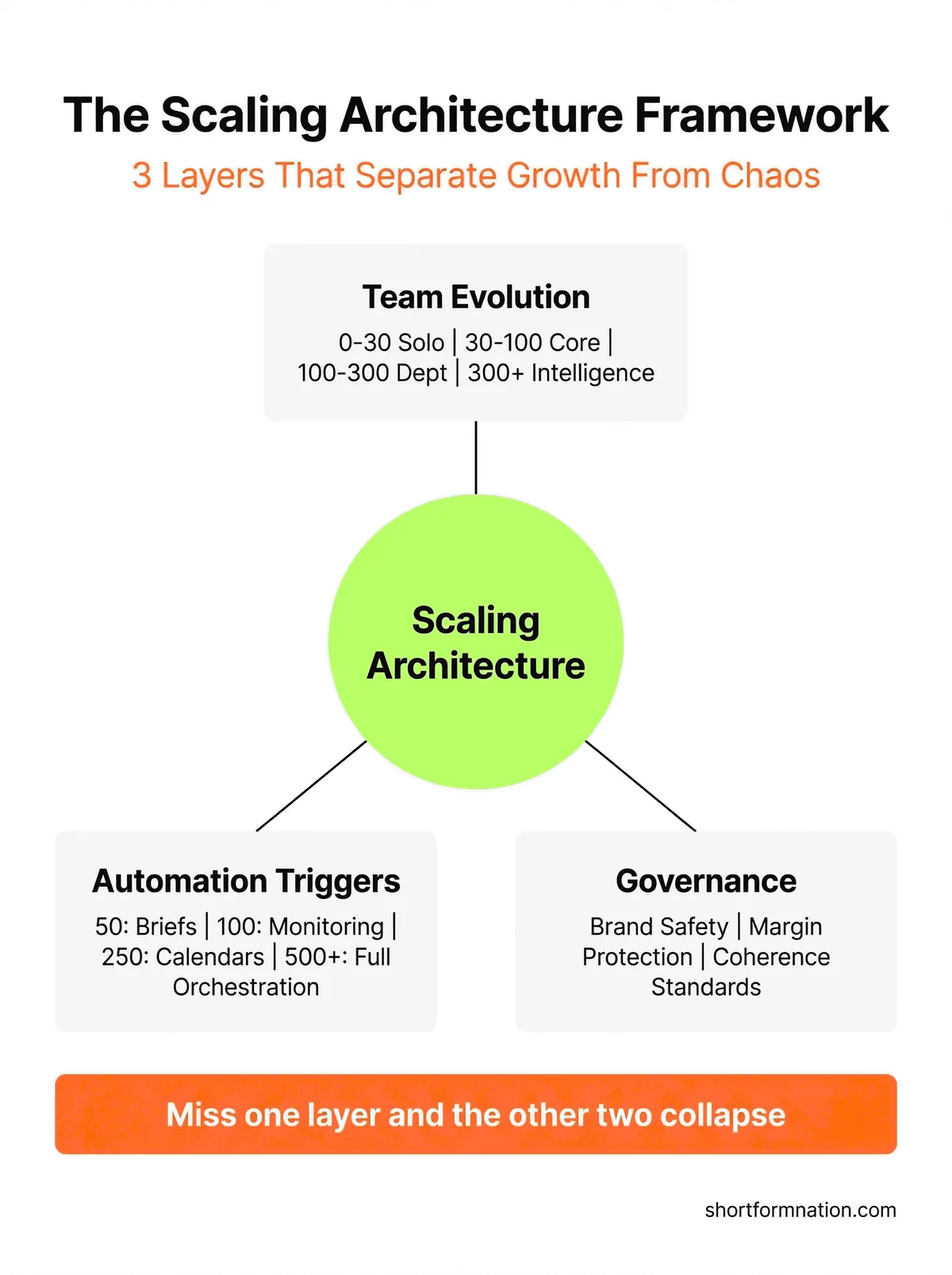
The brands that actually scale from 5 to 500+ don't wing it. They build deliberately across three operational layers, each triggered at specific creator-count thresholds.
We call this the Scaling Architecture Framework. It's the difference between programs that plateau and programs that compound.
Three layers:
Each layer scales independently. But they reinforce each other. Miss one, and the other two collapse.
Layer 1: Team & Roles Evolution
The most expensive mistake in scaling is hiring too late — or the wrong role at the wrong stage. Here's what the team looks like at each breakpoint.
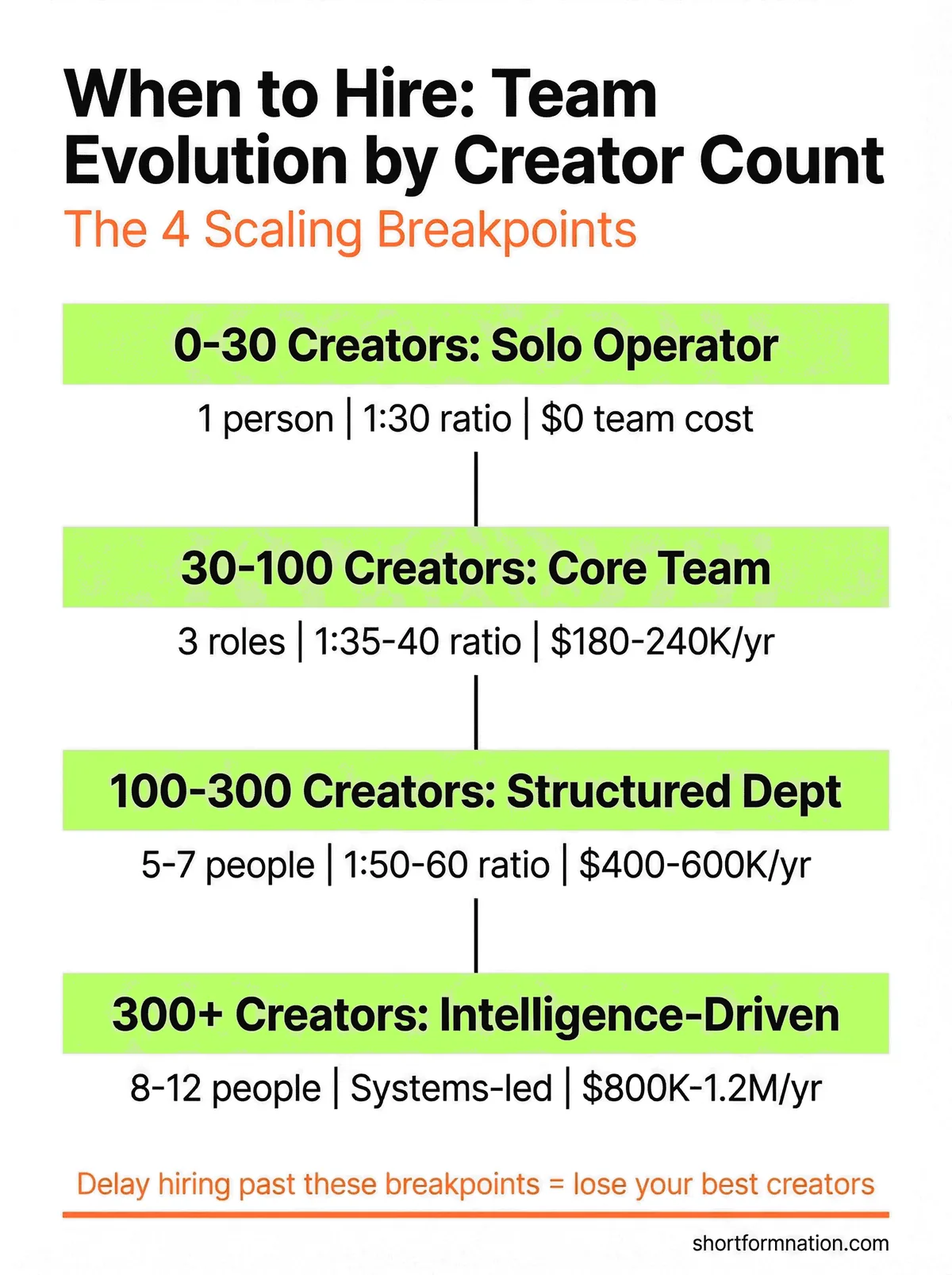
0-30 creators: Solo Operator. One person does everything — recruitment, briefs, comms, performance tracking, payments. Works because relationships are personal and volume is manageable. Manager-to-creator ratio: 1:30 max. The trap: staying in this mode past 30.
30-100 creators: Core Team. Three roles emerge. A Creator Relations Manager owns recruitment, onboarding, and communication. A Content Strategist owns briefs, angle development, and quality review. An Ops Coordinator handles payments, sampling logistics, and reporting. Ratio: 1:35-40 per function. Loaded cost for this team: $180K-$240K/year (Glassdoor, 2025 salary data).
100-300 creators: Structured Department. Add a Program Manager to orchestrate across the three core functions. Add a Data Analyst for per-creator profitability dashboards. Add a second Content Strategist — one person can't produce differentiated angles for 100+ creators. Total: 5-7 people. Ratio: 1:50-60 with automation.
300+ creators: Intelligence-Driven Operation. Manual processes are done. The team shifts from doing work to managing systems that do work. Leadership layer, specialist functions, data/analytics. 8-12 people. The critical shift: every role spends 60%+ of time on strategy and exception handling, not execution. Execution is automated.
Programs that delay hiring past these breakpoints don't save money — they lose their best creators. Response time is the #1 predictor of creator retention, and it degrades exponentially past the 1:40 manager-to-creator ratio (Aspire, 2025 platform analysis).
Hiring buys time. It doesn't solve the problem. That's where Layer 2 comes in.
Layer 2: Automation Triggers
Not everything should be automated immediately. Premature automation creates rigid systems that kill the creator relationships driving real performance. The key is knowing which workflows to automate when.
At 50 creators — automate brief distribution and angle matching. First breakpoint where manual processes visibly crack. Instead of writing individual briefs, build templated briefs by creator tier with dynamic angle insertion. The tiered brief framework should already be in place — now it needs to run without someone manually assigning every angle to every creator.
At 100 creators — automate performance monitoring and compliance alerts. You cannot manually audit 100 creators' output. Build dashboards that flag coherence drift, engagement anomalies, and compliance violations. The Three-Layer Metrics Framework — foundational, conversion, and financial metrics — should be tracking automatically at this point.
At 250 creators — automate content calendars and creator tiering. Content velocity at this volume is enormous. 150 micros at 1-2 posts/month = 150-300 pieces of content monthly. Calendars, SKU rotations, seasonal shifts, and tier reassignments all need systematic workflows. Manual tiering at 250 creators means decisions happen quarterly. On TikTok Shop, quarterly is irrelevant.
At 500+ — full workflow orchestration. Brief generation, distribution, tracking, tiering, payments, compliance, and comms all run as interconnected systems. The team manages exceptions and strategy. The system handles execution.
The data backs this up. Brands that automate brief distribution by the 50-creator mark retain 23% more creators through the 100-creator threshold (HypeAuditor, 2025 program analysis). Simple reason: automated distribution = faster briefs = faster content cycles = faster payouts. Creators follow the money — and the speed.
Layer 3: Governance & Compliance
Scaling without governance is scaling toward a crisis. At 10 creators, a brand safety incident is a DM conversation. At 300, it's a PR problem.
Three domains:
Brand safety monitoring. Every creator's content screened for competitor mentions, prohibited claims (especially health, beauty, supplements), and off-brand messaging. At scale, this requires automated scanning — not manual review. The cost of one viral brand safety incident dwarfs the investment in monitoring infrastructure.
Margin protection. As creator count grows, per-creator contribution margin gets harder to track. Build a payment model that scales: commission-only for nano/micro (variable cost, zero fixed exposure), hybrid for proven mid-tier, performance bonuses for top 10%. Review margins monthly by tier — not annually by program.
Content coherence standards. Define "on-brand" quantitatively, not qualitatively. A coherence score — measuring how closely output matches creative direction — gives you an objective quality metric at scale. Programs with coherence standards above 80% see 2.8x higher GMV per creator versus those with no measurement, across social commerce programs managing 100+ creators.
This brings us to the harder question: should you build all this yourself, or bring in outside help?
Agency vs In-House: The Real Math
The agency vs in-house debate gets framed as philosophy. It's not. It's math — and the math shifts at different scales. Running this across a book of clients rather than one brand changes the unit of work entirely, and the operational side of that is covered in the agency operations guide.
The In-House Model
Full control. Institutional knowledge. Direct creator relationships. Also: fixed costs that don't flex when performance dips.
Real numbers at scale:
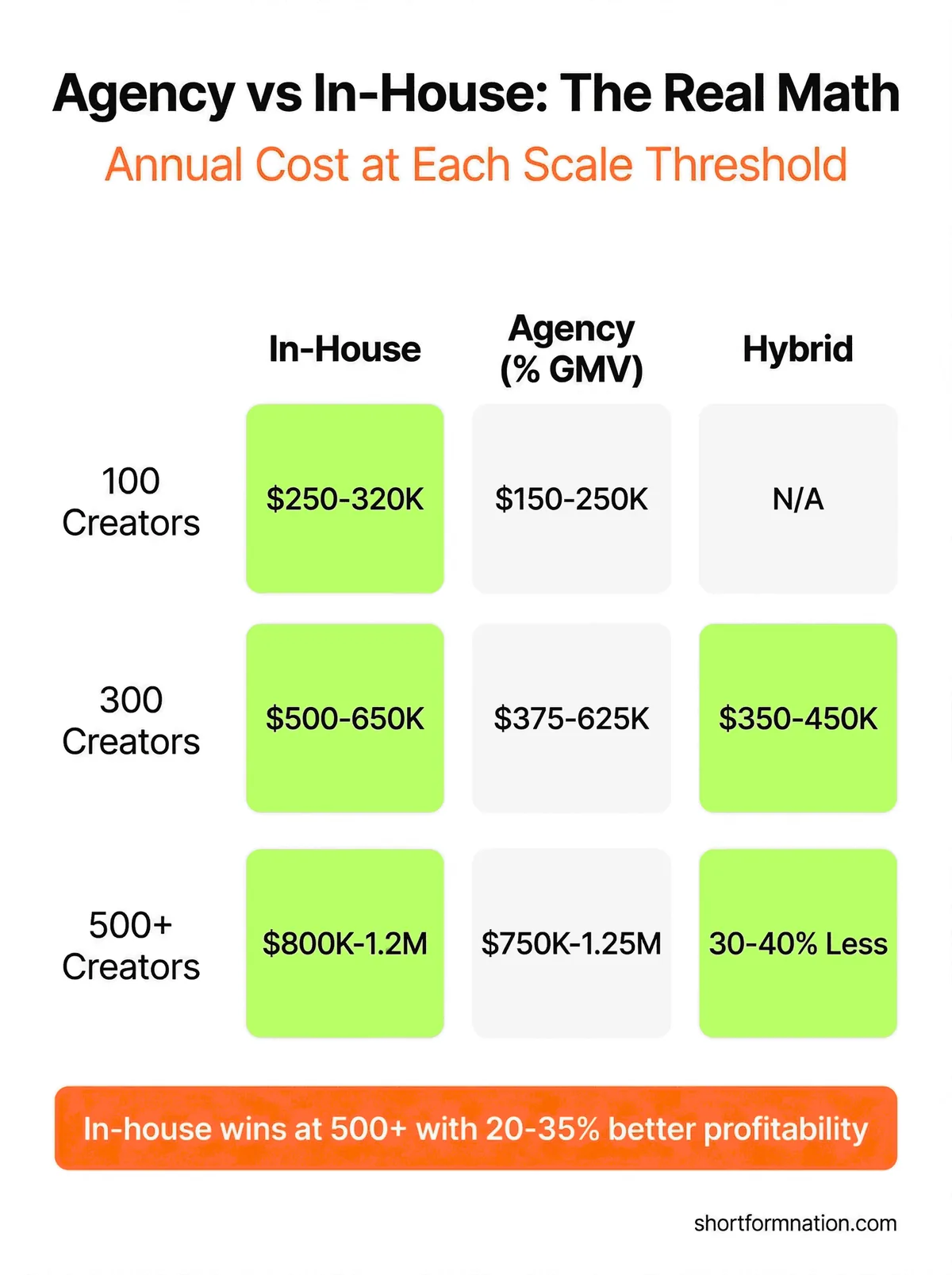
100 creators: 3-person team + tools + overhead = $250K-$320K/year. Sustainable if affiliate GMV hits $1M+ annually — program cost including team lands at roughly 25-30% of affiliate GMV.
300 creators: 6-person team + tools + overhead = $500K-$650K/year. Need $2.5M+ in affiliate GMV to justify it.
500+ creators: Full department = $800K-$1.2M/year. Only works at $5M+ affiliate GMV. But at this scale, in-house delivers 20-35% better per-creator profitability versus agency management (Forrester, 2025 Digital Commerce Ops Report). Why? Institutional knowledge compounds. Your team knows which creator profiles convert for your products. An agency's team manages 15 brands simultaneously.
The Agency Model
Speed and expertise without fixed headcount. Three pricing models:
Percentage of GMV (most common): 15-25% of affiliate-driven GMV. At $1M, that's $150K-$250K — comparable to in-house with zero ramp time. At $5M, it's $750K-$1.25M — significantly more expensive than in-house.
Retainer + performance: $5K-$25K/month plus 5-10% of GMV. Better alignment, but base costs stack.
Flat retainer: $10K-$50K/month. Predictable but no performance incentive.
The hidden cost most brands miss: knowledge leakage. When an agency manages your creator relationships, they own those relationships. Switch agencies or bring things in-house later, you start from zero on relationship equity. 41% of brands that used agencies wished they'd built in-house relationships earlier (Linqia, 2025 State of Influencer Marketing).
The Hybrid Playbook
The smartest operators don't choose. They split. Intelligence and strategy in-house. Execution and volume outsourced.
Keep in-house: Creator intelligence and tiering. Content strategy and angles. Performance analytics. Brand safety standards. T1 creator relationships — your top creators should know your team by name.
Outsource: High-volume recruitment and outreach. Nano/micro management (T3 tier — high volume, lower touch). Sampling logistics. Content calendar execution.
This hybrid model costs 30-40% less than full agency at 300+ creators while keeping the institutional knowledge edge. The agency handles volume work that doesn't need deep brand context. Your team handles intelligence work where specific product knowledge creates an unfair advantage.
The principle: outsource what's commoditizable. Keep what's strategic.
Creator Retention: The Hidden Scaling Lever
Every scaling conversation focuses on acquisition. Finding more creators. Recruiting faster. Onboarding at volume.
Almost nobody talks about the lever that actually determines whether scaling works: retention.
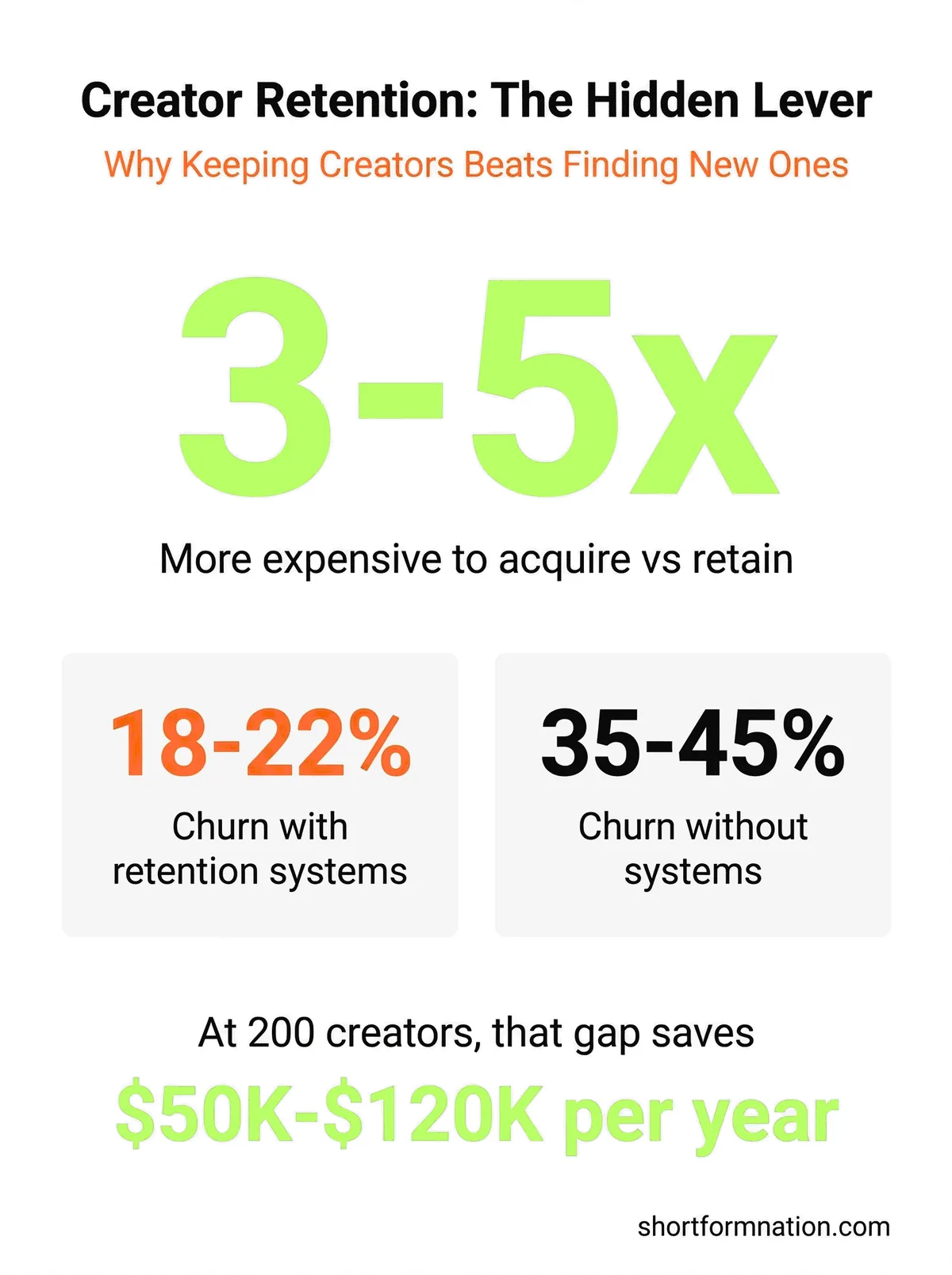
The economics are brutal. Acquiring a new TikTok Shop affiliate costs 3-5x more than retaining an existing one when you factor in sourcing, outreach, samples, onboarding, and the 60-90 day ramp to full content velocity (Aspire, 2025 Creator Economy Report). A program with 30% annual churn is spending 40%+ of its operational budget just treading water.
Retention at scale requires systems, not vibes. Four specific ones:
Transparent performance data. Creators want to know what's working. Programs sharing per-video performance data within 48 hours see 28% higher creator satisfaction versus monthly summaries (CreatorIQ, 2025 benchmark). Show them the numbers. Fast.
Tiered incentive escalation. Flat commission structures don't reward growth. Build escalating tiers: 10% base → 15% at $5K monthly GMV → 20% at $15K → 25%+ for T1. Each tier bump is a retention lock — creators don't want to leave and restart at base rate.
Exclusive access. Top creators get first access to launches, higher sample allowances, direct comms with your brand team. Costs almost nothing. Creates a status hierarchy that drives both retention and performance.
Proactive communication cadence. The #1 reason creators churn isn't money — it's silence. Welcome sequence at onboarding, performance check-in at day 14, monthly touchpoint, quarterly review. Prevent the drift that leads to ghosting.
Structured retention programs at 200+ creators report 18-22% annual churn versus 35-45% without (Influencer Marketing Hub, 2025 benchmark). At 200 creators, that gap = 26-46 fewer replacements annually — saving $50K-$120K in acquisition and ramp costs.
Retention isn't a nice-to-have. It's compound interest for affiliate programs.
What Breaks at Each Phase Gate
Scaling isn't linear. It's a series of phase gates — thresholds where specific systems fail unless you've already built the fix.
At 50 creators: Brief quality collapses. One content strategist can't produce differentiated direction for 50 creators. Output converges. Angles get recycled. Fix: tiered brief templates with automated distribution — reference the brief framework instead of rebuilding it.
At 100 creators: Performance visibility disappears. Spreadsheets can't track per-creator profitability at this volume. You're flying blind. Fix: automated analytics infrastructure with contribution margin tracking per creator.
At 300 creators: Brand safety incidents spike. Probability math: 1% of content has compliance issues × 300 creators × 2 posts/month = 6 incidents monthly. One every 5 days. Without automated monitoring, most go undetected until they surface organically. Fix: automated content screening and real-time alerts.
At 500+ creators: Margin visibility becomes survival. You're spending $800K+ on operations. You need per-creator, per-SKU, per-campaign margin data to know if the program is actually profitable — not just generating top-line GMV. Fix: financial analytics with blended ROAS and contribution margin dashboards.
Each breakpoint is predictable. That's the good news. The brands that fail don't hit some unexpected wall — everyone hits these walls. They fail because they try to solve a 300-creator problem with 50-creator infrastructure.
Tools like SFN AI's TikTok Shop intelligence platform are built for exactly this progression — Creator Intelligence automates profiling and tiering that manual processes can't handle past 50 creators, while Coherence Scoring keeps content quality visible at scale. But whether you use SFN AI, build internal tooling, or run the hybrid playbook above, the infrastructure layers are non-negotiable.
The point isn't which tool you pick. It's that you build systematically before the breakpoints arrive. For a comprehensive comparison of every TikTok Shop tool by category, pricing, and data source, see: Best TikTok Shop Tools for Brands in 2026: The Definitive Guide.
Build the Infrastructure Before You Need It
Scaling a TikTok Shop affiliate program is an operations problem disguised as a recruitment problem. The brands winning at 500 creators aren't better at finding creators — they're better at building systems that make 500 manageable, profitable, and aligned.
Start with the Scaling Architecture Framework: team evolution, automation triggers, governance. Build each layer one threshold ahead. At 30 creators, build for 100. At 100, build for 300. Infrastructure should arrive before the crisis.
And remember: retention is the multiplier. Every creator you keep is one you don't have to find, pitch, onboard, sample, and ramp again. The complete TikTok Shop affiliate marketing guide covers strategy from commission structures through campaign setup — this scaling playbook is the operational layer that turns strategy into a sustainable program.
SFN AI helps brands operationalize this at scale — automated creator profiling and angle matching through Automatic Distribution, real-time performance monitoring via Focus Feed, and coherence measurement that keeps 500 creators aligned without manual audits. See how it works or build the infrastructure manually using the framework above. Either way, build it before you need it.
Last updated: March 2026
Founder of SFN AI. We watch TikTok Shop 24/7 so creators and the brands that run them get the playbook.