Social Commerce Trends 2026: What's Actually Working on TikTok Shop and What's Not
US social commerce crosses $100B in 2026. Data-backed breakdown of what's converting on TikTok Shop... and what top sellers are doing differently.

The $100B Moment — Why Social Commerce Just Changed
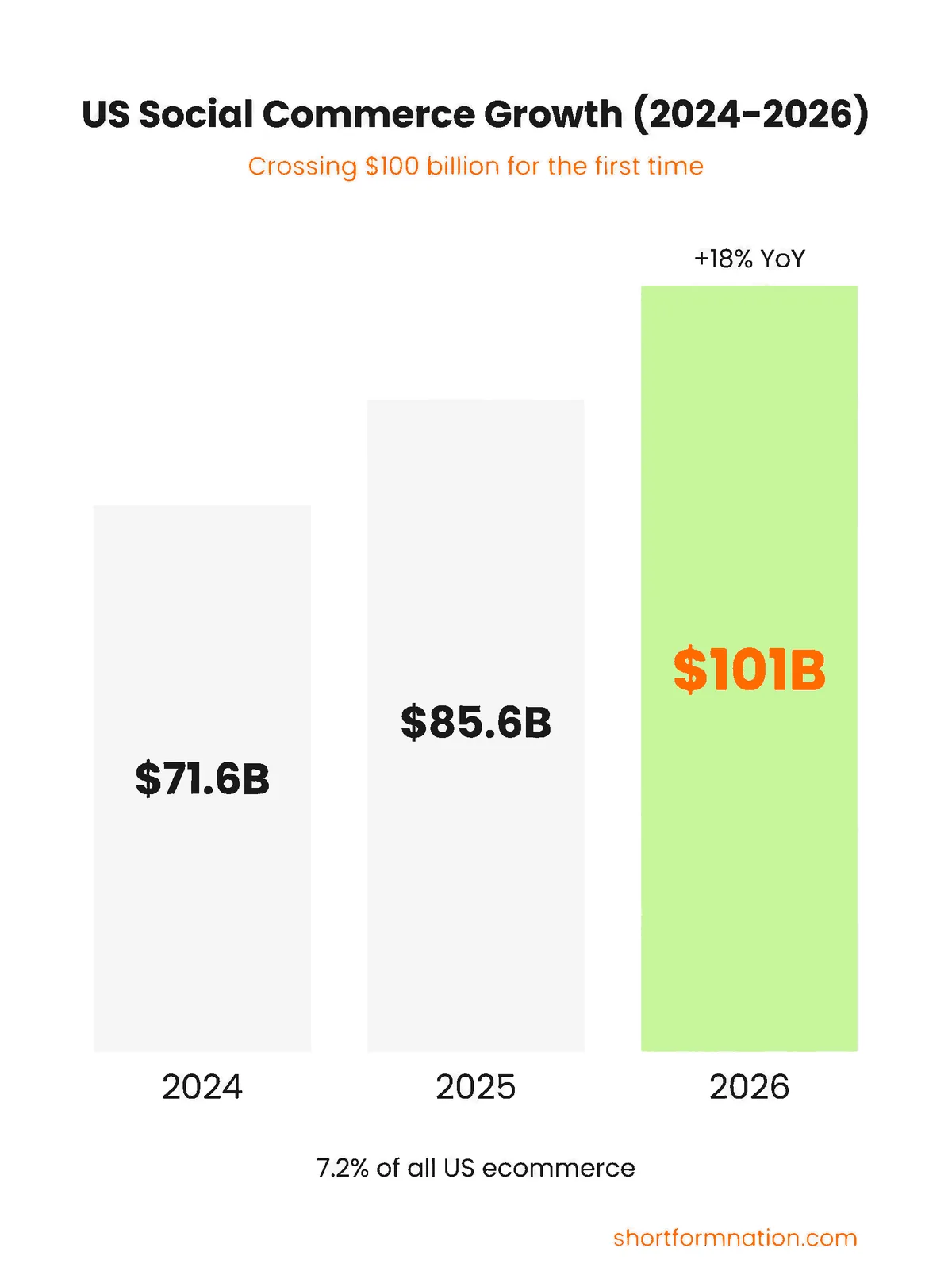
US social commerce just crossed $100B. That's not incremental growth anymore — that's inflection.
Here's what that number actually means: TikTok Shop alone hit $23.4B in US sales in 2026. For scale, Target does $100B globally. Costco does $280B. Best Buy does $40B. TikTok Shop is now bigger than Best Buy's entire US revenue — in a single ecommerce channel, on a single platform, in one country.
But here's the real stat that matters: 82% of sellers on TikTok Shop are losing money.
The gap between who wins and who bleeds isn't budget. It's not product. It's not luck. It's intelligence — knowing which content moves margin, which creators actually drive revenue, which operational systems prevent you from eating samples and margins until you fold.
This article breaks down what actually converts in social commerce in 2026. Not trends for trend's sake. Not what's viral. What's building real GMV, what's destroying margins, and what the second-half market looks like for sellers who want to compete.
The headline: US social commerce hit $100.99B in 2026 — up 48% YoY. TikTok Shop dominates at $23.4B US revenue ($87B globally), beating major retailers on US ecommerce GMV alone.
What's converting: Micro-creator volume beats celebrity deals. Live commerce is hitting 42% YoY growth. Daily-habit products crush viral gimmicks. AI-powered discovery is reshaping content velocity (250+ pieces/month minimum for competitiveness). Creator seeding, GMV Max optimization, and margin-first product selection separate winners from the 82% losing money.
What's not: Celebrity-first strategies are burning cash. Platform dependency without contingency means 40-80% sales drops during outages. Over-polished content loses to raw authenticity.
The framework: The Social Commerce Acceleration Framework — four pillars: Creator Seeding & Validation, GMV Max Optimization, Content Velocity & Creative Rotation, Margin-First Product Selection.
What matters next: AI infrastructure is rewriting competitive advantage. Multi-platform hedging is now mandatory. Intelligence = the difference between scaling and folding.
The $100 Billion Inflection Point — Why 2026 Changes Everything
US social commerce reached $100.99B in 2026, up 48% year-over-year according to eMarketer. That's not margin-of-error growth. That's the moment the channel stops being "experimental" and becomes mandatory infrastructure.
TikTok Shop represents the lion's share of that growth. The platform hit $23.4B in US sales alone in 2026, according to eMarketer, with $87B globally. To put that in competitive context: TikTok Shop's US revenue ($23.4B) now equals roughly 15% of Target's global revenue and 27% of Best Buy's entire US ecommerce business. In 2025, it was smaller than both. In 2026, the inflection happened.
The growth rate compounds the story. TikTok Shop achieved 68% YoY growth according to Marketplace Pulse, meaning the platform is doubling faster than the broader social commerce market (48% YoY). At that velocity, the gap between early movers and late entrants doesn't narrow — it accelerates.
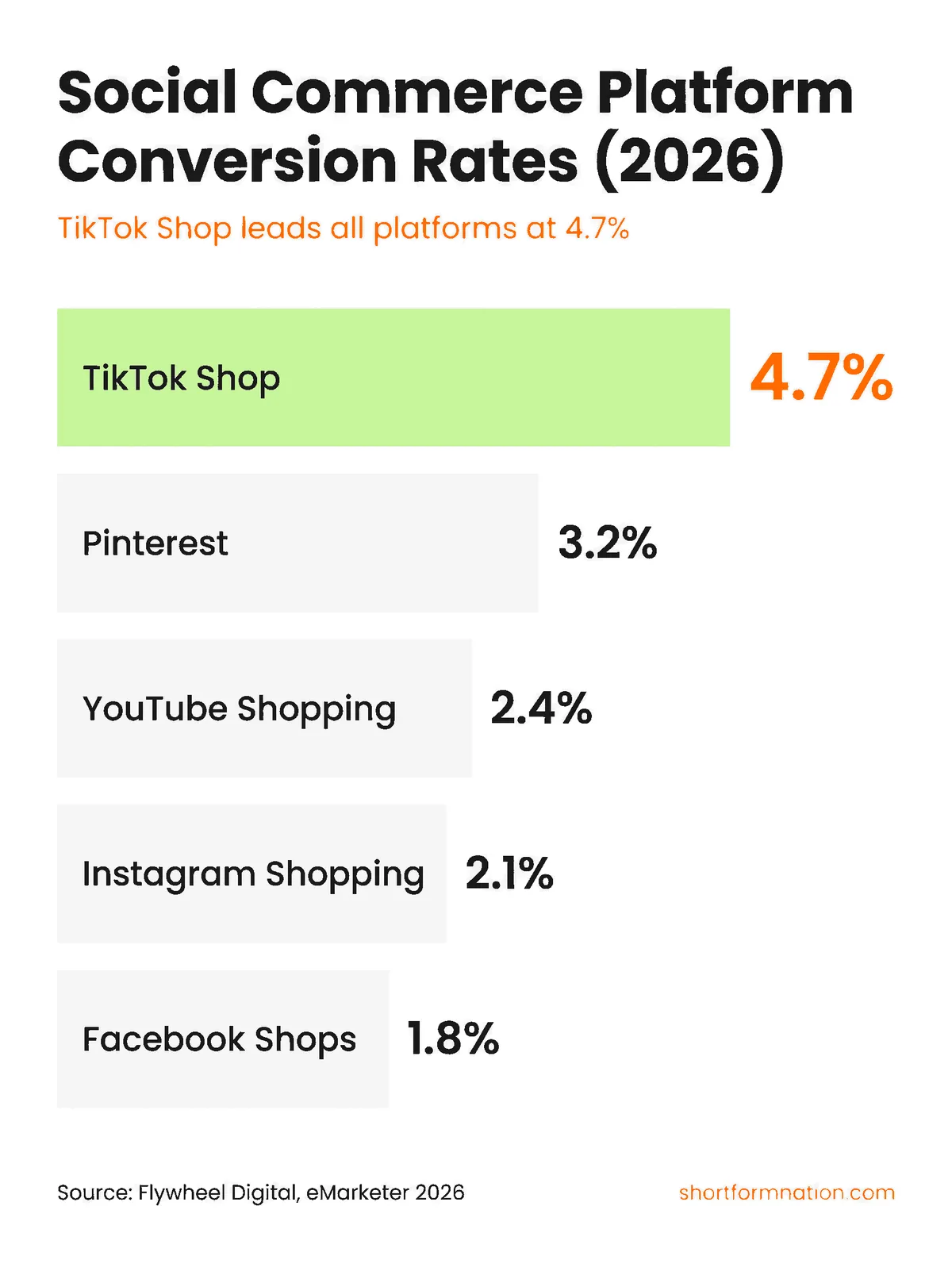
Here's the conversion reality: TikTok Shop converts at 4.7%, according to Flywheel Digital. Instagram Shopping converts at 2.1%, per Dash Social. Facebook Shops: 1.8%, per eMarketer. That 4.7% number isn't just better — it's 2.2x Instagram and 2.6x Facebook. Conversion doesn't scale linearly with traffic. It scales with platform fit.
The buyer base matters too. There are 114M US social commerce buyers, according to Blogging Wizard and eMarketer. That's 34% of the US adult population. Nine years ago, social commerce didn't exist as a category. Today, one in three Americans has bought something through a social feed — turning social shopping from novelty to normalized behavior.
| Platform | US Conversion Rate | YoY Growth |
|---|---|---|
| TikTok Shop | 4.7% | 68% |
| Instagram Shopping | 2.1% | 22% |
| Facebook Shops | 1.8% | 15% |
| Pinterest Buyable Pins | 3.2% | 28% |
So what? The inflection isn't about market size anymore. It's about competitive intensity. Every percentage point of conversion rate difference now represents millions in GMV advantage. Every quarter of delay means your competitors are shipping faster, learning quicker, and building margin while you're still building infrastructure.
5 Social Commerce Trends That Are Actually Converting in 2026
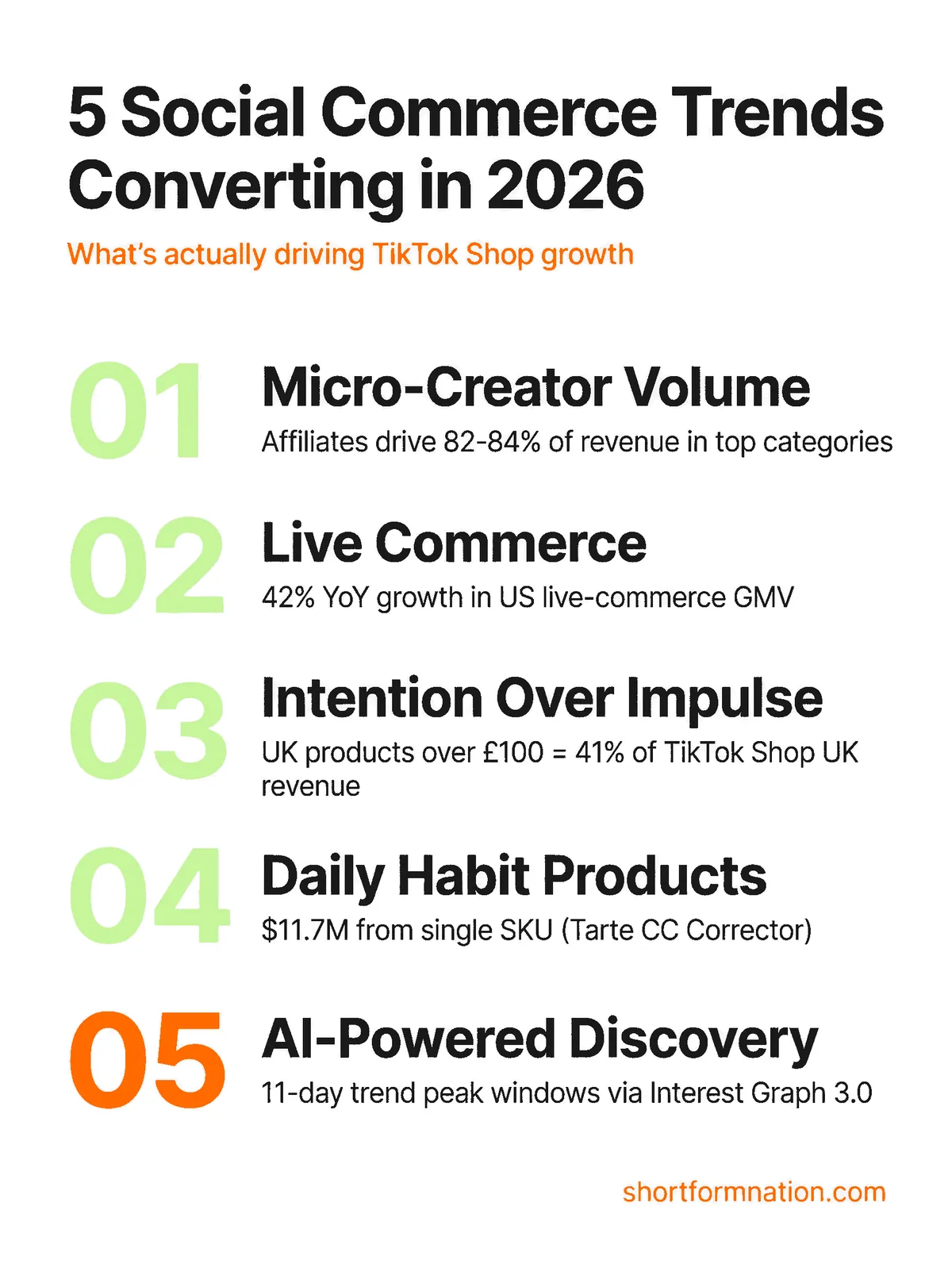
Trend 1: Micro-Creator Volume Beats Celebrity Partnerships
Every brand's first instinct: hire the mega-creator. Spend $50K-$200K on a 500K-2M follower account. Expect viral returns. Get 2-5% conversion on sales.
That's not how it works anymore.
Nano-influencers (10K-100K followers) average 10.3% engagement rates, per Collabstr. Mega-creators (1M+) average 1-2%. The gap isn't negligible — it's the difference between a profitable affiliate and a costly brand sponsorship. (For the full playbook on finding and recruiting TikTok Shop creators at scale, see our recruitment guide.)
Here's the revenue side: affiliates drive 82-84% of revenue on TikTok Shop according to Brennan Tobin (OddDuck Marketing Group). When you flip from paid sponsorships to affiliate seeding, you flip the risk equation. You only pay when the creator converts. You don't pay for reach or impressions.
OddDuck ran this play with a DTC brand. Six organic posts across their seeded creator network. $100K monthly revenue in 60 days. No paid media. No influencer budgets. Just systematic seeding to a network of 500+ nano-creators at 10K-50K followers each.
Tarte Cosmetics went deeper. They built a 6,600-creator affiliate network that produced 23,000 videos in one quarter, generating $45M GMV according to Ashley Wright (Social Tale). One single creator with 50K followers drove $1M+ revenue. Not all 6,600 performed. But the ones that did, converted hard.
The pattern is repeatable: high-volume nano-creator seeding + affiliate-first commission models beats celebrity sponsorships 2:1 on ROI.
The implication: If you're still budgeting for mega-creator deals, you're leaving 60-70% of your affiliate revenue on the table.
Trend 2: Live Commerce Hits Mainstream (Finally)
Live commerce was the "next big thing" for five years. It finally arrived in 2026.
US live commerce grew 42% year-over-year in 2026. That's the growth rate of the entire social commerce market. But the ceiling is higher internationally. Douyin (Chinese TikTok) derives 80% of ecommerce revenue from live according to industry data. TikTok US live commerce represents only 15% of platform GMV — meaning there's roughly 5.3x expansion potential if US adoption catches up.
Here's a real number: Khairul Aming, a Malaysian creator, ran a live stream on TikTok Shop and generated RM2.3M (~$500K USD) in 12 hours, according to Ashley Wright. That's not a fluke. That's live commerce at scale.
Live separates itself from feed content in one critical way: urgency without manipulation. When you go live, you create authentic time pressure. Viewers know the discount or inventory window is real. The creator's energy is real. The product questions get answered in real time. It's closer to in-person retail than any feed-based model can be.
The secondary effect: live commerce platforms are rolling out AI-powered talking heads, auto-translation, and real-time product recommendations. The human factor scales. A single creator can now reach 50K+ viewers in a single stream, and AI infrastructure means your brand can run 10-15 streams daily without human burnout.
The implication: Brands treating live commerce as optional are conceding 40%+ YoY growth to competitors who've already shipped their streaming infrastructure.
Trend 3: Intention Over Impulse (The "Why to Buy" Shift)
Gen Z doesn't want to be sold. They want to be educated.
81% of TikTok users say the platform shows real-life product usage, according to TikTok for Business. That's not aspirational content. That's functional content. "Here's how I use this product. Here's why it works. Here's what happens if you don't."
Gen Z discovers 73% of new products via social media. But discovery doesn't mean impulse. Discovery means research. They're using your content as a product research tool before they buy. The impulse phase already happened — on your competitor's platform, three weeks ago.
This reshapes content commerce strategy entirely. You're no longer competing for "shareability." You're competing for "usefulness." A video showing your supplement's exact dosage, how to stack it with other products, and the three-week window before you see results — that's shoppable content. It pulls harder than a 15-second aesthetic shot.
Daily-use product categories reflect this perfectly. Beauty products, nutritional supplements, skincare, kitchen equipment — categories where the customer needs to understand the product before committing — those are winning on social commerce. Novelty products, trend-based goods, single-use impulse purchases — those are struggling.
The creator who can explain product value in 60 seconds and prove it with their own results becomes your top affiliate. The creator optimizing for virality becomes background noise. (For how to brief creators effectively, see our guide to writing TikTok Shop affiliate briefs that creators actually use.)
The implication: If your creative briefs still emphasize "make it viral" over "explain what it does," you're losing to creators who know the actual conversion levers.
Trend 4: Daily Habit Products Beating Viral Gimmicks
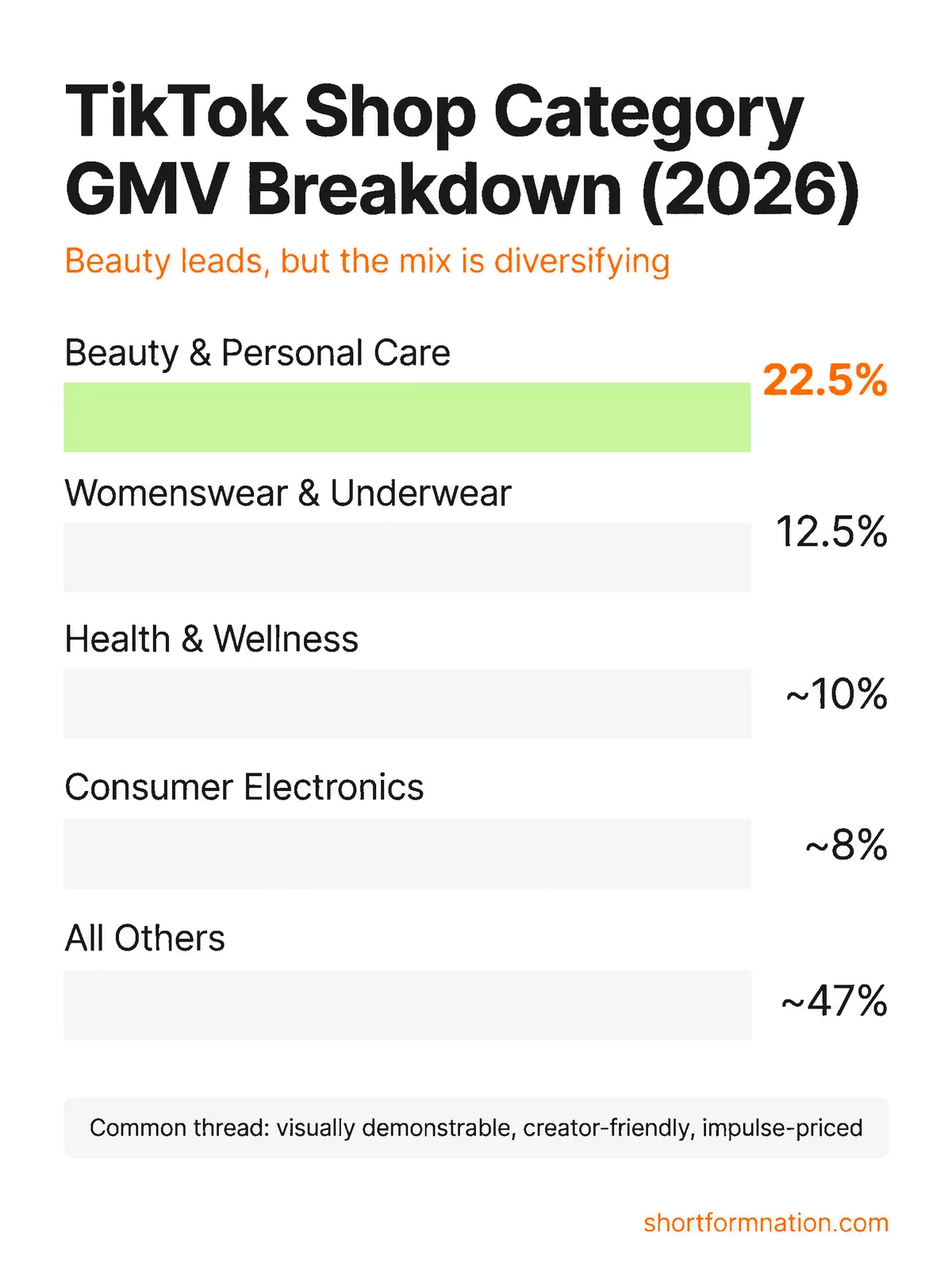
Beauty products represent 22.5% of total TikTok Shop GMV, per industry data. That's your largest category. Not novelty toys. Not dropshipping gadgets. Not trending TikTok challenges. Consumable products people buy repeatedly.
The sub-pattern: premium daily-use products are outperforming commodity goods. In the UK, products priced at £100+ represent 41% of total revenue, according to Ashley Wright. That's counterintuitive if you're still thinking "social commerce = impulse buys from price-sensitive Gen Z." It's not. It's research-driven, daily-habit, high-margin purchases from buyers who trust the creator.
Goli Nutrition is the #1 brand on TikTok Shop by GMV. They do $7.1M monthly revenue, moving 423.4K units of gummies. GuruNanda (oral care) hits $100K weekly revenue with 1.2M lifetime units sold. Foodology hit 378% YoY growth. None of these are viral one-hit wonders. They're all categories where the product is used daily or weekly, where the creator's recommendation carries real weight, and where margin is built into the price.
The creator playing this right: posting consistently about the same product, showing before-and-after results over weeks, building narrative around why the product fits their life. One top performer for a supplement brand was posting five videos per week, all angles on the same product category, for three months straight. Her conversion rate climbed from 2.1% to 9.7%. Her monthly affiliate revenue went from $12K to $94K.
Novelty content gets views. Habit-based content gets revenue.
The implication: If your product isn't bought repeatedly, you're fighting the platform's natural incentive structure.
Trend 5: AI-Powered Discovery Reshaping Content Strategy
TikTok's Interest Graph 3.0 (rolled out mid-2025, now standard in 2026) compresses trend lifecycles to 11-day peak windows with 79% predictive accuracy, according to SFN AI's data. That means by the time a trend is visible in mainstream TikTok, it's already on day five of its 11-day lifespan. You have roughly 6 days left to extract value before the algorithm rotates.
The operational implication: content velocity is no longer optional. You need 250+ pieces of content per month minimum to stay visible in the algorithm's rotation. That's 8-12 pieces per day across your creator network.
Creators posting five or more times weekly generate 3.2x higher GMV than those posting 1-2x weekly, per SFN AI's analysis. The frequency gap is now a revenue gap. The algorithm rewards velocity because velocity signals freshness. Fresh signals active, engaged creator communities. Active communities convert.
The coherence layer: when creators post at velocity, quality can fracture. SFN AI's data shows that creators maintaining 90%+ coherence (visual consistency, messaging consistency, product focus) across high-volume posting earn 6.9x higher per-post revenue than those posting at the same frequency with incoherent creative. Coherence isn't perfection. It's discipline. Same color palette. Same product angles. Same narrative thread across 10-15 videos posted in a week.
The meta-trend: AI content generation tools (CapCut, Synthesia, RunwayML) are becoming table stakes. Brands able to generate 250+ pieces monthly without 10-person creative teams are outpacing those still hand-editing individual videos. But—and this is critical—AI restrictions are coming mid-2026. TikTok's policies on "fully AI-generated" content are tightening. The winners are using AI as a production multiplier (editing, transitions, background generation) while keeping creator authenticity in the foreground.
The implication: If you're posting twice a week and expecting to rank, you're competing with creators doing 250+ monthly. The gap isn't closing.
The Social Commerce Acceleration Framework — How Top Sellers Build Systems
The difference between the 82% losing money and the 18% scaling profitably isn't intuition. It's systems.
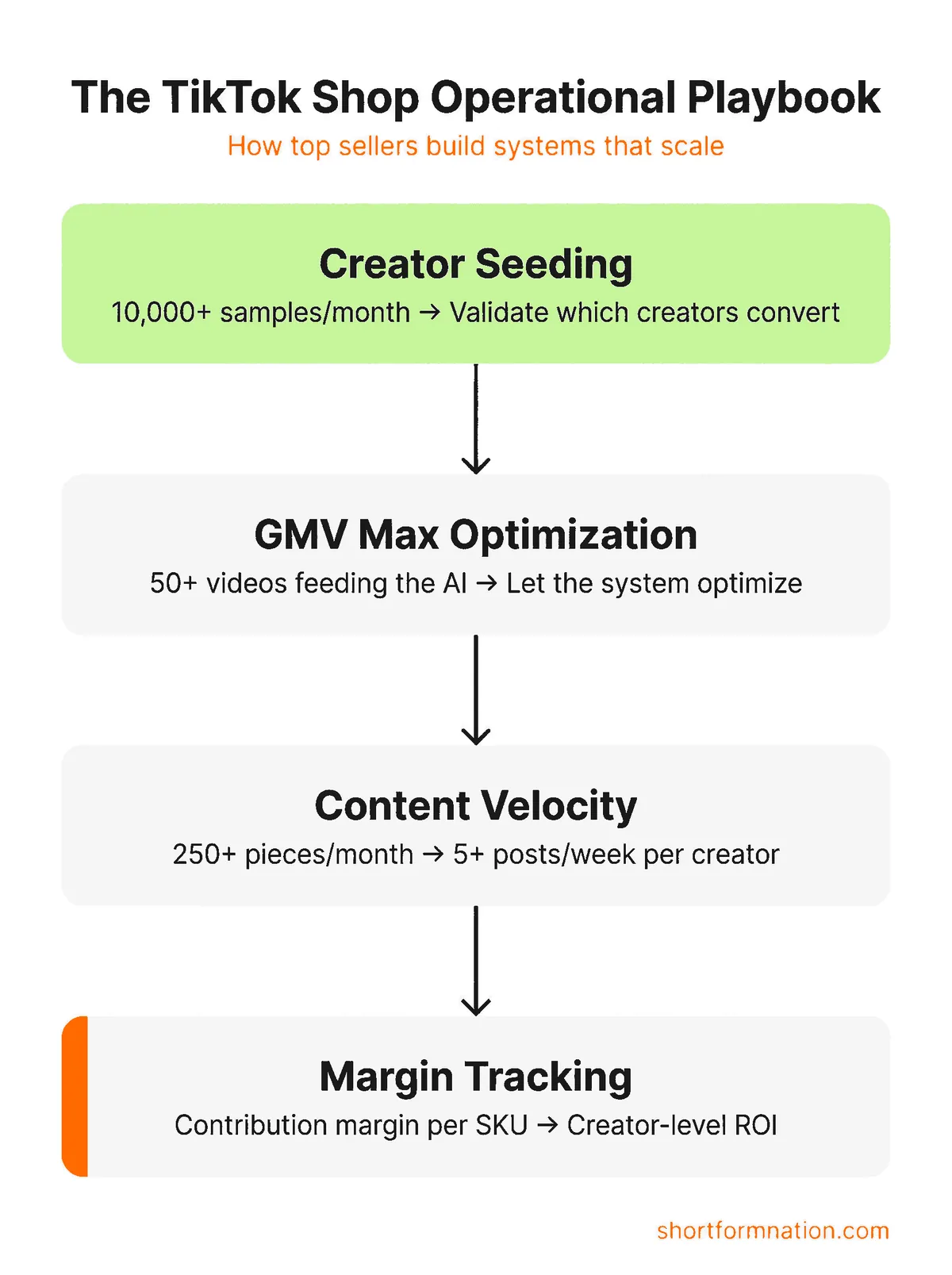
The Social Commerce Acceleration Framework breaks down into four pillars. Each pillar has a measurable standard. Each standard separates winners from the field.
Pillar 1: Creator Seeding and Validation
Before you pay commissions, you sample.
The benchmark: 10,000 product samples per month to your creator network. That's not frivolous. That's the throughput required to find the 50-100 creators (out of 500-1,000 seeded) who will become your revenue drivers.
Here's the cost equation one DTC founder learned the hard way: they cut their sample program from 10K/month to 4K to "optimize spend." GMV dropped to $45K within 60 days. They were spending $20K on samples to generate $180K GMV (9:1 ROI). They cut to $8K in samples and generated $45K GMV (5.6:1 ROI). Lower spend, lower revenue, lower total margin.
The seeding process is a funnel: - Month 1: Seed 500-1,000 nano-creators (10K-100K followers) with samples. Track who posts, when, and what content they create. - Month 2: Double down on the top 20% of posters. Increase sample rate. Introduce affiliate briefs. Measure conversion. - Month 3: Narrow to the top 50-100 by conversion. Move these to tiered commission models (higher commission for higher conversion, not equal pay).
The validation metric: conversion rate per creator. If a creator is generating 2-3% conversion with your product, they're working. If they're hitting 5%+, they're a tier-one affiliate. If they're below 1.5%, you stop seeding and redeploy budget.
This removes ego from creator selection. You don't pick creators you like. You pick creators whose audience converts your product.
Pillar 2: GMV Max Optimization
GMV Max is TikTok's smart promotion algorithm. It launched in Q4 2025 and was made broadly available in Q1 2026. If you're not using it, you're leaving margin on the table.
Here's what it does: you set a ROAS target (e.g., 5:1 — you want $5 revenue for every $1 spent). The algorithm automatically bids on impressions, audiences, and placements to hit that target while maximizing volume. (For a deeper breakdown of how to set up your TikTok Shop affiliate campaign end-to-end, see our campaign setup guide.) It removes the guesswork of manual CPA bidding.
The January 2026 Smart Promotion upgrade added a 3.5% platform fee but included a 5x ROI guarantee. That means if your promoted content doesn't hit 5x, TikTok credits back the difference. That's a floor. You now bid with risk removal.
The operational standard: every product should run through GMV Max if its margin supports the 3.5% fee (anything above 8-10% margin comfortably clears this). Brands running GMV Max are seeing 20-40% volume increases over manual bidding while hitting the same or better ROAS targets.
The second-order play: layer GMV Max on top of your highest-conversion creators. Take OddDuck's 100K monthly from six organic posts. Now seed 50 similar creators, get 20 who hit 4%+ conversion, run their top videos through GMV Max at a 5:1 target. Multiply the baseline by 8-12x by amplifying what's already working. (For how to track what's actually converting, see our analytics guide.)
Pillar 3: Content Velocity and Creative Rotation
You need 250+ pieces per month. This isn't about hiring more creators. It's about systematic content production.
The velocity breakdown: - 50 pieces/month: Brand team (in-house creative, founder content, product shots). This is your baseline. It's not enough to rank. - 100 pieces/month: Seeded nano-creator network (if you have 30-40 active nano-creators posting 2-3x weekly). This is your core volume. - 100+ pieces/month: Affiliate creators at higher frequency tiers. The ones hitting 5%+ conversion get paid monthly retainers to post 5+ times weekly.
That 250+ number sounds massive until you measure it against the January 2026 outage fallout. When TikTok went down for 12+ hours, sellers saw 40-80% sales drops within 24 hours, +20% CPA on paid media (creators dried up), and +60% CPM across paid channels as everyone scrambled for ad volume. Brands with 250+/month content libraries could pivot to Instagram, TikTok Shops (web-based backup), and email marketing instantly. Brands with 40/month died. (For how to scale your affiliate program without losing margins, see our scaling guide.)
Content rotation prevents creator fatigue and viewer fatigue simultaneously. If creator A is posting product X every day, conversion drops week two. If you rotate through 8 creators showing different angles of product X, the content feels fresh, the algorithm keeps pushing, and the viewer isn't burnt out on the product.
The coherence standard: 90%+ coherence across all 250+ pieces. Same color palette (stick to 3-4 brand colors). Same product focus (each piece centers on one product benefit). Same narrative arc (problem → product → result). High-volume content fails when it's visually incoherent or message-scattered. Coherence is the glue that makes velocity work.
Pillar 4: Margin-First Product Selection
Not all products are created equal on social commerce.
The commission structure changed in January 2026. Europe moved from standard 5% commissions to 9%. True take rate (TikTok's fee + payment processing + operational overhead) is 30-45% depending on region and volume tier. You can't run low-margin products through this and expect profitability.
The hero SKU principle: in the first 90 days of a campaign, 70% of revenue comes from a single SKU. You're not selling a broad catalog. You're identifying one hero product and driving it until saturation, then rotating to the next hero.
Real example: one DTC brand launched with eight SKUs. The first hero SKU generated $11.7M over 12 weeks. The remaining seven SKUs generated $2.3M combined. The 70/30 split was actually 83/17. They should have doubled down on hero SKU inventory and supply chain, not split resources across eight products.
The product selection framework: high-margin (40%+ gross margin), consumable (repeat purchase, not one-time), and category alignment (beauty, health/nutrition, home/kitchen — categories that dominate the top 22.5% of GMV).
The margin-first discipline: if a product doesn't gross 40%+ margin, it doesn't get seeded. If it doesn't fit a repeat-purchase model, it doesn't get seeded. Seeding, commissions, and fulfillment burn margin faster than most brands expect. A 35% margin product dies in social commerce. A 50% margin product thrives.
What's Not Working in Social Commerce Right Now
The flip side matters as much as what works.
Celebrity-First Strategies Are Burning Cash
Brands still think: hire a big creator, get big reach, get big sales.
That math never worked. A 1M-follower creator with 1.2% engagement reaches 12K people. If 2.1% (Instagram rate) convert, that's 252 sales. At $50 AOV, that's $12.6K revenue. If you paid the creator $25K, you lost money. The reach was never the constraint. The conversion rate was always the problem.
Celebrity strategies work when: (1) you're launching a new brand and need awareness, or (2) the celebrity's audience directly overlaps your ICP. Otherwise, you're paying for vanity metrics.
Micro-creator seeding is cheaper, faster, and more profitable. You pay $5-10 per sample to 500 creators (cost: $2.5-5K). The top 20 become your affiliates. You pay them $200-500/month in retainer plus affiliate commission. Your total program cost: $6-8K/month. If 50 affiliates are hitting $3K/month GMV each, that's $150K monthly revenue. The 82/18 split is affiliate upside.
Platform Dependency Without Contingency
January 2026 taught this lesson hard.
TikTok Shop went down for 12+ hours due to payment processing failures. Sellers lost 40-80% of projected daily revenue. CPA on paid media jumped 20% as affiliate creators couldn't produce new content. CPM across paid channels jumped 60% as every brand scrambled to maintain traffic through paid media.
The secondary issue: payment distrust. When buyers couldn't complete purchases, 61% experienced checkout abandonment, and many didn't retry for 48+ hours. The trust damage was real.
The contingency play: sell through multiple channels. TikTok Shop for reach. Shopify for margin control. Amazon for Prime legitimacy. Pinterest for older demographics. Instagram for engagement. Douyin for international expansion. A brand that only sells TikTok Shop is one outage away from collapse.
Multi-channel isn't complexity. It's insurance.
Over-Polished Content Losing to Raw Authenticity
Studio-produced content gets 2-3% conversion. UGC (user-generated content) and semi-pro creator content gets 4-7%.
The pattern: viewers trust creators who look like them more than they trust brands. A 50K-follower creator showing actual results with a product in their actual apartment beats a $10K studio shoot every time.
This is why nano-creator seeding works. The creative quality is lower. The trust is higher. The conversion more than compensates for the lower production value.
The counter-intuitive play: brief your creators poorly. Don't script their videos. Don't demand specific shots. Tell them the product and the commission and let them create. The best converting content is the content the creator authentically believes in.

The AI Infrastructure Nobody's Talking About
The competitive advantage in social commerce in H2 2026 is AI infrastructure, not creative talent.
TikTok's suite of creator tools — TikTok One (content planning), Smart+ (automation), F.I.R.S.T. Standard (brand safety), Pulse Suite (analytics) — are becoming mandatory for brands running 250+ monthly posts. Manual content planning at that velocity is impossible.
Separately, Amazon Rufus (AI shopping assistant) generated $12B in incremental ecommerce value in 2025 and is expanding to Instagram and TikTok Shop in 2026. That changes discovery. Buyers will ask Rufus for product recommendations instead of searching. Brands not optimized for AI-powered discovery will be deprioritized.
The second-order effect: AI content restrictions are tightening mid-2026. TikTok is cracking down on "fully AI-generated" videos without creator attribution. The policy isn't "AI is bad." It's "transparency is required." Use AI to scale production, but keep the creator face and voice human. Brands automating away the human element are getting caught in the algorithm's tightening policies.
The real play: AI as production multiplier. Use CapCut's AI transitions. Use Synthesia for B-roll. Use RunwayML for background generation. (For what's working and what gets you penalized, see our guide to AI-generated UGC for TikTok Shop.) Keep the creator doing the talking and the product demonstration. That blend — AI-assisted but human-led — is the 2026 standard for high-volume content.
Brands that can't automate production at scale will be priced out of the 250+/month velocity requirement. Brands using AI as a shortcut to remove creators entirely are getting deprioritized by the algorithm. The gap is the workflow, not the tool.
What This Means for Sellers in the Second Half of 2026
Three operating principles for the back half of 2026:
Platform risk is now operational risk. The January outage wasn't an anomaly. It was a signal. TikTok's infrastructure, policy changes, and algorithm shifts are your external variables. You can't control them. You can only hedge against them. Multi-channel distribution isn't optional. It's survival.
Intelligence is the new margin. The 18% of sellers scaling profitably aren't smarter. They're data-forward. They measure creator conversion. They rotate based on performance. They track coherence. They know their hero SKUs. They understand commission structures by region. Information advantage scales faster than product advantage.
Content velocity is the new competitive moat. You need 250+ pieces monthly. You need 90%+ coherence. You need 5+ creators posting weekly. This sounds like a lift until you build the system. Then it becomes inevitable. Brands still stuck at 40/month are already out.
One layer deeper: SFN AI's TikTok Shop intelligence platform helps you measure what's actually working across your creator network — conversion per creator, content coherence scores, discovery trends, and GMV forecasts. It's one way to solve the intelligence gap. Manual spreadsheets and TikTok's native analytics are another (slower, noisier) way. The point is: you need some system to measure what's working. The winners in H2 2026 have it. The losers don't.
The platform risk piece, though — the multi-channel hedging — you have to build that yourself. It's not a software problem. It's an operational discipline.
Social Commerce 2026: Frequently Asked Questions
How big is the social commerce market in 2026?
US social commerce hit $100.99B in 2026, up 48% YoY according to eMarketer. That's roughly 10% of total US ecommerce. Globally, social commerce is now larger than the entire US ecommerce market was five years ago.
What is the TikTok Shop conversion rate compared to other platforms?
TikTok Shop converts at 4.7% according to Flywheel Digital. Instagram Shopping: 2.1% (Dash Social). Facebook Shops: 1.8% (eMarketer). Pinterest Buyable Pins: 3.2%. TikTok's conversion advantage is structural — younger audience, native video, algorithm prioritization of commerce content.
What is GMV Max on TikTok Shop?
GMV Max is TikTok's smart promotion algorithm. You set a target ROAS (e.g., 5:1). The algorithm automatically bids to hit that target while maximizing volume. The January 2026 Smart Promotion update added a 3.5% platform fee and included a 5x ROI guarantee. If you don't hit 5x ROAS, TikTok credits the difference.
What categories sell best on TikTok Shop in 2026?
Beauty (22.5% of GMV), health/nutrition supplements, home/kitchen, and skincare dominate. The common thread: daily-use, consumable products where the creator's endorsement carries trust weight. Novelty products and low-margin commodity goods underperform. Premium products (£100+ in UK, for example) represent 41% of revenue — contrary to the "Gen Z buys cheap impulse products" stereotype.
Is TikTok Shop worth it for sellers in 2026?
Yes, if: (1) your product is high-margin (40%+ gross margin), (2) you can commit to creator seeding and sample investment (10K/month minimum), (3) you're willing to post 250+ pieces monthly across your creator network, and (4) you can build systems to measure conversion per creator and rotate based on performance. If you're planning to "try it with one creator" or "see if it works with organic posts," it won't. The winners treat it like a business system, not an experiment.
Founder of SFN AI. We watch TikTok Shop 24/7 so creators and the brands that run them get the playbook.