AI-Generated UGC for TikTok Shop: What Actually Works and What Gets You Demonetized (2026 Guide)
What TikTok Shop actually allows with AI-generated UGC. Platform rules, demonetization triggers, and the 70/30 human-AI framework for compliant content.

AI-generated UGC gets 350% higher engagement on TikTok than human-created content. That stat from Superscale's January 2026 study made every brand manager in the TikTok Shop ecosystem sit up and pay attention.
Then they read the fine print.
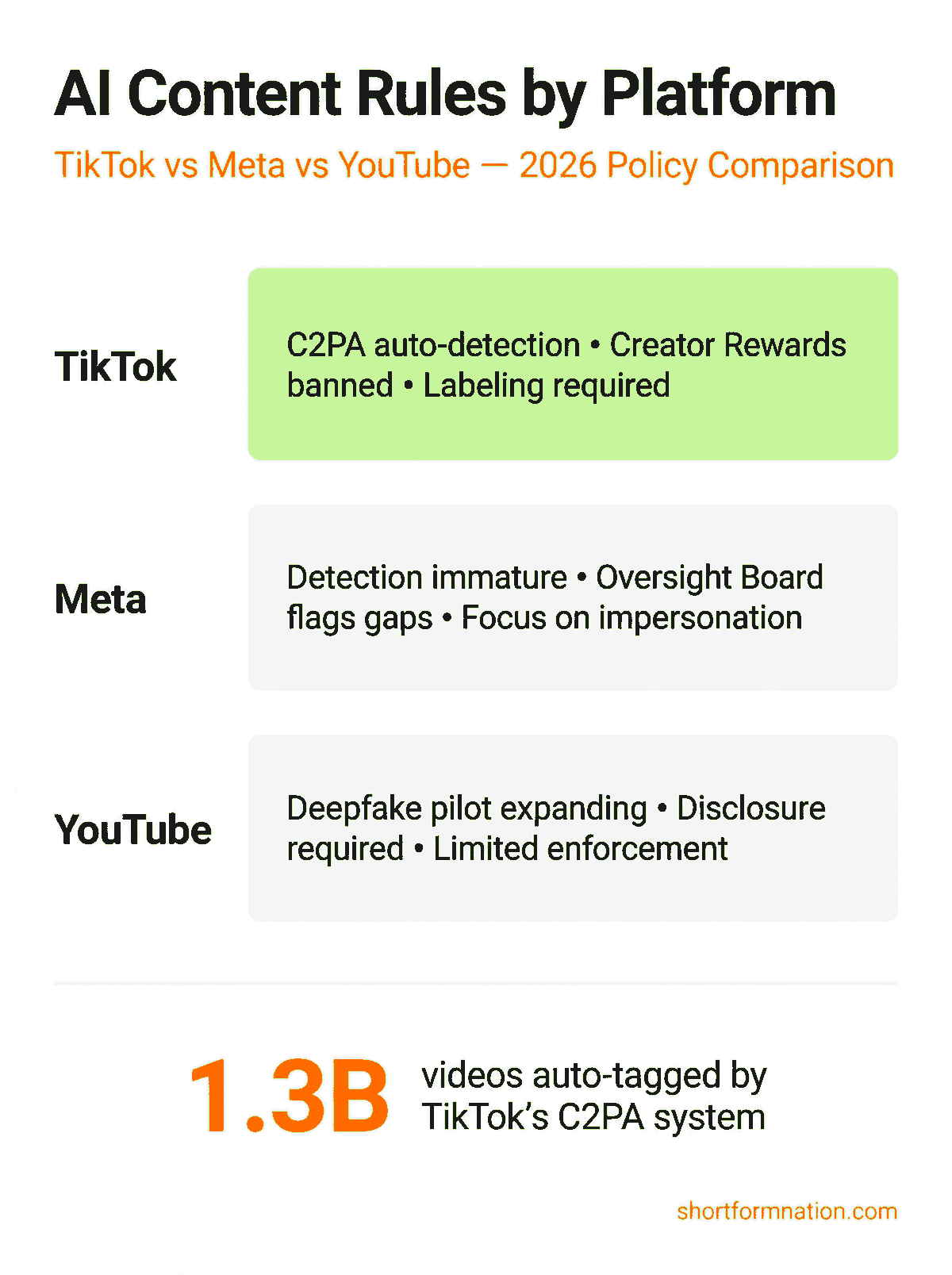
TikTok's Creator Rewards Program explicitly bans AI-generated content from monetization. The platform's C2PA Content Credentials system has auto-labeled over 1.3 billion videos. And enforcement actions against unlabeled AI content reportedly increased over 340% in 2025, according to platform transparency data.
So which is it — the future of TikTok Shop content, or the fastest way to tank your affiliate program?
The answer is both. And that paradox is exactly why most brands are deploying AI wrong on TikTok Shop right now. They're either going all-in on AI production (and watching their creators lose monetization access) or avoiding it entirely (and drowning in the content velocity war).
The smart play isn't obvious. It requires understanding exactly where TikTok draws the line, why that line exists, and how to build a content strategy that uses AI as an intelligence multiplier — not a creator replacement.
This guide breaks down the complete landscape: the policies that matter, the economics that work, and the playbook that lets you use AI without destroying the incentive structure that makes your affiliate program run.
TLDR: TikTok bans AI content from its Creator Rewards Program but doesn't explicitly block AI-generated affiliate content from earning Shop commissions. The catch: C2PA auto-detection labels all AI content, algorithmic suppression reduces distribution, and creators won't make content they can't monetize. Smart brands use AI for internal hook testing and creative R&D (30% of effort), then deploy winning patterns through human creators (70% of published content). The intelligence layer — knowing what to tell creators to make — matters more than the production tool.
The Content Velocity Problem Nobody Wants to Do the Math On
Competitive TikTok Shop programs need a minimum of 250 pieces of content per month. That's roughly 8-10 posts per day across your creator network. TikTok's own recommendation for individual accounts is 1-4 posts daily to maximize algorithmic distribution.
Now do the math on your creator roster.
If you have 25 creators each posting once per week, you're producing about 100 pieces per month — less than half the minimum. To hit 250, you'd need every creator posting 2-3 times per week, consistently, with quality that doesn't tank your shop score.
Most brands hit a wall between 50 and 100 creators. Without a clear TikTok Shop content strategy, the scaling problem compounds. The traditional management model caps out around 30-50 creators per manager. Beyond that, content reviews pile up, coaching calls get skipped, briefs get misinterpreted. You're not managing anymore — you're triaging.
And here's where it gets expensive. Product sampling — the fuel of affiliate programs — scales linearly with your creator count. Leading TikTok Shop agencies report that content-to-sample ratios should hit 15:1 (15 pieces of content per sample sent). Most brands run closer to 3:1. That means 80% of your samples are generating minimal content, and each unproductive sample is $15-50 in shipping and product cost that produced nothing.
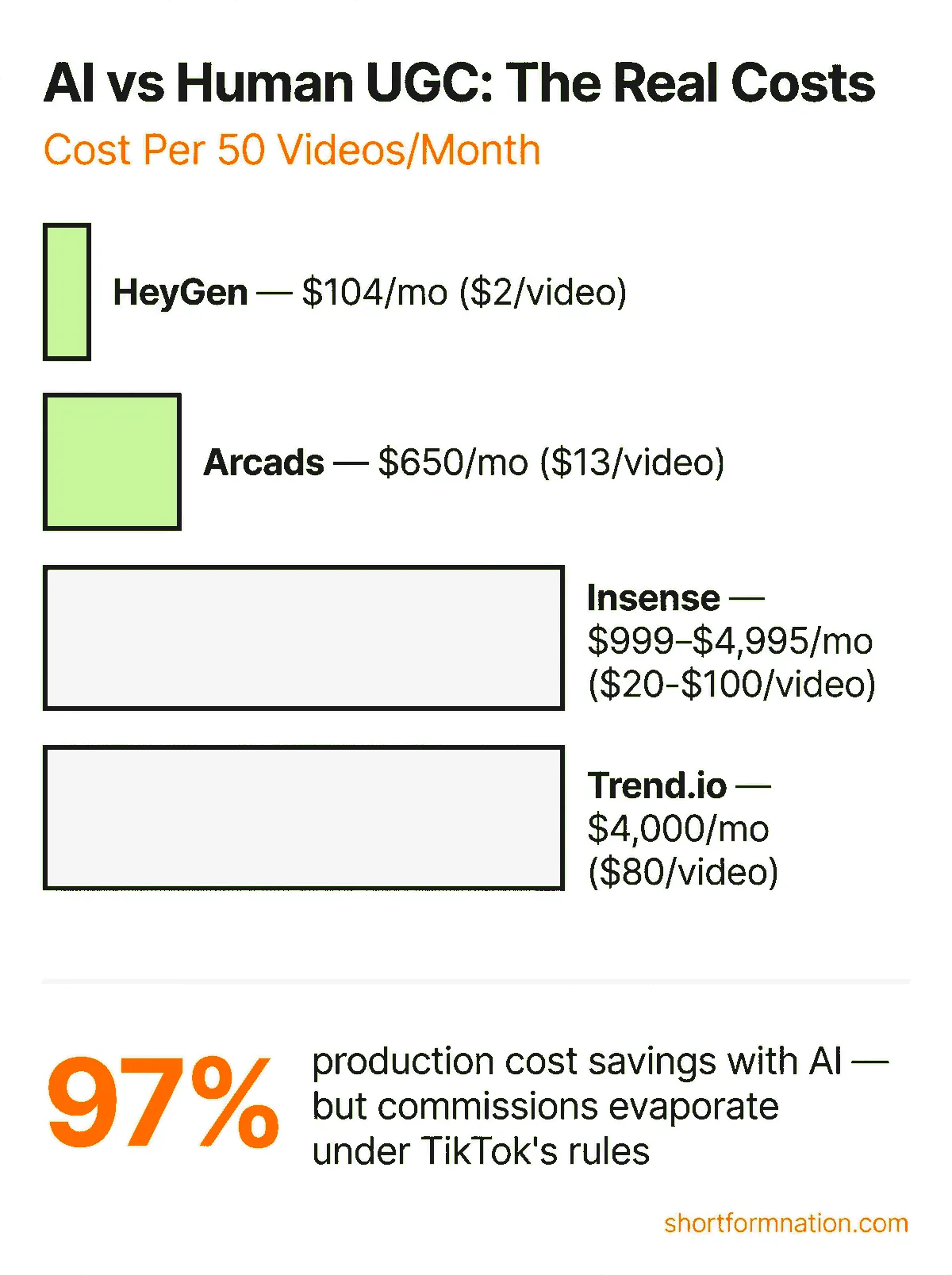
The math creates an obvious gravitational pull toward AI. If you could generate 50 videos per month through AI avatar tools at $104 (HeyGen's rate) instead of $4,000 through a UGC creator marketplace like Trend.io, you'd save 97% on production costs alone.
That's the pitch every AI UGC tool is making right now. And the pitch is correct — on the cost side. Where it falls apart is on the platform side. Because TikTok has opinions about AI content. Strong ones.

TikTok's AI Rules: What Actually Gets You Demonetized
TikTok's AI content policy isn't a single rule. It's a layered system with different consequences depending on which monetization channel you're using. Most brands conflate these layers and make bad decisions as a result. Here's how it actually works.
Creator Rewards Program: AI Is Banned
TikTok's Creator Rewards Program (the platform's direct payment system for views) explicitly excludes AI-generated content. Virtual influencers — accounts built entirely on AI-generated avatars (synthetic media personas) — cannot participate in Creator Rewards at all. This is a hard ban, not a gray area.
What this means for your affiliate program: if your creators rely on Creator Rewards as part of their income (and many do), AI-generated content directly cuts into their earnings beyond just your affiliate commissions. That's a disincentive you can't solve with a higher commission rate.
TikTok Shop Affiliate Commissions: Not Explicitly Banned — But Effectively Suppressed
Here's the nuance most content about AI UGC misses entirely. TikTok Shop affiliate commissions are paid by sellers, not by TikTok's Creator Rewards pool. TikTok's Content Policy requires labeling of AI content and bans anything "misleading about matters of public importance or harmful to individuals" — but it doesn't explicitly prohibit AI-generated videos from earning affiliate commissions.
So technically, a creator could post a properly labeled AI-generated product video, include a TikTok Shop product link, and earn the seller's commission on any resulting sales.
In practice, this breaks down for three reasons:
1. C2PA auto-detection eliminates deniability. TikTok's Content Credentials system, built on the C2PA metadata standard, has tagged 1.3 billion videos. It detects AI-generated content automatically — even when creators don't self-disclose. You cannot hide that a video is AI-generated.
2. Unlabeled AI content gets algorithmically suppressed. If C2PA detects AI markers and the creator hasn't labeled the content, TikTok suppresses its distribution. Fewer views mean fewer clicks, fewer clicks mean fewer sales, and fewer sales mean lower commissions. The penalty isn't account termination — it's economic irrelevance.
3. Labeled AI content gets reduced organic reach. Even properly labeled AI content appears to receive lower algorithmic priority in the For You feed compared to human-created content. TikTok's algorithm optimizes for authenticity signals, and the "AI-generated" label itself signals lower authenticity.
The result: an economic death spiral where AI content is technically allowed but practically unviable for affiliate commission generation.
The Penalty Escalation You Can't Afford
For creators who try to bypass the labeling requirements, TikTok's enforcement is aggressive and escalates fast:
- First offense: Content removal + strike
- Second offense: 7-day posting restriction
- Third offense: 30-day account restriction
- Fourth offense: Permanent monetization ban
- Fifth offense: Account termination
Enforcement actions against unlabeled AI content reportedly increased over 340% in 2025, according to platform transparency data. TikTok is not bluffing on this.
The Line That Matters: AI-Assisted vs AI-Generated
TikTok draws a critical distinction that creates real strategic opportunity:
- AI-generated visuals and audio (avatar videos, synthetic voiceovers, AI-generated product demos) → must be labeled, subject to suppression
- AI-assisted text (scripts, captions, shot lists, brief generation, editing assistance) → exempt from labeling, no distribution penalty
This distinction is the entire basis for a smart AI strategy on TikTok Shop. AI-generated videos face penalties. AI-generated intelligence that humans then execute does not.
That's the playbook.
The 70/30 Framework: Where AI Actually Wins
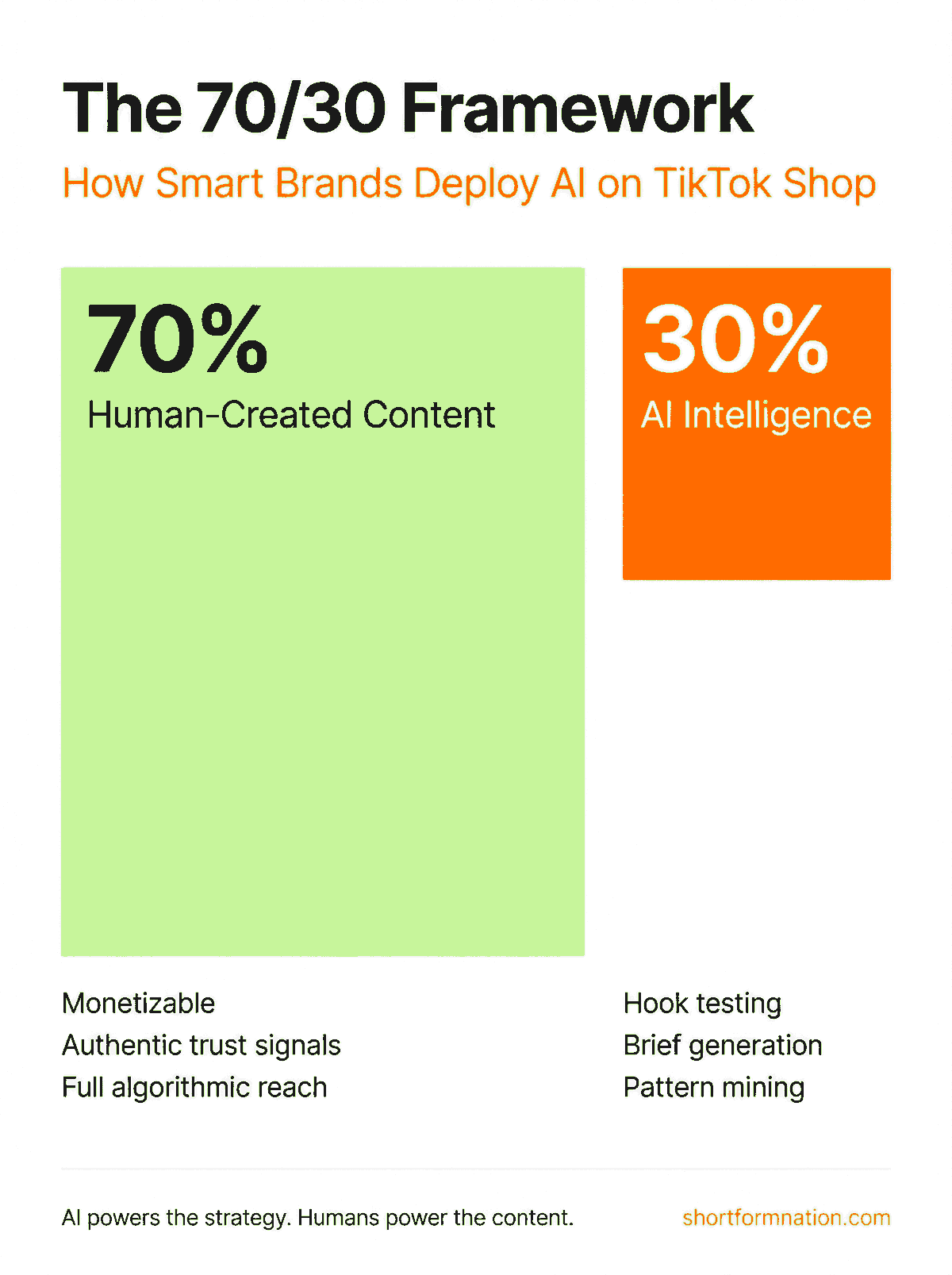
Leading TikTok Shop agencies have converged on a model that works within the platform's constraints. The split: 70% human-created published content (the monetizable, distributable, authentic stuff) and 30% AI-powered intelligence and testing (the R&D that makes the 70% perform better).
This isn't about replacing creators with AI. It's about making every human-created video smarter, faster, and more likely to convert.
The 30% AI Side: Intelligence, Not Production
Here's where AI creates massive value without ever appearing in a published TikTok:
Hook Testing at Scale. The biggest performance lever in TikTok Shop content is the hook — the first 1-3 seconds. AI tools can generate dozens of hook variations in hours. Brands run these through internal testing (paid Spark Ads with small budgets, focus groups, or A/B tests on other platforms) to identify which hooks land. The winning hooks then go to human creators for full production.
At $1.50-$15 per AI-generated test video, you can test 20 hook variations for the cost of one human-produced video. That's 20x the creative intelligence at the same budget.
Content Brief Intelligence. AI-assisted text is exempt from TikTok's labeling requirements. That means scripts, shot lists, talking points, and creative briefs can all be AI-generated and fed to human creators with zero platform risk. The creator executes with their face, their voice, their authenticity. The AI provided the strategic direction.
Pattern Mining and Angle Discovery. What's actually converting right now in your subniche? Manually reviewing hundreds of competitor videos is a full-time job. AI-powered intelligence tools can scan thousands of TikTok Shop videos daily, identify which content patterns drive sales, and extract those patterns into actionable frameworks — what SFN AI calls Angles.
This is where the intelligence layer transforms your program. Instead of guessing what content to make, your creators open their dashboard to find 2-3 fresh ideas backed by real GMV data — complete with hooks, shot lists, and proof videos showing the pattern in action.
Quality Validation Before Publishing. AI can score content against your brand brief before it goes live. SFN AI's Coherence Scoring analyzes every posted video against the content idea and brief, measuring how well the creator executed the intended angle. When a creator drifts off-script or misses key elements, the system flags it before the content accumulates views on a weak execution.
The 70% Human Side: What AI Can't Replace
Some things remain firmly in the human-creator domain — and will stay there for the foreseeable future:
Complex Product Demonstrations. Showing how a skincare product absorbs, how a kitchen tool operates under real conditions, or how a fashion item drapes — these require physical interaction with the product that AI can't convincingly simulate. TikTok Shop buyers want to see the actual product in action with a real person's real skin, real kitchen, real body.
Trust-Building Content. Consumer trust scores for human UGC sit at 81% versus 63% for AI-generated content. That 18-point gap is the difference between a viewer who clicks "Add to Cart" and one who scrolls past. For high-consideration purchases (anything over $30), trust is the conversion bottleneck.
Trend-Jacking and Cultural Moments. TikTok trends move in hours, not days. By the time you've prompted an AI tool, generated a video, and posted it, the trend has peaked. Human creators can film, edit, and post a trend-response in 20 minutes. Speed-to-culture is a human advantage AI can't match.
Authentic Testimonials and Reviews. The most persuasive TikTok Shop content is a real person genuinely reacting to a product. AI can fake the format, but TikTok's audience — particularly Gen Z, who according to consumer research influence 70% of purchase decisions through UGC — has developed sharp instincts for authenticity. The uncanny valley isn't just visual; it's emotional.
Building Your AI-Powered Content Pipeline
Here's the step-by-step for implementing AI in your TikTok Shop program without triggering platform penalties or destroying creator incentives.
Step 1: Separate Your Intelligence Stack from Your Production Stack
Your AI budget should flow into two categories:
Intelligence tools (no platform risk): Pattern mining, angle generation, brief writing, script drafting, coherence scoring, performance analytics. These tools generate insights that human creators execute. SFN AI's platform is purpose-built for this — watching thousands of TikTok Shop videos daily to identify what drives sales, then converting those patterns into personalized Content Ideas for each creator.
Testing tools (controlled risk): AI video generation for internal hook testing and creative R&D. These videos are NOT published to your affiliate creators' accounts. They're used for internal analysis, Spark Ads testing with small budgets, or cross-platform testing on Meta where AI rules differ.
Step 2: Build a Hook Testing Loop
The process that pays for itself:
- Use Pattern Mining to identify the top-performing content patterns in your category this week
- Generate 10-20 AI hook variations using those patterns (Arcads at ~$11/video, or HeyGen at ~$1.50/video)
- Run the top 5 hooks as Spark Ads with $50-100 budget each
- Measure click-through rate and watch-time retention at 3 seconds
- Send the 2-3 winning hook frameworks to your human creators as brief inserts
- Track which creators execute the hooks with highest Coherence Scores
- Repeat weekly
Cost: ~$300-500/week for 10-20 hook tests. Return: dramatically higher conversion rates on the 50+ human-created videos your creators publish that week.
Step 3: Deploy AI Briefs, Not AI Videos
The AI-assisted text exemption is your superpower. Use it aggressively:
- Generate daily content briefs with AI (exempt from labeling)
- Include AI-written scripts and talking points (exempt)
- Add AI-generated shot lists and scene-by-scene breakdowns (exempt)
- Use AI to write product-specific hook frameworks (exempt)
- Let the creator add their face, voice, personality, and authentic reaction (their value)
This approach gives creators the intelligence they need to post confidently — no more staring at the camera wondering what to make — while keeping every published video fully human-created and fully monetizable.
Step 4: Use the TikTok → Meta Pipeline
Here's where AI-generated content finds its second life.
Meta's AI content detection is significantly less mature than TikTok's. Meta's Oversight Board has publicly noted that their AI content moderation is "not robust enough." While Meta does demonetize "unoriginal" content, their enforcement is primarily focused on impersonation rather than general AI detection.
The play: test content patterns on TikTok Shop using the human-creator model. When you find a winning angle that drives sales, create AI variations of that winning pattern and deploy them on Meta (Instagram Reels, Facebook) where the rules allow it.
This is what leading agencies call the "performance lab" model — TikTok is where you discover what converts, Meta is where you scale it. The Halo Effect data backs this up: TikTok Shop's unified ROAS is 20% higher when Amazon sales are included, and brands trending on TikTok see Amazon branded search revenue increase by $35K or more per month. For a full breakdown of where each platform wins, see our TikTok Shop Affiliate vs Amazon Associates comparison.
Your TikTok-originated content intelligence doesn't just stay on TikTok. It becomes the foundation of your entire cross-platform commerce strategy.
The Numbers: AI UGC Economics That Actually Hold Up
Strip away the hype and here's what the data says.
Performance by Platform
| Metric | AI UGC | Human UGC | Source |
|---|---|---|---|
| TikTok engagement rate | 18.5% | 5.3% | Superscale, Jan 2026 |
| TikTok views (relative) | Baseline | 35% lower | Superscale, Jan 2026 |
| Instagram engagement rate | Baseline | +28% higher | Superscale, Jan 2026 |
| Consumer authenticity trust | 63% | 81% | Superscale, Jan 2026 |
| Consumer quality approval | 68% approve | Baseline | Superscale, Jan 2026 |
The takeaway isn't "AI wins" or "human wins." It's that performance is platform-dependent. TikTok's fast-scroll, short-attention format masks AI artifacts that would be obvious on slower-consumption platforms like Instagram. AI wins on TikTok reach; humans win on cross-platform trust.
Cost at Scale (50 Videos/Month)
| Method | Monthly Cost | Cost Per Video |
|---|---|---|
| HeyGen (AI) | $104 | ~$2 |
| Arcads (AI, e-commerce) | $650 | ~$13 |
| Trend.io (human marketplace) | $4,000 | ~$80 |
| Insense (creator network) | $999-$4,995 | $20-$100 |
AI production is 6-100x cheaper. But remember: that cost advantage evaporates if the content can't earn affiliate commissions due to platform restrictions. The economics only work within the 70/30 framework — AI for R&D, humans for distribution.
The Hidden ROI: Intelligence Multiplier
The real return on AI investment isn't in production cost savings. It's in the performance lift across your entire human-created content library.
When you use AI to test 20 hook variations and find the 2 that convert, then deploy those hooks across 50 human creators, the ROI calculation changes completely. You're not comparing $2/video AI vs $80/video human. You're comparing $300/week in AI testing that makes $4,000/week in human content perform 30-50% better.
That's the intelligence play. And it's one that no amount of cheap AI video generation can replicate.
Common Mistakes: The AI Content Traps
Brands make the same errors repeatedly. Here's how to avoid them.
Trap 1: Going All-In on AI Production. The cost savings are seductive. But when your entire content library is AI-generated, you lose the authenticity signals that TikTok's algorithm rewards, your creators lose monetization access, and your shop score takes a hit from lower engagement quality. One brand reportedly saw their TikTok Shop score drop from 4.8 to 4.2 after shifting to majority AI content — below the threshold for featured placement.
Trap 2: Not Labeling (and Hoping TikTok Won't Notice). C2PA Content Credentials have tagged 1.3 billion videos. TikTok's detection is production-grade. The penalty escalation — content removal, posting restriction, account suspension, permanent monetization ban, termination — isn't worth the risk. Always label.
Trap 3: Using AI for the Wrong Content Types. AI excels at hook testing, scripted product overviews, and A/B variations. It fails at authentic reactions, complex physical demos, trend-jacking, and anything requiring emotional range. Match the tool to the task.
Trap 4: Ignoring the Creator Incentive Problem. Your affiliate creators need to monetize their content — through both your commission AND TikTok's Creator Rewards. If you push AI content through their accounts, you're cutting their Creator Rewards income to save yourself production costs. That's a fast way to lose your best creators to brands that respect their economics. Structuring the right payment model — retainer, commission, or hybrid — ensures creators stay incentivized even as AI shifts which content lanes they operate in.
Trap 5: Treating AI as a Creator Replacement Instead of Creator Enablement. The brands winning with AI aren't replacing creators. They're making creators faster, smarter, and more effective. Daily AI-generated briefs, hook frameworks backed by data, and quality scoring that catches issues before they compound — that's enablement. Uploading synthetic avatar videos to creator accounts is replacement. The distinction matters.
What's Coming: The Next 12 Months
Three forces are converging that will reshape AI's role in TikTok Shop:
Detection technology is accelerating. TikTok's C2PA system is already production-grade. Meta is building similar capabilities. YouTube's deepfake pilot is expanding. Within 12 months, hiding AI content on any major platform will be functionally impossible. Brands building strategies that depend on evading detection are building on sand.
AI quality is improving faster than detection. The gap between AI-generated and human-created content is narrowing every quarter. Tools like HeyGen and Synthesia are approaching the point where casual viewers can't distinguish AI avatars from real people. This doesn't help with platform detection (C2PA works at the metadata level, not the visual level), but it does mean AI content's engagement metrics will continue to improve.
The intelligence layer is becoming the moat. As AI production tools commoditize (they already range from pennies to $15 per video), the differentiation shifts from "can you make AI content?" to "do you know what content to make?" Pattern mining, angle generation, coherence scoring, and real-time trend detection — the intelligence layer — becomes the strategic advantage.
Brands that build their AI strategy around intelligence rather than production will compound their advantage as the market matures. Those that bet on cheap AI video generation will find themselves in a race to the bottom against every other brand running the same tools.
The Intelligence Play: How SFN AI Fits
SFN AI was built for exactly this moment — when the bottleneck shifts from content production to content intelligence.
Pattern Mining watches thousands of TikTok Shop videos daily, identifying which content patterns actually drive sales in your specific subniche. Not generic best practices — data-backed Angles extracted from real GMV performance.
Angle Generation converts those patterns into actionable content frameworks your creators can execute immediately. Each Angle includes hooks, talking points, and proof videos showing the pattern in action.
Content Ideas personalize those Angles to each creator's unique style through Content DNA analysis — matching what's converting to how each creator naturally creates. Every morning, your creators open their Creator Studio to find 2-3 fresh ideas waiting.
Coherence Scoring measures how well each posted video executed the intended Angle. When content drifts off-brief, the system flags it so you can coach before weak patterns compound.
Alert Feed surfaces only what needs human judgment — brand safety violations, negative sentiment, low coherence scores — while the intelligence engine runs continuously in the background.
One person can now direct hundreds of creators. Not by replacing them with AI, but by giving them better intelligence — faster, more precise, more personalized than any manual process could deliver.
Explore how SFN AI turns content intelligence into creator performance →
Frequently Asked Questions
Is AI-generated content allowed on TikTok Shop?
AI-generated content can be posted on TikTok Shop, but it must be labeled. TikTok's Creator Rewards Program bans AI content from monetization entirely. TikTok Shop affiliate commissions (paid by sellers, not TikTok) are not explicitly banned for AI content, but algorithmic suppression of labeled AI content significantly reduces its commercial viability.
Does AI content perform better than human content on TikTok?
On raw engagement metrics, yes — Superscale's January 2026 study found AI UGC gets 350% higher engagement and 2.8x more views on TikTok. However, human content scores 18 points higher on authenticity trust (81% vs 63%), and on Instagram, human content outperforms AI by 28%. Performance is platform-dependent.
What's the best ratio of AI to human content for TikTok Shop?
Leading agencies recommend a 70/30 split: 70% human-created published content (fully monetizable) and 30% AI-powered intelligence and testing (hook validation, brief generation, pattern mining). AI should drive your creative strategy, not your content production.
Can TikTok detect AI-generated content automatically?
Yes. TikTok uses C2PA Content Credentials to automatically detect and label AI-generated content at the metadata level. The system has tagged over 1.3 billion videos and operates at production scale. Attempting to post unlabeled AI content risks escalating penalties including content removal, posting restrictions, and eventual account termination.
What AI tools are best for TikTok Shop brands?
For intelligence and briefs (no platform risk): SFN AI for pattern mining and angle generation, plus any AI writing tool for scripts and shot lists. For internal hook testing (controlled risk): HeyGen (~$1.50/video) or Arcads (~$11/video) for generating test variations. For published content: keep it human — the economics of AI production don't overcome the monetization restrictions.
Last Updated: March 2026
Founder of SFN AI. We watch TikTok Shop 24/7 so creators and the brands that run them get the playbook.