Product Seeding for TikTok Shop: The ROI of Free Samples in 2026
TikTok Shop product seeding costs $15-$75 per sample. The 5 ROI levers, creator criteria, and fulfillment playbook to turn samples into revenue.

A skincare startup spent $150,000 sending 2,000 product samples to creators last year. The result: $12,000 in attributed sales. That's a 0.08x return — meaning they lost 92 cents on every dollar invested.
They're not an outlier. According to GRIN's 2026 Product Seeding Report, 60–80% of product samples sent to creators produce zero content. No video. No post. No story. The product sits in a pile of PR packages, unopened or unrecorded, while the brand burns cash on shipping and inventory.
But here's what makes product seeding paradoxical: the brands that do it well see returns that make paid advertising look expensive. GRIN's data shows beauty and skincare gifting programs averaging $11.40 returned for every $1 invested. That's not a typo — and it's nearly double the industry-wide influencer marketing average of $5.78 per dollar.
The gap between 0.08x and 11.4x isn't luck. It's infrastructure. The brands winning at product seeding in 2026 have solved three problems that the $150K skincare startup never addressed: creator targeting, personalized outreach, and systematic follow-up.
This guide breaks down the economics, the platform mechanics, and the operational playbook that separates profitable seeding programs from expensive gifting experiments.
Quick Answer: TikTok Shop product seeding costs $15–$75 per sample shipped. Well-targeted programs achieve 40–62% post rates and beauty-category ROI of $11.40 per dollar invested. The difference between waste and returns comes down to three variables: creator vetting, personalized outreach, and structured follow-up cadence.
Why Most Brands Burn Money on Product Samples
The default approach to product seeding is what the industry calls "spray and pray." Ship 500 units to every creator who accepts a free product. Hope they post. Move on.
It worked in 2021. Creator inboxes were less saturated, free products still felt special, and post rates hovered around 30–40% even with minimal targeting. Fast-forward to 2026, and the math has inverted. According to data from GRIN and SeedingOps, untargeted seeding programs now see waste rates of 60–80% — meaning the majority of samples generate no content at all.
The problem compounds in three ways.
Creator saturation is real. Mid-tier TikTok Shop creators receive dozens of sample offers weekly. Your package competes with every other brand in their category for attention, shelf space, and production time. Without a reason to prioritize your product, it sits in a pile.
The attribution gap kills measurement. Most brands can't connect a shipped sample to a posted video to an actual sale. They know they sent 200 units and see some content appear weeks later, but the causal chain is invisible. This makes it impossible to optimize — you can't improve what you can't measure.
"Ship and forget" is the silent killer. The anonymous skincare startup that lost $150K didn't fail because their product was bad. They failed because there was no audience overlap between their brand and the creators they seeded, and — critically — no follow-up after shipping. According to SeedingOps, the single biggest predictor of post rate isn't product quality or creator size. It's whether someone follows up.
The brands still treating seeding as a line item — "send X units, hope for content" — are subsidizing creators' personal skincare routines. The brands treating it as a system are building affiliate pipelines that compound over time.
But that system requires understanding the actual economics.
The Product Seeding Economics Engine
Product seeding math is deceptively simple on the surface — cost per sample times number of samples — but the real economics reveal themselves in the conversion layers beneath.
What a Single Sample Actually Costs
The all-in cost per product sample on TikTok Shop breaks down into three components:
| Component | Range | Notes |
|---|---|---|
| Product cost | $5–$50 | Your COGS, not retail price |
| Packaging & inserts | $2–$10 | Branded packaging lifts post rates |
| Shipping | $5–$15 | FBT from $2.86/item for multi-unit |
| Total per sample | $15–$75 | Category and product-dependent |
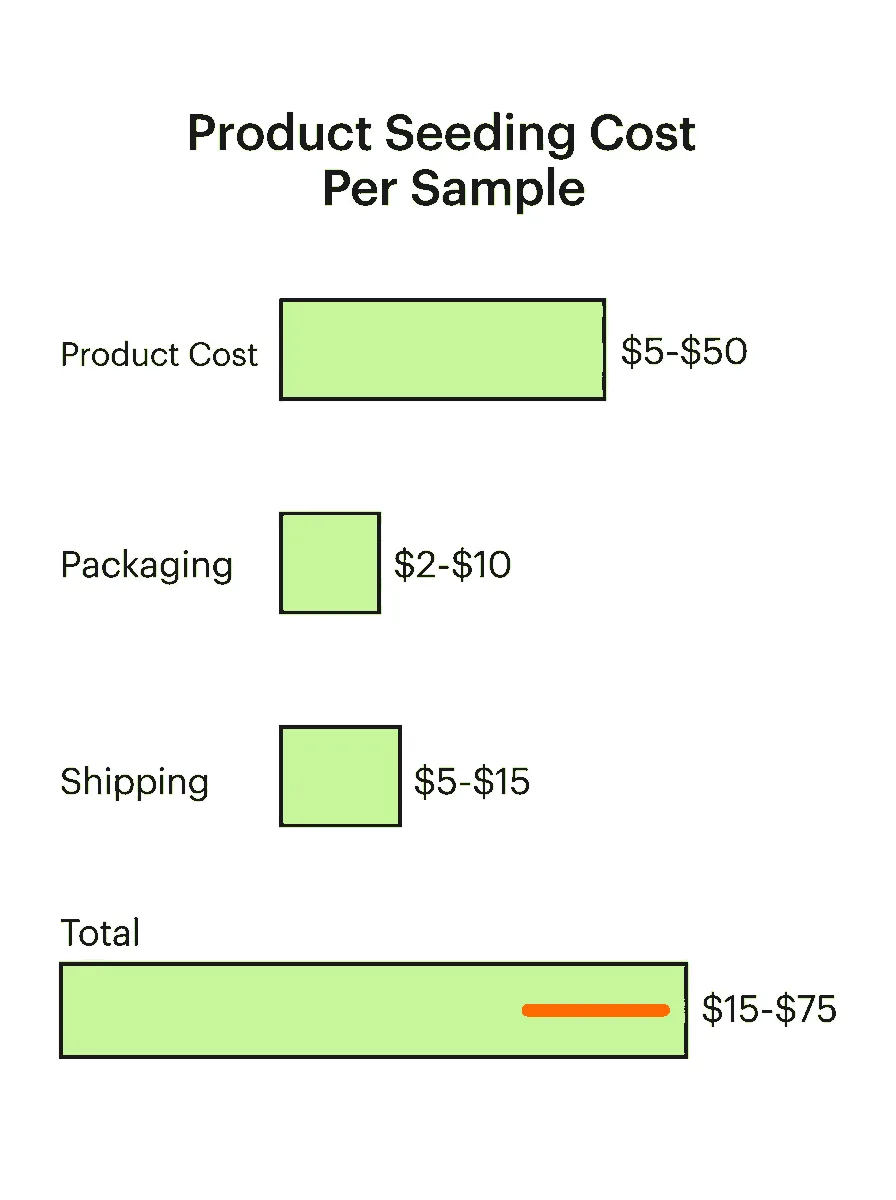
According to data compiled from GRIN, SeedingOps, and Storyclash, the median all-in cost sits around $30 per sample for mid-market consumer products. Beauty and skincare skew lower ($15–$35) because unit costs are small. Electronics and home goods push higher ($40–$75) due to product value and shipping weight.
For brands using TikTok's Fulfilled by TikTok (FBT) logistics, fulfillment costs drop significantly — as low as $2.86 per item on multi-unit shipments, according to TikTok Seller University. This makes FBT-eligible products structurally advantaged for seeding programs.
Post Rate Benchmarks: The Number That Decides Everything
Post rate — the percentage of creators who actually produce content after receiving a sample — is the single most important variable in seeding economics. It determines your effective cost per piece of content.
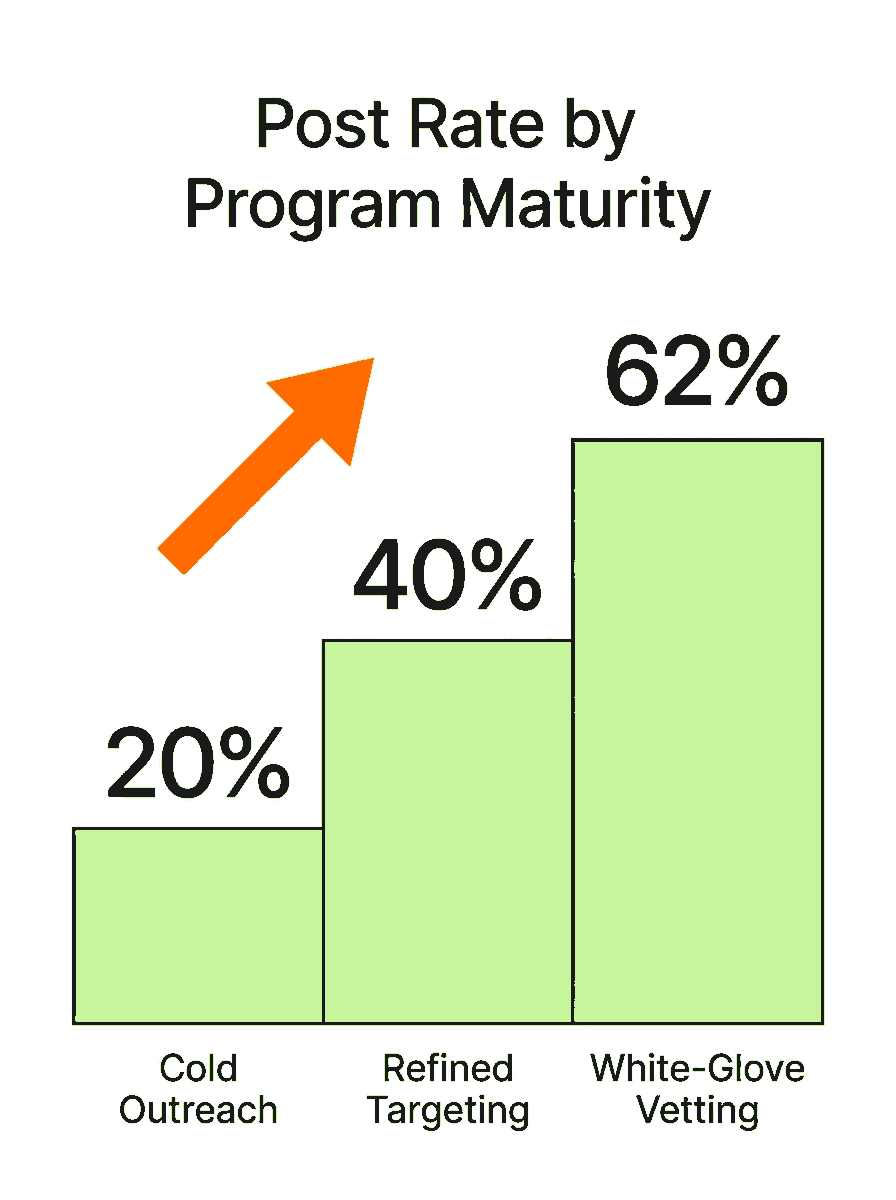
According to GRIN's 2026 Product Seeding Report, post rates follow a clear progression based on program maturity:
- First-round seeding (cold outreach): ~20% post rate
- Refined targeting (4th+ round): 40%+ post rate
- Best-in-class programs (white-glove vetting): 62% post rate, per SeedingOps data
The spread between 20% and 62% isn't incremental. It's the difference between a cost center and a profit engine.
Cost Per Post: Where the Math Gets Real
Here's the calculation that separates sophisticated seeding programs from expensive experiments:
100 samples × $30/sample = $3,000 total investment.
At 20% post rate → 20 posts → $150 per post.
At 40% post rate → 40 posts → $75 per post.
At 62% post rate → 62 posts → $48 per post.
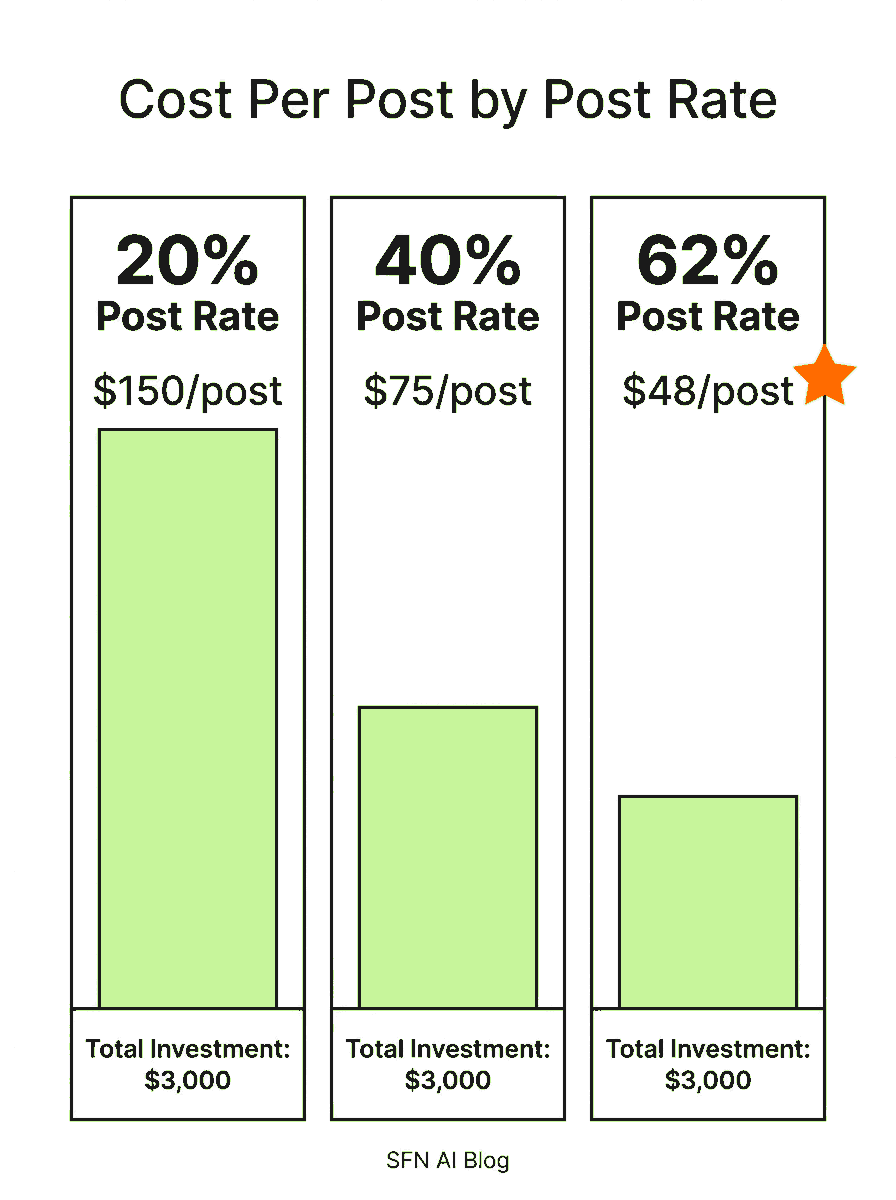
At $48 per post, product seeding beats paid creator content by an order of magnitude. Most agencies charge $100–$200 per nano-creator activation for managed campaigns, according to Influencer Marketing Hub's 2026 benchmarks.
But the economics get even more interesting when you factor in engagement quality.
Why Gifted Content Outperforms Paid Content
This is the data point that surprises most brands: gifted creator content doesn't just cost less — it performs better.
According to controlled studies from CreatorsJet and Open Influence, gifted content generates a 2.19% average engagement rate compared to 1.94% for paid sponsored content. That's a 12.9% engagement premium for content that cost a fraction of the price.
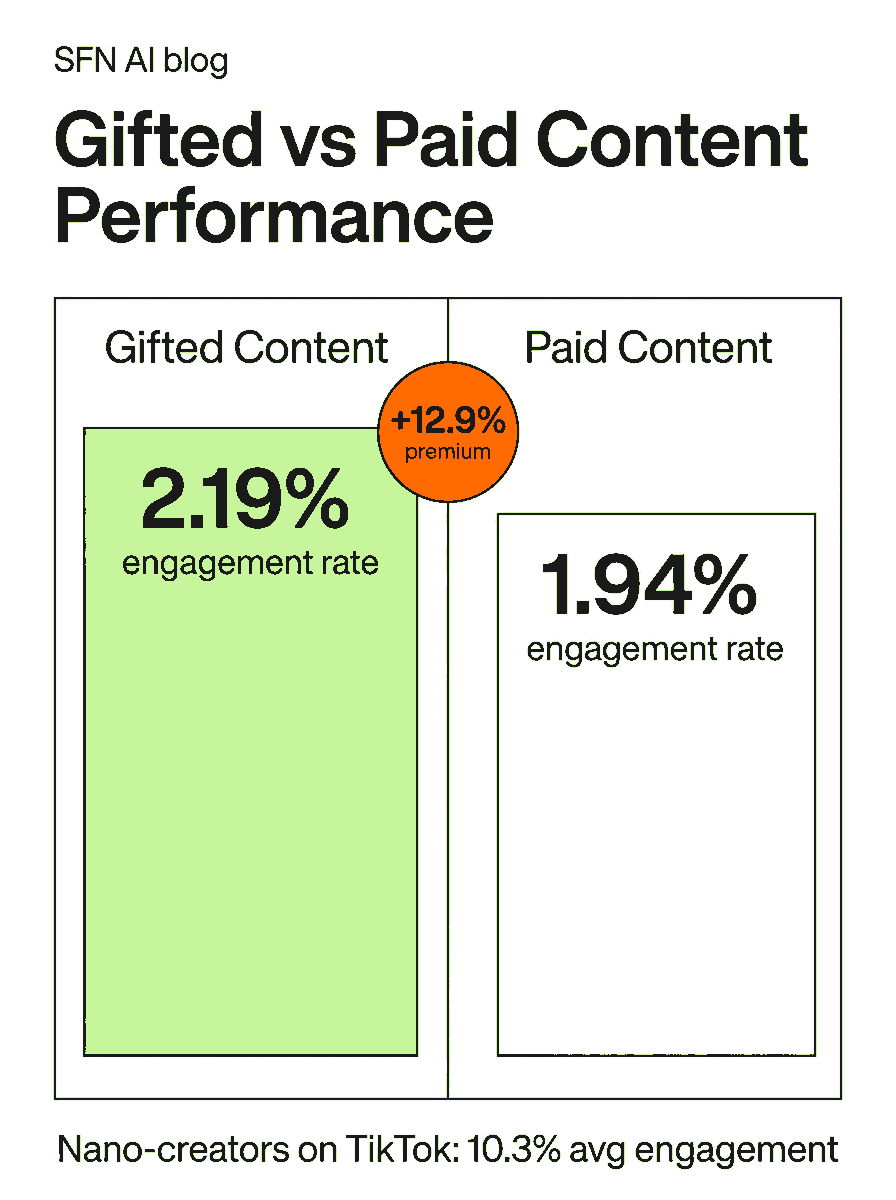
On TikTok specifically, the gap widens further. Nano-creators (under 10K followers) average a 10.3% engagement rate on TikTok, per CreatorsJet data — and these are the creators most likely to accept product samples and create authentic, unscripted content.
The mechanism is straightforward: gifted content feels authentic because it often is. A creator who genuinely likes a product they received for free produces different content than one executing a paid brief with specific talking points and mandatory disclosures. Audiences detect the difference. The algorithm rewards it.
This is where product seeding connects back to the broader TikTok Shop affiliate marketing strategy. Seeding isn't a standalone tactic — it's the acquisition layer that feeds your affiliate pipeline with creators who already believe in the product. And once those creators are producing content, tracking the right performance metrics becomes the difference between scaling what works and repeating what doesn't.
TikTok Shop's Seeding Infrastructure: Platform Rules and Mechanics
TikTok Shop has formalized product seeding into a structured system with specific eligibility requirements, content obligations, and tiered access. Understanding these mechanics is non-negotiable before launching a seeding program.
Platform Requirements for Sample Recipients
Not every creator qualifies for TikTok Shop product samples. According to TikTok Seller University, creators must meet specific thresholds:
- Minimum 5,000 followers OR historical Shop sales performance
- "Green" account health status — no community guideline violations
- Content posted within the last 30 days — dormant accounts are ineligible
These requirements serve as a baseline quality filter, but they're insufficient for high-ROI seeding. A creator with 5,000 followers and Green status may still have zero audience overlap with your product category. The platform filter gets you to "eligible." Your vetting process gets you to "profitable."
The 14-Day Content Obligation
TikTok Shop enforces a critical rule that most platforms don't: creators who accept samples must produce content within 14 days of receipt. The content must be either a short video visible for at least 3 days or a 10-minute LIVE session with the product pinned.
This is a significant structural advantage for TikTok Shop seeding compared to Instagram or YouTube gifting, where there's no enforcement mechanism. The 14-day window doesn't guarantee quality, but it guarantees activity — and activity is the prerequisite for everything else.
Free Samples vs. Refundable Samples
TikTok Shop offers two seeding models:
Free Samples are straightforward: the brand ships product at no cost to the creator. This is the traditional gifting model. The brand absorbs the full cost, and the creator's only obligation is the 14-day content requirement.
Refundable Samples add a performance layer: the creator receives the product, and if they hit a GMV milestone tied to their content, TikTok refunds the sample cost to the brand. This model aligns incentives — creators who drive sales effectively make the sample free for the brand.
For brands operating at scale, refundable samples reduce downside risk. For new programs still building creator relationships, free samples are the lower-friction entry point.
Sample Tier Limits
TikTok Shop restricts how many active samples a brand can have in circulation, based on seller performance:
- Tier 1 sellers (under $5K GMV/month): 5 active samples at a time
- Tier 2 sellers (high-performing): Up to 20 active samples
This means scaling a seeding program on TikTok Shop requires scaling your seller tier first. Brands hitting the 5-sample ceiling need to focus on conversion rate per sample rather than volume — making every seeding slot count.
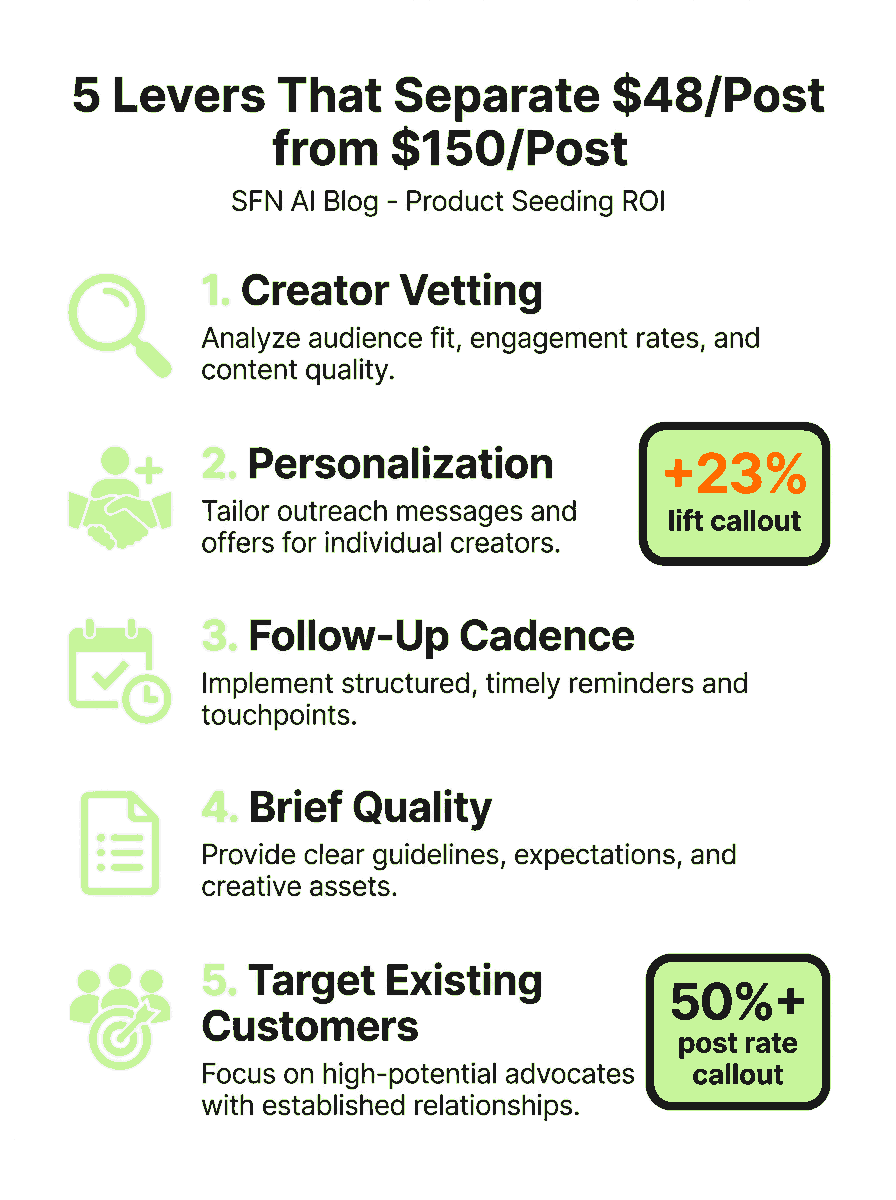
The 5 ROI Levers: What Separates $48/Post From $150/Post
The gap between a 20% post rate and a 62% post rate comes down to five operational levers. Each one is independently valuable, but they compound when combined.
Lever 1: Creator Vetting Beyond Platform Minimums
TikTok Shop's eligibility requirements (5K followers, Green status) are a floor, not a ceiling. The brands achieving 40%+ post rates add three additional vetting layers:
Audience overlap analysis. Does the creator's audience match your product's buyer profile? A beauty creator with 50K followers sounds great — until you realize their audience is 70% male viewers watching for entertainment, not purchase intent. According to GRIN, targeting creators who are existing customers of your brand or category pushes post rates above 50%.
Content recency and cadence. Has the creator posted TikTok Shop content in the last 14 days? Creators who are actively producing commerce content are significantly more likely to produce content for your sample than creators who haven't posted in weeks.
Historical post-rate data. If you've seeded before, you have data on which creator profiles actually post. Build a scoring model: past posters and their lookalikes get priority. Otinga's case studies show that white-glove vetting processes achieve 65% post rates — more than triple the cold-outreach baseline.
Lever 2: Personalization That Earns Attention
Here's the thing. Creators who receive personalized outreach are measurably more likely to post.
According to GRIN's controlled studies, including a handwritten note with a sample increases the post rate by 23%. That's not a marginal lift — it's the difference between 40 posts and 49 posts on the same 100-sample send.
Personalization goes beyond the note. It includes:
- Referencing specific content the creator has made ("I loved your video on affordable skincare routines — our product fits that exact use case")
- Customized product selection based on the creator's content style (sending the shade or variant most relevant to their audience)
- Explaining why them specifically — not a mass email, but a genuine reason for the outreach
This is where writing strong creator briefs becomes critical. The brief that accompanies a sample isn't just instructions — it's the difference between a creator who films your product and one who shelves it.
Lever 3: Follow-Up Cadence
The skincare startup that lost $150K didn't just fail at targeting. They failed at follow-up. There was zero post-shipment communication.
The data consistently shows that structured follow-up improves post rates. The pattern that works:
- Day 1: Shipping confirmation with tracking and a personal note
- Day 3-4 after delivery: Gentle check-in ("Did the package arrive safely? Let me know if you have questions about the product")
- Day 7-8: Content inspiration message ("Other creators have had great success with [specific angle] — here's an example")
- Day 12: Soft deadline reminder ("Your 14-day window closes soon — happy to help with any production questions")
This isn't nagging. It's reducing friction. Creators have dozens of commitments. A well-timed follow-up moves your product from "I'll get to it" to "I'll film it today."
Lever 4: Brief Quality
A sample without a brief is a gift. A sample with a strong brief is a content catalyst.
The brief should include the product's unique story, 2–3 suggested content angles, proof of what's working for other creators, and a clear CTA format. It should not include a rigid script, mandatory talking points, or tone-deaf corporate messaging.
The distinction matters: you're giving the creator a launchpad, not a cage. The best-performing seeded content happens when creators adapt your angles to their natural style — not when they read your script verbatim.
Lever 5: Targeting Existing Customers
GRIN's data reveals the single highest-leverage targeting strategy: seeding creators who are already customers of your product.
Creators who have purchased your product before accepting a sample post at 50%+ rates — more than double the cold-outreach baseline.
The logic is obvious once you see it: these creators already know the product, already have an opinion, and already have authentic experiences to draw from. The sample isn't introducing something new — it's giving them a reason to share what they already think.
For TikTok Shop sellers, this means mining your existing customer data for creators. Cross-reference your order history with TikTok creator profiles. The overlap is your highest-ROI seeding list, and building it is a direct extension of your creator recruitment strategy.
Case Studies: What $11.40 ROI Looks Like — And What 0.08x Looks Like
The gap between success and failure in product seeding isn't theoretical. These cases illustrate what each side of the equation looks like in practice.
Success: Daniel Wellington's Micro-Seeding Machine
Daniel Wellington built a $200M+ watch brand largely through product seeding. Their approach: send free watches to 1,000+ micro-influencers with minimal creative direction. The result was over 5 billion social media impressions and 8–12% conversion rates on creator-driven traffic, according to Harvard Business School's analysis of the brand.
The key insight wasn't the watch itself — it was the volume-meets-quality targeting. Daniel Wellington didn't seed randomly. They identified creators whose aesthetic already matched the brand's minimalist positioning. The product felt like a natural extension of the creator's existing content, not an interruption.
Success: Blissim's TikTok Shop Seeding Program
Blissim, a German beauty subscription brand, seeded 700+ micro-influencers with product samples and achieved approximately €280K in attributed GMV. Their post rate hit roughly 50% — meaning 350 of their 700 seeded creators actually produced content.
What separated Blissim from average programs was their selection criteria: they targeted creators who were already posting beauty content on TikTok at least twice weekly. The existing content cadence predicted future content creation better than follower count, engagement rate, or any other metric.
Failure: The $150K Skincare Experiment
The anonymous skincare startup's failure is instructive precisely because the product was good. They had strong reviews, real customer demand, and a compelling value proposition. None of it mattered.
Their mistakes were systematic: no audience overlap analysis (they seeded fitness creators for a skincare product), no personalization (mass-shipped with generic inserts), and no follow-up (shipped and waited). The result — 2,000 samples, roughly 20 posts, $12,000 in attributed sales — wasn't a product failure. It was an operational failure.
Industry data corroborates this pattern. According to Social Commerce Accountants, untargeted campaigns sending 500 units with no audience analysis can produce as few as 10 posts — a 2% post rate, or 98% waste.
The Pattern
The through-line across these cases is consistent: targeting × personalization × follow-up = ROI multiplier. Remove any one variable and the economics collapse. The product matters — but it's necessary, not sufficient.
It's also worth noting that most published case studies predate TikTok Shop's current infrastructure. Daniel Wellington's success was built on Instagram. Blissim operated across multiple platforms. TikTok Shop's formalized seeding system — with its 14-day content obligation and tiered sample limits — changes the mechanics. The principles transfer. The execution details are evolving.
The Seeding-First Affiliate Strategy
Here's the second-order insight most brands miss: product seeding isn't a cost center. It's the cheapest affiliate acquisition channel that exists.
The traditional affiliate recruitment path looks like this: identify creators → negotiate commission rates → send briefs → hope they post. The creator has no relationship with the product, no authentic experience to draw from, and no reason to prioritize your brand over the dozen other affiliate offers in their inbox.
The seeding-first path inverts the funnel: send product → creator experiences it genuinely → creator posts organic content → creator converts to long-term affiliate with real product knowledge. According to Impact.com, the industry-wide average influencer marketing ROI sits at $5.78 per dollar. GRIN's data shows that programs combining gifting with performance-based compensation — exactly the seeding-to-affiliate pipeline — achieve $14.20 per dollar. That's the highest recorded ROI model in influencer marketing.
The compounding effect is real. A seeded creator who posts once and drives sales doesn't just generate that one transaction. They become a long-term affiliate who:
- Already has authentic content featuring your product
- Can repurpose seeded content as Spark Ads (paid amplification of organic UGC)
- Has genuine product knowledge for future briefs and live sessions
- Serves as social proof when you recruit their peers
Ashley Wright, a TikTok Shop strategy consultant featured in SFN AI's research, frames it bluntly: "1 creator posting 10 times is more valuable than 10 creators posting once." She recommends a 70/30 content split — 70% real creator content, 30% AI-generated — with seeding as the engine that produces the authentic 70%.
This connects directly to commission rate strategy. Seeded creators who convert to affiliates accept lower commission rates because they've already received product value. The sample isn't just a content investment — it's a negotiation lever that reduces your ongoing affiliate costs.
The brands building this pipeline systematically — seeding into affiliation into retention — are constructing an asset that compounds. The brands treating seeding as a one-off gifting experiment are renting attention month to month.
Building Your Seeding System: From Manual to Scalable
Making product seeding profitable requires moving from ad-hoc gifting to a repeatable system. The operational infrastructure matters as much as the strategy.
Step 1: Build Your Creator Targeting Model
Start with your existing customer data. Cross-reference order history with TikTok creator profiles to identify buyers who already create content. These are your Tier 1 seeding targets — the group most likely to post, most likely to be authentic, and most likely to convert to long-term affiliates. If you're building this from scratch, the complete campaign setup guide covers the full process.
For Tier 2, build a scoring model based on three variables: audience overlap with your buyer demographic, content recency (posted TikTok Shop content in the last 14 days), and engagement rate on commerce-related content specifically.
Step 2: Personalize the Outreach and Package
Every sample package should include a personalized note referencing specific content the creator has made, 2–3 suggested content angles tailored to their style, and proof that similar creators have succeeded with your product. GRIN's data shows this personalization lifts post rates by 23% — the single highest-leverage operational change you can make.
Step 3: Execute a Structured Follow-Up Cadence
Map out touchpoints at delivery confirmation, 3–4 days post-delivery, day 7–8 with content inspiration, and day 12 with a soft deadline reminder. This isn't aggressive — it's supportive. Each touchpoint reduces friction and keeps your product top-of-mind during the 14-day content window.
Step 4: Measure and Iterate
Track three metrics per seeding cohort: post rate (% of recipients who create content), cost per post (total investment ÷ posts produced), and attributed sales per post. These are the creator product seeding ROI metrics that separate data-driven programs from expensive guesswork. After each cohort, update your targeting model: which creator profiles posted? Which didn't? What did the posters have in common? For the full measurement framework, see our guide on TikTok Shop affiliate analytics.
Step 5: Convert Top Performers to Affiliates
Creators who post high-performing seeded content are your highest-value affiliate recruitment pool. Reach out within 48 hours of a strong post with an affiliate offer. The conversion rate from seeded creator to committed affiliate far exceeds cold outreach — they already have product experience and content proof.
Platforms like SFN AI's TikTok Shop intelligence platform can accelerate this pipeline. SFN AI's Content DNA analysis identifies each creator's unique content style — hook patterns, editing rhythm, narrative structure — so that sample briefs are personalized to how they actually create, not a one-size-fits-all template. The Coherence Score predicts which creators are most likely to produce content that converts, scoring alignment between a creator's approach and proven performance patterns. And the Brand Workspace tracks seeding ROI per creator cohort with real-time attribution, closing the measurement gap that kills most programs.
But the system works without any platform too. A spreadsheet tracking creator profiles, sample shipments, follow-up dates, and post outcomes gets you 80% of the way there. The platform makes it faster and more precise. The process makes it work.
Frequently Asked Questions
How much does product seeding cost on TikTok Shop?
The all-in cost per product sample ranges from $15–$75, depending on product value, packaging, and shipping method. The median cost for mid-market consumer products is approximately $30 per sample. Brands using TikTok's Fulfilled by TikTok (FBT) logistics can reduce fulfillment costs to as low as $2.86 per item on multi-unit shipments.
What is a good post rate for product seeding?
A good post rate depends on program maturity. First-round cold outreach typically achieves ~20%. Refined programs with audience-matched targeting reach 40%+. Best-in-class programs with white-glove creator vetting report 62% post rates. The industry consensus for a "well-run" program is 20–40%, according to GRIN, SeedingOps, and Aspire.
What's the ROI of product seeding vs. paid influencer campaigns?
Gifted content generates a 2.19% average engagement rate versus 1.94% for paid content — a 12.9% engagement premium. On ROI, the industry-wide influencer marketing average is $5.78 per dollar invested. Beauty and skincare gifting programs average $11.40 per dollar, and programs combining gifting with performance compensation reach $14.20 per dollar, according to GRIN and Impact.com.
How many samples can I send on TikTok Shop?
TikTok Shop limits active samples based on seller tier. Tier 1 sellers (under $5K monthly GMV) can have 5 active samples at a time. High-performing Tier 2 sellers can have up to 20 active samples. These limits make targeting precision critical — every sample slot needs to count.
What's the difference between Free Samples and Refundable Samples on TikTok Shop?
Free Samples are shipped at no cost to the creator, with the brand absorbing the full expense. Refundable Samples add a performance layer: if the creator hits a GMV milestone through their content, TikTok refunds the sample cost to the brand. Refundable Samples reduce downside risk at scale, while Free Samples offer lower friction for new programs building creator relationships.
Last updated: March 2026
Founder of SFN AI. We watch TikTok Shop 24/7 so creators and the brands that run them get the playbook.