Fulfilled by TikTok (FBT): Complete 2026 Guide for Sellers
Fulfilled by TikTok (FBT) starts at $3.58/unit. The complete 2026 guide to the full fee stack, the volume incentive, and what it means for your margins.

$3.58 per unit. That's the entry price for Fulfilled by TikTok, the in-house fulfillment service TikTok Shop built to pull sellers off self-ship and into the platform's own logistics backbone. On January 12, 2026, TikTok quietly cut multi-unit fulfillment fees by up to 24%. That's not a cost move. That's a recruitment campaign.
Most sellers treat Fulfilled by TikTok (FBT) as a line-item in the P&L. It isn't. It's a conversion lever, a visibility boost, and a structural decision about who owns your customer experience. The Free 3-Day Delivery badge alone moves conversion rates 15 to 20%, according to TikTok's own seller data. And then... in February 2026, TikTok reversed the mandate that was about to force every US seller onto platform-controlled shipping. Suddenly the FBT decision is back on the table... and most of the content ranking for "fulfilled by tiktok" is still running the old mandate language.
This guide is the current picture. We're covering the 2026 fee stack, the FBT vs self-ship decision framework, where FBT wins and where it kills margin, and how fulfillment connects to the creator content engine that's actually driving TikTok Shop GMV in 2026.
Quick Answer: Fulfilled by TikTok (FBT) is TikTok Shop's in-house fulfillment service where TikTok handles storage, picking, packing, shipping, and returns through 3PL partners. Single-unit fees start at $3.58/unit and multi-unit fees start at $2.86/unit (January 2026 rate card, with multi-unit cuts of up to 24%). FBT sellers get free shipping by default, a Free 3-Day Delivery badge, and measurable conversion lift of +17% on average. It's the right call for lightweight SKUs ($15-$60 AOV, sub-4 lb, return rates under 8%, and high velocity). Heavy, cheap, or slow-moving SKUs still belong on self-ship.
Why Fulfillment Became a GMV Lever, Not a Cost Center
Fulfillment used to be the boring layer. The part of the business you optimized once a year and otherwise ignored. That's no longer true on TikTok Shop.
Here's what changed. TikTok's algorithm uses fulfillment signals as a ranking factor. Late shipments tank your Shop Performance Score (SPS). A dropping SPS reduces your placement in search, LIVE shopping, and creator affiliate carousels. The penalty doesn't just hit one order... it compounds across every SKU in your catalog. Sellers with SPS scores below 4.7 report daily impression drops of 40 to 60% within two weeks of the score decline.
Then there's the badge. TikTok Shop displays a Free 3-Day Delivery badge on FBT products. That badge is visible in search results, creator storefronts, LIVE shopping feeds, recommended carousels, and the BNPL carousel that launched April 2026. According to TikTok's partner data cited by hyperfocus.tech, the badge drives CTR lifts of +12 to 18% on non-FBT listings and conversion rate lifts of +15 to 20%. Those aren't marginal gains. That's the difference between profitable and unprofitable at scale.
And then, on February 17, 2026, the ground moved again. TikTok Shop had announced that independent seller shipping would be eliminated by the end of March 2026... all US sellers forced onto TikTok Shop Logistics Services (FBT, Upgraded TikTok Shipping, or CBT). The backlash was loud. Brands like Grande Cosmetics and August publicly pushed back. And in a reversal reported by Modern Retail, TikTok emailed sellers: "At this time, Seller Shipping remains unchanged, and previously shared deadlines are not going into effect."
Independent shipping is still available as of May 2026. The FBT decision is a choice again... not a mandate. That context matters for everything that follows.
This is the real state of play heading into the rest of 2026. Fulfillment is no longer a back-office problem... it's gated to algorithmic visibility, tied to creator program performance, and shaped by a policy that the platform could revive at any point ... industry consensus reading the Feb-17 reversal as a pause, not a cancellation. The sellers who treat FBT as a strategic call rather than a cost calculation are the ones pulling ahead.
What FBT Actually Is... and the 2026 Pricing Stack
Fulfilled by TikTok is TikTok Shop's first-party fulfillment service. It runs on 3PL partners (ShipBob is the first publicly named partner, per ShipBob's own documentation). Sellers ship inventory to TikTok-assigned fulfillment centers. TikTok handles receiving, storage, picking, packing, shipping, and returns. Think Amazon FBA, but inside TikTok's commerce ecosystem.
Here's how the flow works end to end.
How FBT Works (Process Flow)
- Enrollment. Apply in Seller Center under Fulfillment Settings. TikTok reviews in 5-7 business days. Approval requires 30+ days of account history, $500+ in sales (or 50+ orders), 95%+ account health score, and KYC verification. Estimated rejection rate is ~30%, per seller surveys compiled by sellerops.io.
- Inventory inbound. TikTok provides shipping labels. Seller preps inventory to packaging standards. Minimum 20 units per SKU on initial shipment.
- Receiving and QC. TikTok 3PL partners receive, inspect, and catalog. Inventory sync to Seller Center runs under 15 minutes as of March 2026 (down from 4 hours in 2025).
- Order fulfillment. Customer orders trigger pick, pack, ship. Processing time is 1-2 business days.
- Shipping. Standard delivery in 3-5 business days via USPS, UPS, or regional carriers. Faster options available via Upgraded TikTok Shipping and CBT.
- Returns. Customer-initiated via the TikTok Shop interface. Items return to TikTok warehouses for inspection, grading, and restock.
That's the mechanical picture. Now the pricing.
The 2026 Fee Stack (Primary-Source from TikTok Shop Seller University)
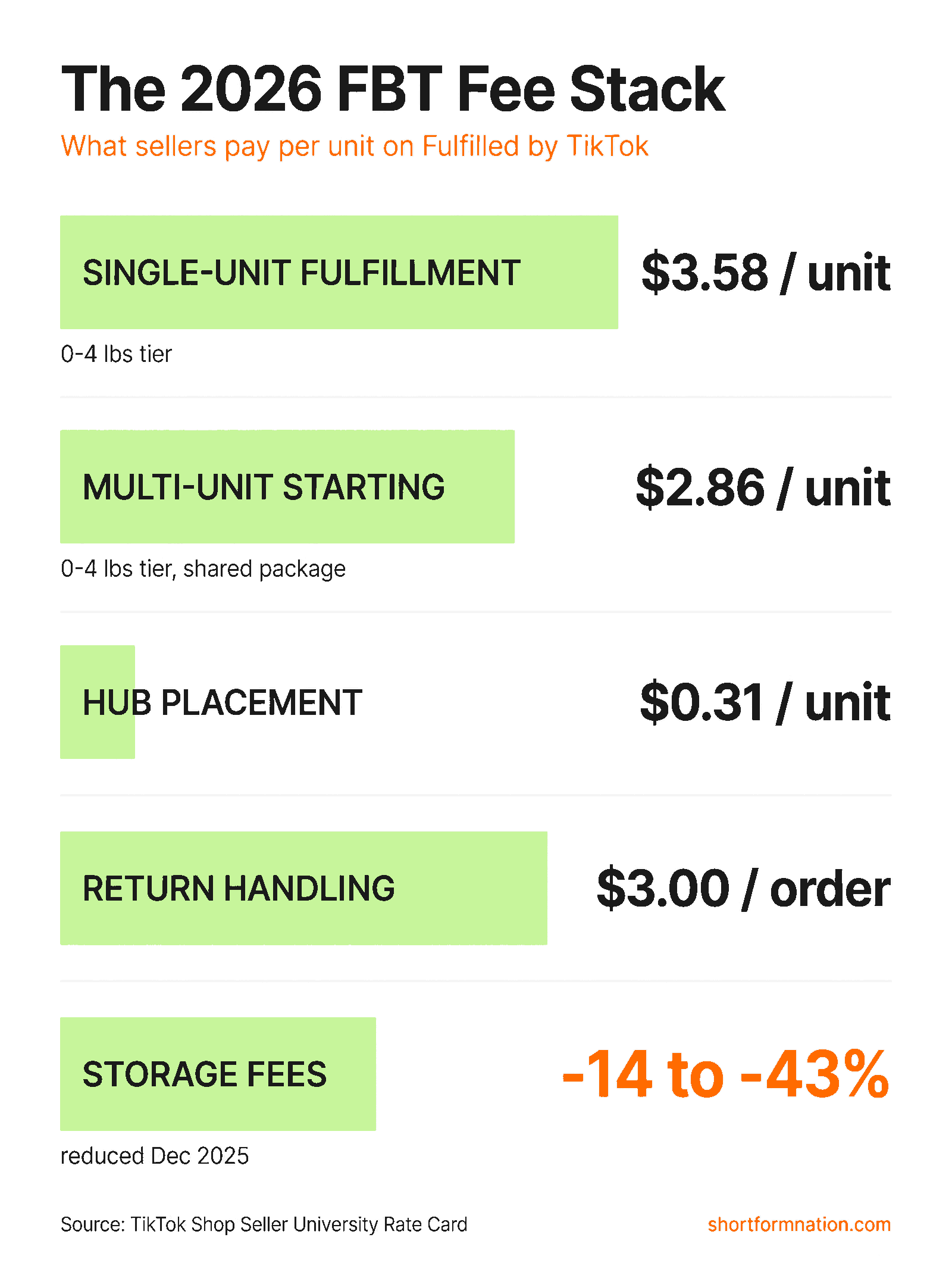
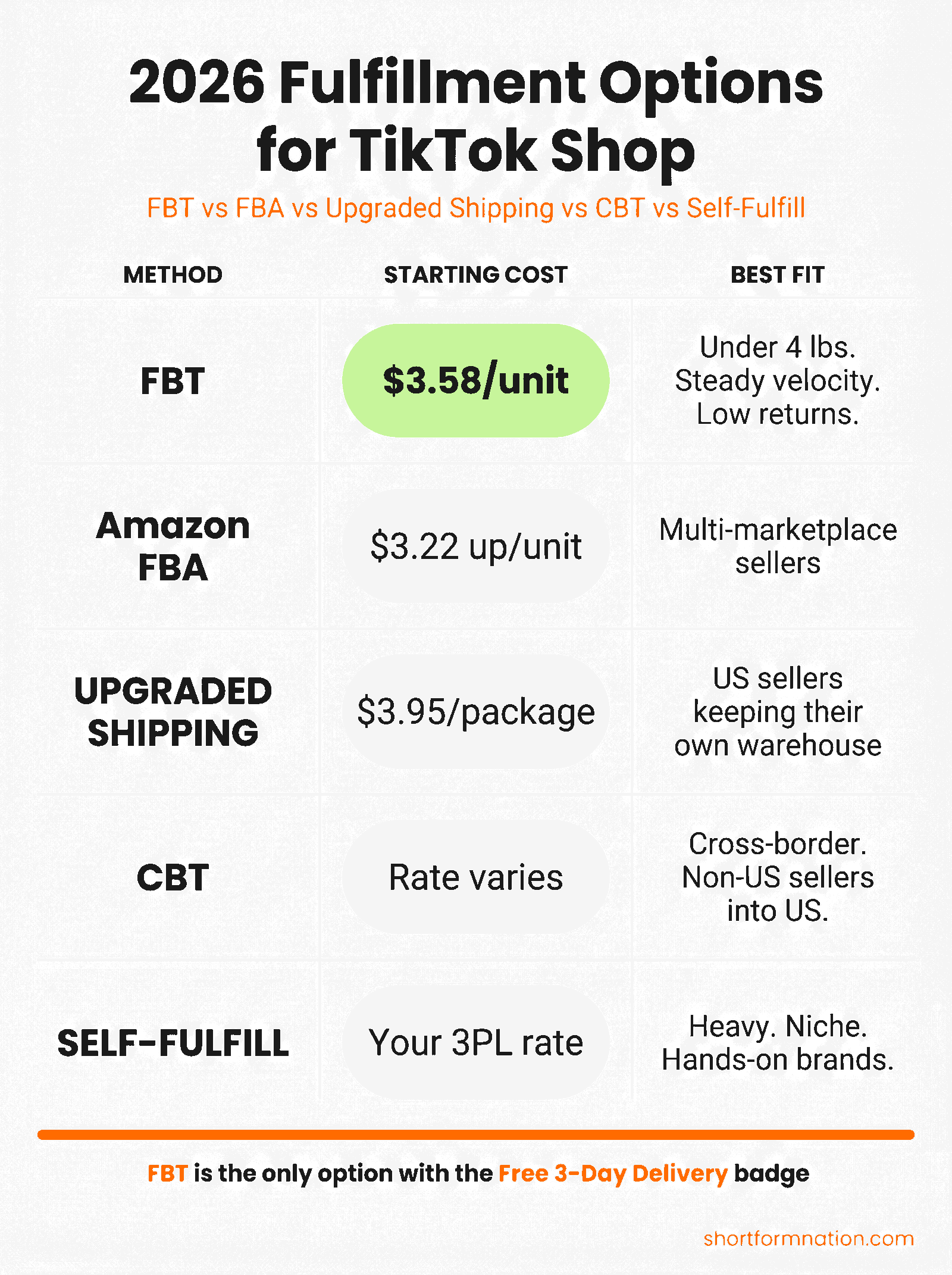
FBT pricing is a stack, not a line item. Every seller pays the core fulfillment fee. Some pay more for storage, returns, hub placement, and optional upgrades. Here's what the full stack looks like on the January 12, 2026 rate card (FBT Rate Card FAQs, TikTok Shop Seller University).
Fulfillment fees (all-inclusive: pick + pack + packaging + last-mile):
- Single-unit orders: $3.58/unit starting point (lightest weight tier, 0-4 lbs)
- Multi-unit orders (same seller, same order): $2.86/unit starting point (0-4 lbs tier)
- January 12, 2026 update: multi-unit fees cut up to 24% for 2, 3, and 4+ item orders in 0-4 lbs weight tiers. Single-unit unchanged.
- Weight/dimension calc: fees are the greater of actual or dimensional weight
- Max product weight: 50 lbs. Max dimension: 60" longest side.
Storage fees (effective December 15, 2025):
- Days 1-60: Free
- Days 61-270: standard fees reduced 14-43% vs prior rate card
- 270+ days: long-term storage penalties apply
Return handling: Flat $3.00/order (covers inspection, grading, restock at the fulfillment center).
Hub Placement Fee: $0.31/unit starting point when TikTok redistributes inventory internally between regional FCs. Applies to sellers who ship only to one FC when their SKU needs multi-region coverage.
Active Through September 2026: The FBT Volume Incentive
One more line item that's missing from most competitor content. TikTok Shop launched an FBT volume incentive program running April through September 2026 (Seller University, FBT April-September 2026 Incentive). The mechanics:
- Baseline: Your delivered FBT units in February 2026.
- Trigger: Deliver 600+ more FBT units in any month from April through September 2026 vs the February baseline.
- Reward: 10% reimbursement of FBT fulfillment fees on incremental units.
- Cap: $1.00 per incremental unit.
- Window: Six months (April-September 2026), monthly qualification.
The math is simple. If you go from 1,000 February FBT units to 1,800 in June, the 800 incremental units qualify for the 10% reimbursement (capped at $800 if every unit hits the $1 cap). Sellers running paid social into FBT-routed SKUs are the obvious winners ... the incentive effectively subsidizes the fulfillment cost on incremental volume during the window.
One read on this: TikTok Shop is paying to accelerate FBT adoption while the mandate option remains off the table. The post-Feb-17 reversal didn't kill the platform's logistics ambition. It just shifted the playbook from forced migration to financial pull. The Q2-2026 product preview (April 21) confirmed continued investment in FBT, including a redesigned onboarding surface that puts the FBT vs seller-fulfilled side-by-side comparison directly in front of new sellers.
Optional upgrades (stack on top of base FBT):
- Upgraded TikTok Shipping: $3.95/package (March 12, 2026 launch). TikTok-managed carriers with up to 30% savings vs legacy shipping. Performance exemptions on VTR, OTDR, NRR, CCR if the seller dispatches within 2 business days.
- Package Signature Service: $3.95/package (March 12, 2026 launch). Reduces "Delivered Not Received" claims for orders above $400.
- Shipping Protection Service Fee: 1% of package value on packages over $100 (April 2, 2026 launch). Packages $100 and under are protected free.
- Collections by TikTok (CBT): up to 30% additional savings on top of Upgraded TikTok Shipping. Requires avg > 50 orders/day, warehouse in eligible zip code (Greater LA, select East Coast, Texas), and CBT handover procedures. Free door-to-door pickup included.
Platform fees (stack on top of all FBT costs):
- Referral fee: 2-6% of sale price in the US (category-dependent)
- Transaction/payment processing: 2.2% per transaction
- Refund Admin Fee (April 2026): 20% of referral fee, capped at $5/order
For a plain-language breakdown of how these interact with creator commissions, see our guide on TikTok Shop affiliate commission rates.
What You Actually Get for the Fee
This is the part most FBT cost analyses miss. FBT isn't just a fulfillment service. It's a bundle. Here's what's inside the price:
- Free shipping default. Since June 16, 2025, all FBT products qualify for free shipping by default... no $30 order minimum. Sellers who opt out are subject to the $30 threshold and a $5.99 buyer-paid fee below it. Opt-outs get a $0.75/unit reimbursement when shipping is charged, but they also lose the visibility boost.
- Free 3-Day Delivery badge. The visibility signal on every FBT listing. Drives the CTR and conversion lifts that make the whole program economically defensible.
- SPS protection. Logistics-related negative reviews, late-delivery hits, and tracking failures are carved out of your SPS calculation when you're on FBT or Upgraded TikTok Shipping (except for "out of stock / wrong item" and "damaged items" which still count).
- Campaign eligibility. FBT sellers get preferential placement in BNPL carousels, LIVE shopping feeds, and creator affiliate recommendation carousels.
- Return handling. No physical touch from the seller. TikTok processes everything... inspection, grading, restock.
- Algorithmic lift. Seller consensus across surveys puts the FBT ranking factor at +5-10% relevance boost in TikTok Shop search.
Put it all together and the bundle looks different than the $3.58 sticker price suggests. For the right SKU profile, FBT isn't a cost... it's an unlock.
The FBT Fit Matrix: Your Decision Framework
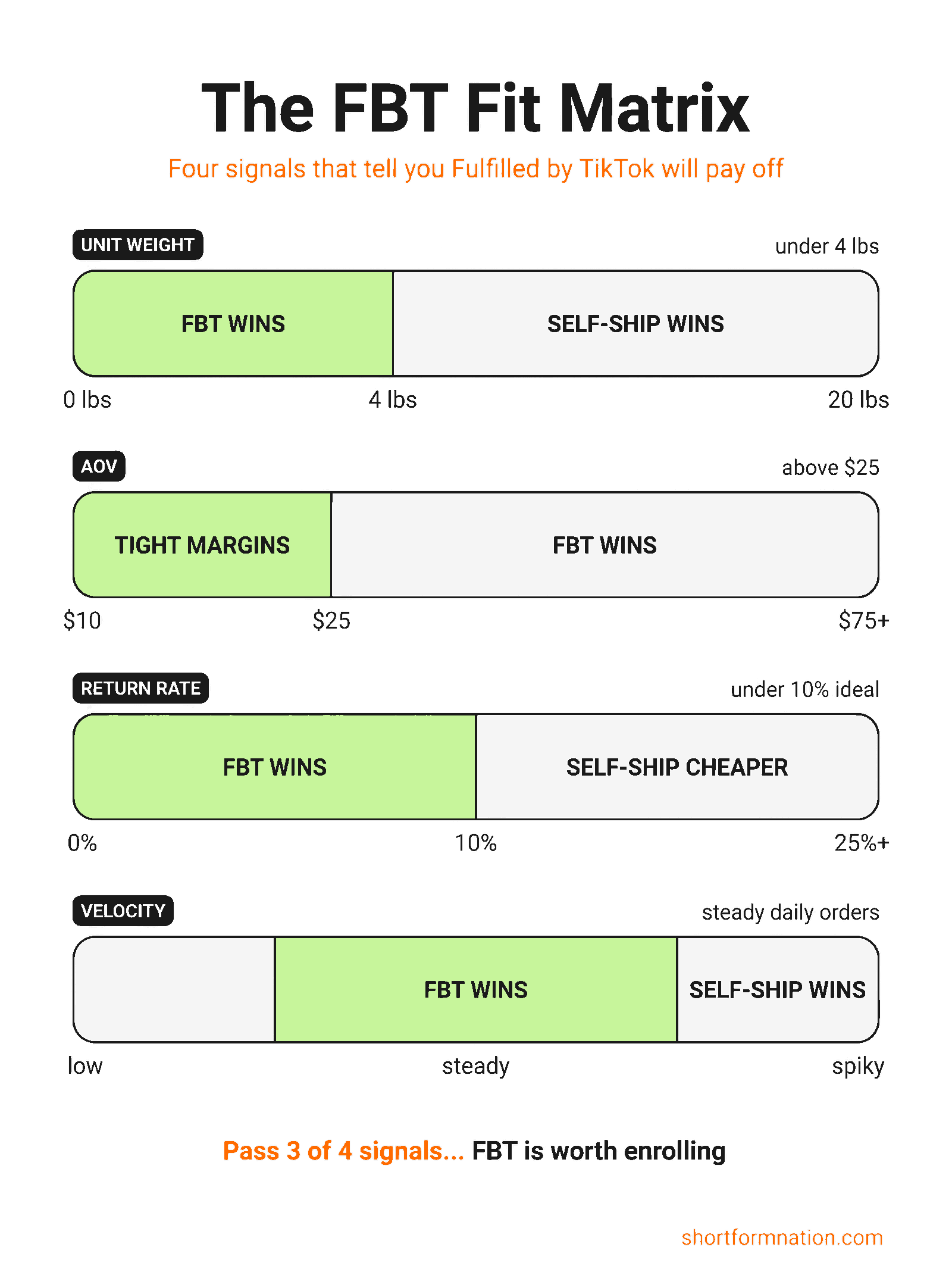
Here's the framework most sellers need and most blog posts skip. The FBT vs self-ship decision isn't a single calculation. It's a matrix across four variables: category, AOV, return rate, and velocity. Get the matrix right and FBT compounds. Get it wrong and you pay $3.58 per unit to accelerate your own margin bleed.
The FBT Fit Matrix
The framework has four variables:
- Weight and dimension. Products under 4 lbs land in the cheapest FBT tier ($3.58 single, $2.86 multi). Above that, dimensional-weight calc kicks in and fees scale fast. Anything over 10 lbs is typically better self-shipped unless the SKU has a structural reason to be on FBT (expedited shipping demand, high AOV, algorithmic boost requirement).
- AOV (Average Order Value). The $15-$60 AOV band is the FBT sweet spot. Below $15, the $3.58 fulfillment fee plus 2-6% referral fee plus 2.2% transaction fee eats 25-40% of revenue before COGS. Above $60, the fee becomes a rounding error and the conversion lift dominates.
- Return rate. FBT charges $3.00 per return. Combine with the original fulfillment fee and you're at $6.58+ in round-trip logistics cost. Apparel (15-25% returns), footwear (20-30%), and fit-dependent categories are the worst FBT fits. Beauty, consumables, and accessories (3-8% returns) are the best.
- Velocity. FBT storage is free for the first 60 days. After that, reduced but still real. SKUs that turn in under 60 days capture the free-storage window. Slow movers (90+ days) get expensive fast and lose the relative advantage vs self-ship.
Score each SKU on the four variables. High fit across all four is the FBT lane. Mixed fit is where the hybrid play matters. Low fit on two or more variables... self-ship.
When FBT Wins
Lightweight products in the $15-$60 AOV band with return rates under 8% and 60-day inventory turns. Think beauty tools, supplements in 1-3 month supply, accessories, phone cases, small home goods, books and media. These SKUs sit in the fat part of the FBT curve. The $3.58 fee is 4-20% of revenue. The conversion lift is 15-20%. The badge is free marketing. This is where FBT prints money.
Beauty and Personal Care is the top FBT category at 28% of FBT sellers, according to sellergains.com survey data. That's not a coincidence. Beauty AOVs sit in the sweet spot, return rates are low (typically 4-7%), and the products are light.
Sellers without warehouse operations also win. If you're running TikTok Shop as a side channel without existing 3PL relationships, FBT removes an entire operational layer. No warehouse lease, no labor management, no carrier negotiations. Just ship pallets in and let TikTok handle the rest.
When Self-Ship Wins
Heavy products (4+ lbs), high-return categories (apparel, footwear), low-AOV SKUs where the $3.58 fee eats margin, slow-moving inventory (90+ day turns), and sellers with existing high-performance 3PL relationships. Self-ship also wins when your brand experience depends on custom packaging. FBT standardizes packaging. If you built a brand on unboxing, you'll lose that moat.
Self-fulfillment typically wins for items over 4 pounds, products with return rates above 8%, SKUs that sit in warehouse longer than 60 days, and items priced below $15 where the $3.58 FBT fee constrains margins.
That benchmark is drawn from cross-referenced seller data compiled by sellerops.io and hyperfocus.tech. It's not universal. But it's a strong first filter.
The Hybrid Play
This is what top operators actually do. FBT for hero SKUs (the top 20% of products driving 80% of GMV) and self-ship for the long tail. You capture the algorithmic lift and badge visibility where it matters most... on the products that need to win... and you keep the rest of your catalog on lower-cost self-fulfillment.
TikTok's multi-warehouse logic makes this clean. The system supports up to 20 warehouses per seller. When a buyer orders a hero SKU, FBT ships it. When they order a long-tail item, self-ship routes directly. Orders with SKUs split across FBT and non-FBT warehouses auto-split into multiple packages... customer gets the hero SKU fast via FBT, long-tail items ship on the seller's timeline.
For brands running this hybrid pattern, the key is SKU-level merchandising discipline. Our deeper breakdown on product seeding for TikTok Shop covers how hero SKU designation connects to creator gifting strategy.
How to Set FBT Up (Step-by-Step)
For the sellers who want to move:
- Confirm eligibility. Navigate to Seller Center > Fulfillment Settings > FBT Application. Verify 30+ days of account history, $500+ in past 30 days sales or 50+ completed orders, and 95%+ account health score.
- Prepare ASN (Advanced Shipping Notice). TikTok generates inbound shipping labels and a unique FBT SKU mapping. Min 20 units per SKU on first shipment.
- Ship inventory. Send pallets to the TikTok-assigned fulfillment center. Receiving and QC typically completes in 2-3 business days.
- Enable FBT at the SKU level. In Seller Center, flip the FBT toggle on for each SKU you want fulfilled. Orders on those SKUs route automatically.
- Monitor SPS and fee performance. Review the Fulfillment Analytics tab weekly. Track fulfillment fee percent of revenue, return rate by SKU, and SPS trajectory. Adjust enrollment if a SKU's economics change.
What FBT Sellers Are Actually Seeing (Proof Layer)

The performance claims around FBT are big. Here's what's actually defensible in the data.
Conversion lift. sellergains.com surveyed 500+ FBT sellers and reports an average conversion rate lift of +17% after FBT enrollment. That tracks with the independent hyperfocus.tech analysis citing TikTok partner data at +15-20%. The mechanism is a combination of the Free 3-Day badge, free shipping default, and algorithmic preference.
Visibility lift. Daily impressions increase +30-50% for sellers on FBT with consistent conversion performance, per hyperfocus.tech. The badge and the ranking signal work together. Sellers in the sellerops.io case study compilation report going from 2K to 6K+ daily impressions within 30 days of FBT enrollment.
Repeat purchase. +22% repeat purchase rate on FBT products vs non-FBT listings, per the sellerops.io compilation. Customers who experience fast shipping once return for it again.
Adoption. As of Q2 2026, approximately 22% of TikTok Shop sellers are on FBT, per sellerops.io survey data. That number is climbing quickly. The January 2026 fee cuts and the post-mandate-reversal normalization both point to adoption hitting 30%+ by end of 2026.
The ShipBob signal. In Q1 2026, ShipBob was publicly named as the first official FBT 3PL partner. That matters because ShipBob is one of the largest 3PL operators in US ecommerce. TikTok bringing in infrastructure at that scale signals that FBT is a long-term platform bet, not an experiment. ShipBob's own documentation confirms the partnership and outlines the operational handoff.
The macro backdrop. Projected global TikTok Shop GMV for 2026 is $112.2B, per Resourcera aggregate data. US GMV crossed $9B in 2024 per multiple secondary sources. This is the scale on which FBT is being built out. The platform needs sellers on first-party fulfillment to compete with Amazon's shipping experience... and they're pricing accordingly.
Implications: Why Fulfillment Is a Creator Program Decision
Here's the second-order effect most sellers miss. Fulfillment quality directly affects your creator content economics.
When creators promote your products... through affiliate campaigns, LIVE shopping, seeded posts... the customer experience downstream determines whether that promotion compounds or churns. A late shipment from a creator's viral video leads to one-star reviews, chargebacks, and creator reputation damage. Creators drop products with bad fulfillment. Your top affiliates won't promote a brand twice if the first batch of orders shipped late.
Put concretely: the Free 3-Day Delivery badge isn't just a conversion lift on search. It's a trust signal to creators. When an affiliate evaluates whether to keep promoting your product, they check two things... commission rate and fulfillment reliability. FBT sellers with 95%+ on-time delivery rates report creator retention rates 30-40% higher than self-ship sellers with inconsistent performance.
This is where fulfillment meets the creator program. FBT removes the operational tax that kills creator retention. It frees the brand operator to focus on the work that actually moves GMV... recruiting creators, developing hero SKUs, optimizing commission structures, and iterating on content angles. A full breakdown of how to structure the creator layer lives in our guide on how to set up a TikTok Shop affiliate program and the deeper affiliate vs Amazon comparison for brands still choosing platforms.
The brands winning TikTok Shop in 2026 aren't the ones with the best logistics OR the best creator program. They're the ones where both layers compound. FBT is the unlock on the operational side. Creator intelligence is the unlock on the content side. The brands that run both well are pulling away.
Where SFN AI Fits
Fulfillment hygiene is the operational floor. Once that's solid, the next margin lever is your creator program... which is where SFN AI's TikTok Shop intelligence platform runs. SFN AI analyzes thousands of TikTok Shop videos on a daily basis to extract what's converting, then delivers personalized Content Ideas to every creator in your roster. The system measures execution with Coherence Scoring so you can spot drift before it becomes a pattern, and it surfaces only the creators and videos that need human attention.
If you're sorting out FBT enrollment and still running creator ops manually, start with fulfillment. Apply for FBT in Seller Center, get the operational layer solid, and revisit the creator program once fulfillment is no longer a bottleneck. If you're further along and already feeling the content scaling wall (the moment around 50-75 creators where briefs stop landing), that's where SFN AI fits. Start here.
Frequently Asked Questions
What is Fulfilled by TikTok (FBT)?
Fulfilled by TikTok (FBT) is TikTok Shop's first-party fulfillment service. Sellers ship inventory to TikTok-assigned fulfillment centers. TikTok handles storage, picking, packing, shipping, and returns through 3PL partners like ShipBob. FBT products qualify for the Free 3-Day Delivery badge, free shipping by default, and preferential placement in TikTok Shop search, LIVE shopping, and creator affiliate carousels.
How much does FBT cost in 2026?
FBT single-unit fulfillment fees start at $3.58/unit for products 0-4 lbs. Multi-unit fulfillment fees start at $2.86/unit and were cut up to 24% on January 12, 2026. Storage is free for the first 60 days, then reduced 14-43% for days 61-270. Return handling is a flat $3.00/order. Hub Placement Fees start at $0.31/unit. Optional upgrades include Upgraded TikTok Shipping ($3.95/package), Package Signature Service ($3.95/package), and Shipping Protection (1% of package value on orders above $100).
Is there an active FBT discount or incentive in 2026?
Yes. TikTok Shop is running a six-month FBT Volume Incentive from April through September 2026. Sellers whose delivered FBT units in any qualifying month exceed their February 2026 baseline by 600+ units qualify for a 10% reimbursement of FBT fulfillment fees on the incremental units, capped at $1.00 per unit. Monthly qualification, no application beyond standard FBT enrollment. Source: TikTok Shop Seller University FBT Incentive announcement.
Is FBT free shipping available on all products?
Yes. Since June 16, 2025, all FBT products qualify for free shipping by default with no $30 order minimum. Sellers can opt out, in which case the standard $30 threshold applies (buyers pay $5.99 on orders under $30, sellers receive $0.75/unit reimbursement). Opting out is not recommended because it forfeits the visibility lift tied to the free shipping signal.
Did TikTok Shop really eliminate independent shipping?
No. TikTok Shop announced in late 2025 that all US sellers would be required to use TikTok Shop Logistics Services (FBT, Upgraded TikTok Shipping, or CBT) by the end of March 2026. After seller and brand backlash, TikTok reversed the mandate on February 17, 2026. A company email confirmed: "At this time, Seller Shipping remains unchanged, and previously shared deadlines are not going into effect." Independent seller shipping is still available as of May 2026. Modern Retail flagged that the policy could be revised again ... and the W17 industry consensus is reading the reversal as a pause, not a cancellation. As of today, the choice is back on the table, but plan for it to shift.
Who should use FBT vs self-ship?
Use FBT for lightweight products ($15-$60 AOV, sub-4 lb, return rates under 8%, velocity under 60 days). Beauty, supplements, accessories, small home goods, and consumables are the strongest fits. Use self-ship for heavy products (4+ lbs), low-AOV items where the $3.58 fee eats margin, high-return categories (apparel, footwear), slow-moving SKUs (90+ days), and sellers with existing high-performance 3PL relationships. Most top operators run a hybrid model... FBT for hero SKUs, self-ship for long-tail.
Can I use FBT with my existing 3PL?
Yes... in a hybrid model. TikTok's multi-warehouse system supports up to 20 warehouses per seller, including FBT fulfillment centers and seller-owned or 3PL warehouses. You can designate some SKUs to FBT (hero products, fast movers) and keep others on your existing 3PL (long-tail, heavy items). The system routes orders automatically based on SKU-level FBT enrollment. Orders containing both FBT and non-FBT SKUs auto-split into multiple packages.
How do FBT returns work?
Customers initiate returns through the TikTok Shop interface. Items ship back to the TikTok fulfillment center that originally shipped the order. TikTok handles inspection, grading, and restocking. Current processing time is 7-21 days, with TikTok publicly targeting a 7-day SLA by Q2 2026. Return handling costs the seller a flat $3.00/order. Returns in resellable condition restock automatically and become available for future orders. Damaged returns are reported in Seller Center with disposal or return-to-seller options.
Takeaways
Fulfilled by TikTok is the cleanest unlock TikTok Shop offers for the right SKU profile. The January 2026 fee cuts make it more attractive than it's ever been. The February mandate reversal makes the decision real again instead of forced. The sellers getting this right are the ones treating FBT not as a cost question but as a strategic call on where margin, conversion, visibility, and creator program performance all compound.
Score your SKUs on the FBT Fit Matrix (weight, AOV, return rate, velocity). Enroll hero products. Keep long-tail and edge-case SKUs on self-ship or your existing 3PL. Revisit the decision quarterly as the fee structure continues to shift.
The operational floor is fulfillment. The ceiling is the creator program that sits on top. Get both right and you win.
Sources
Primary (TikTok Shop Seller University, April 2026 validation):
- FBT Rate Card & FAQs (updated Jan 8, 2026)
- FBT Rate Card
- Upgraded TikTok Shipping & Collections by TikTok (03/16/2026)
- Temporary Shipping Rate Update for Peak Season (01/12/2026)
- FBT April-September 2026 Incentive Program
Trade press (mandate reversal + ownership context):
- TikTok halts plan to end independent shipping for U.S. sellers ... Modern Retail, Feb 18, 2026
- TikTok's New U.S. Owners Are Already Making Big Changes ... Inc.com, Jan 26, 2026
- TikTok Reverses Plan to End Independent Shipping ... Adweek
- TikTok won't end independent shipping for U.S. sellers ... Digiday
Partner + ecosystem:
- Guide to TikTok Fulfillment in 2026 ... ShipBob
- TikTok Shop Reverses US Shipping Mandate ... Easyship
SFN AI internal cluster:
- TikTok Shop Affiliate Marketing: The Complete 2026 Guide (hub)
- TikTok Shop Affiliate Commission Rates
- TikTok Shop Affiliate Program Setup
- TikTok Shop Affiliate vs Amazon Associates
- Product Seeding for TikTok Shop
Founder of SFN AI. We watch TikTok Shop 24/7 so creators and the brands that run them get the playbook.