Your TikTok Shop Return Rate Isn't a Shipping Problem. It's a Content Problem.
TikTok Shop return rates hit 8-15%... roughly double Amazon's. The 2026 guide to policy, costs, SPS impact, and how to cut returns with better content.


Most TikTok Shop sellers treat returns as a logistics line item. Ship it, eat the cost, move on. That framing is why fashion sellers are watching most of their gross margin get eaten alive by reverse logistics before they understand what hit them... roughly 77% of it, once the full cost stack gets counted.
Here's the uncomfortable part. On TikTok Shop, returns are almost entirely a content problem in disguise. When a buyer returns a product because "it's not what I expected," that isn't a shipping failure. It's a gap between what the creator video showed and what arrived in the box. Fix the video, the returns follow.
This matters because every TikTok Shop seller is about to face the Q4 2026 return wave... with the Jan 2026 policy update quietly shifting cost-split economics, the May 2025 Refund Admin Fee still on the books, and seasonal rates climbing toward 35%. The playbook sellers imported from Amazon doesn't work here. The playbook being sold by most returns software doesn't work here either.
The rest of this guide breaks down the 2026 policy, the real category benchmarks, the full per-return cost stack, and a 5-step prevention framework built around the one lever most sellers never touch... their creator content. If you want the broader commerce context behind this, the TikTok Shop affiliate marketing hub covers how it all connects.
TikTok Shop return rates run 8-15% on average... roughly double Amazon's 5-7%... with fashion hitting 18-25% and seasonal spikes reaching 35% in November-December. Buyers get a 30-day return window; sellers have 48 hours to accept or dispute. The Jan 2026 policy update introduced a 50/50 cost split on non-seller-fault returns plus SPS-tiered return shipping subsidies for sizing-related returns. Commission gets fully clawed back on every refund. Prevention beats processing: most TikTok Shop returns trace to content misalignment, not logistics.
Why TikTok Shop Returns Are Double Amazon's
TikTok Shop sellers build their unit economics on Amazon benchmarks. 5-7% return rates, predictable refund timelines, platform-absorbed return shipping. None of that applies here.
TikTok Shop's return mechanics are fundamentally different because the buying journey is fundamentally different. Amazon is a search-first platform. Buyers arrive with intent, compare options, read reviews, and make a considered decision. Return rates reflect that... low, predictable, mostly defect-driven.
TikTok Shop is a discovery-first platform. Buyers arrive without intent. A creator video catches them mid-scroll, hits them with emotion, and routes them through a 3-second checkout. According to agency benchmarks across TikTok Shop programs, add-to-cart rate runs 12-18%... materially higher than search-first commerce. That impulse is the platform's strength. It's also the structural reason return rates sit at 8-15%.
Add-to-cart conversion on TikTok Shop: 12-18%. Search-first platforms run materially lower, with buyers arriving on research-driven intent and returning at roughly half the rate.
Three structural differences break the FBA-era returns playbook the moment a seller ports it over.
Commission is clawed back in full on every refund. Amazon referral fees behave similarly, but TikTok's 5% plus $0.30 transaction fee reversal is immediate and non-negotiable. Every refund is a gross revenue event that turns into a net loss on the settlement line.
Dispute arbitration sides with the buyer roughly 70% of the time. This number isn't officially published by TikTok, but it shows up consistently in seller community reporting across Reddit and seller Discord channels. Sellers who dispute every return find their win rate doesn't justify the admin cost.
Platform-absorbed return shipping is tiered, not automatic. Jan 2026 introduced a cleaner model (50/50 split for non-seller-fault, SPS-tiered return shipping cost subsidies for sizing-related returns), but the default assumption that TikTok eats return shipping the way FBA does is wrong. Seller share varies by fault assignment and SPS.
Sellers who import Amazon assumptions compress their own margin before they ever post a product. This guide is built to stop that.
The 2026 TikTok Shop Returns Policy (What Actually Applies)
The 2026 TikTok Shop return policy gives buyers 30 days from delivery to initiate a return and gives sellers 48 hours to accept or dispute before auto-approval kicks in. The Jan 2026 Policy Pulse update added a 50/50 cost split on non-seller-fault returns, plus SPS-tiered return shipping cost subsidies on sizing-related returns. Policy mechanics, benchmarks, and fault-assignment rules are all documented in TikTok Seller University. Here's how each piece actually applies.
The 30-Day Return Window and the 48-Hour Seller Clock
Buyers get 30 calendar days from delivery to initiate a return. Once initiated, sellers have 48 hours to accept or dispute. Miss the 48-hour window and the system auto-approves the return... which counts against Non-Buyer Fault Return Rate in the Shop Performance Score model.
The auto-approval path is almost always worse than manual handling. Even a declined-but-respected return preserves the Shop Performance Score better than a passive auto-approval.
Seller-Fault vs Non-Seller-Fault (The Cost Split Rule)
Fault assignment drives the cost mat The fault determination is algorithmic on first pass, reviewable by seller on dispute. "Item not as described" defaults to buyer-fault in the platform's logic unless the photo evidence is clear. "Damaged on arrival" defaults to seller-fault.
The January 2026 Sizing Subsidy Update
This is the quietly important change. Per the Jan 2026 Policy Pulse update, SPS 4.0+ sellers receive a 20-25% return shipping subsidy. SPS 3.5-3.9 gets reduced coverage. Below 3.5 gets nothing. For sizing-related returns specifically (which drive most fashion and home-goods reverse logistics), sellers at higher SPS tiers receive additional coverage uplift... verify exact sizing-specific rates in current Seller University documentation before pricing these into your margin model.
This ties SPS to cash flow in a way that didn't exist before. A fashion seller at SPS 4.2 is paying materially less of return shipping than the same seller at SPS 3.4. Same product, same return rate, very different margin.
The Returnless Refund Threshold
TikTok Shop's default returnless refund threshold is $10, per Webgility's seller documentation. Orders under $10 can be refunded without requiring the buyer to ship anything back. Sellers can adjust this upward in the seller center... some push it to $20 or $30 for products where reverse logistics costs exceed the cost of goods sold.
Returnless refund is underused by most sellers and aggressively used by the high-performers. Pet product sellers in particular will often set the threshold at $25 for anything that can't reasonably be resold, protecting the buyer relationship and avoiding return shipping cost entirely.
Auto-Approval... What Happens If You Miss 48 Hours
Passive refund. Full commission clawback. Counts against SPS as if it were an accepted return. No platform cost-share applied. Worst of all paths.
Sellers who scale past $50K/mo in TikTok Shop GMV need a return queue process with 48-hour SLA built in. The manual operational view lives in the how to sell on TikTok Shop guide, which covers Seller Center queue management in detail.
Policy is the ceiling. Category return rates are the floor.
Return Rates by Category (The Real Benchmarks)
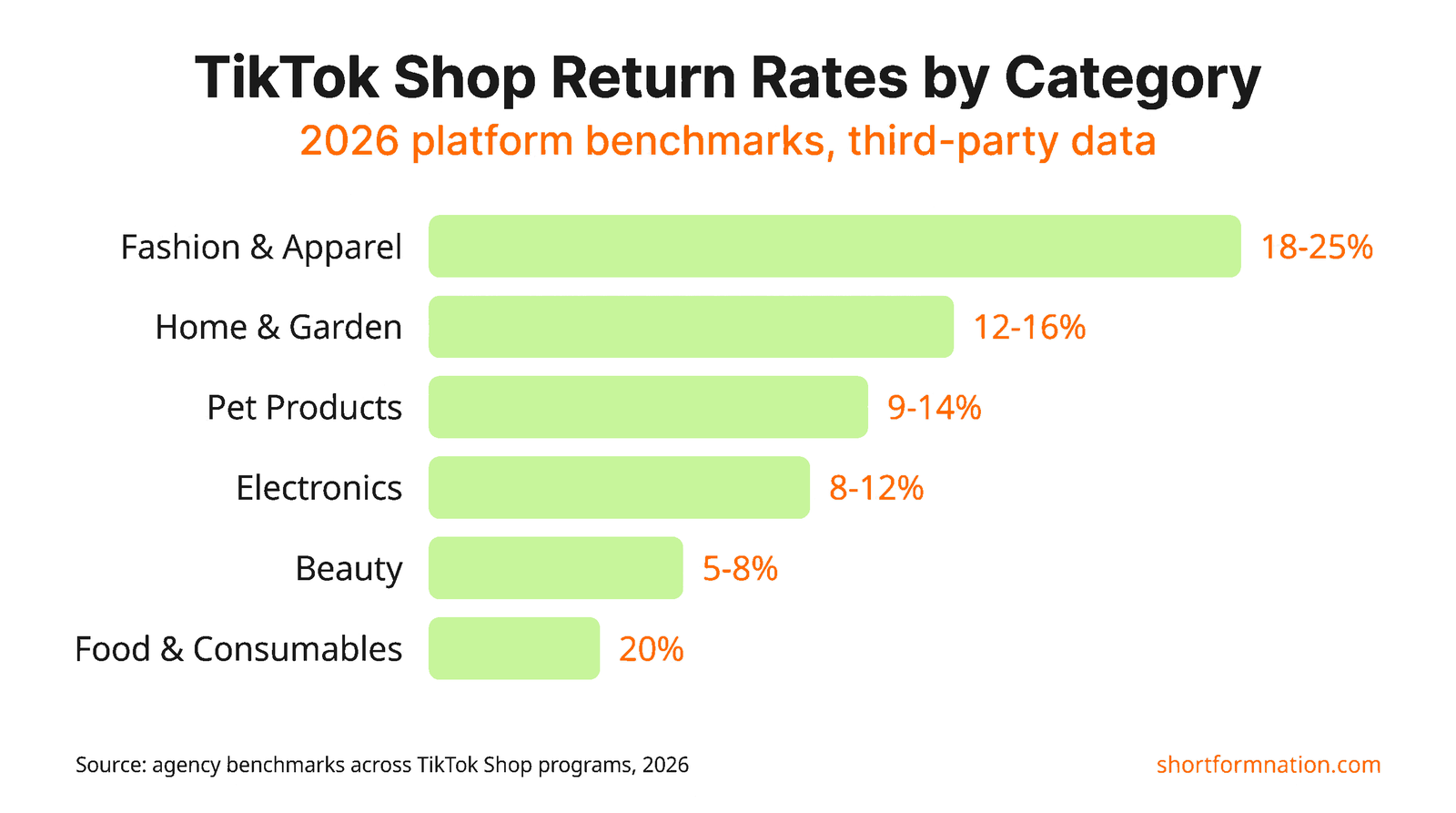
TikTok Shop's platform-wide return rate sits between 8 and 15%. That range exists because categories behave radically differently... fashion sits at 18-25%, beauty at 5-8%, food at 3-6%. Here are the benchmarks sellers should actually plan for, pulled from third-party data published by Dashboardly and Canopy Management.
CategoryReturn RateFashion & Apparel18-25%Home & Garden12-16%Electronics & Gadgets8-12%Pet Products9-14%Beauty & Cosmetics5-8%Food & Consumables3-6%Platform average8-15%
Cross-platform the picture gets starker.
PlatformReturn RateTikTok Shop8-15%Instagram Shop6-10%Amazon FBA5-7%Shopify Direct4-6%eBay2-3%
TikTok Shop's return rate runs 2-3x Amazon's across every category. The structural reason is content-first buying, not logistics quality.
For a side-by-side on how TikTok Shop stacks against Amazon across the full P&L, see TikTok Shop vs Amazon.
Why Fashion Tops Every Other Category
Fashion's 18-25% return rate isn't about shipping. It's about five overlapping content drivers. Sizing mismatch is the biggest... a creator wearing a Medium on a 5'2" frame doesn't translate cleanly when a 5'9" buyer orders the same size. Quality perception gap is second... fast-fashion TikTok content often shows products under ring-light conditions that flatter stitching and fabric drape in ways the product can't match in natural light.
The third driver is impulse-from-emotion. Fourth is try-and-return culture, where buyers treat TikTok Shop fashion like a no-commitment fitting room. Fifth is filter-distorted color. All five are content decisions, not shipping decisions.
The Holiday Return Spike (And How to Forecast for It)
November-December return rates hit 25-35% across the platform, according to seller-reported data across multiple forums and Discord channels. Gift-buying buyers have weaker purchase conviction. Returns lag the sale by 2-4 weeks, which means Q4 sales show up in Q1 cash flow as returns.
Sellers who survive the Q4-to-Q1 transition cleanly plan for three things: a cash flow buffer equal to 20% of projected Q4 GMV, inventory buffer for restocked returnable items, and a customer service bench big enough to hold the 48-hour SLA on a 2x return queue volume.
Cross-Platform Comparison (Why TikTok's Rate Runs 2-3x Amazon's)
The easy answer is "TikTok buyers are impulsive." The real answer is that the TikTok Shop funnel is pre-compressed into the creator video. On Amazon, a buyer reads 50 words of copy, three reviews, a return policy, and specs before checkout. On TikTok Shop, the buyer makes the same decision in 11 seconds of creator emotion. The return rate reflects that compression.
This has knock-on implications for commission rate structure... because every refund fully reverses the commission, high-return-rate categories need to price in 10-15% margin headroom the moment they set creator commission tiers.
The True Cost of a Return (Margin Math Sellers Miss)
The headline return rate hides the real damage. A fashion seller at 20% return rate loses 77% of their gross margin to reverse logistics once the full cost stack gets counted. Commission clawback, Refund Admin Fee, return shipping, inspection labor, and lost SPS points compound. Here's the math.
Cost Components of a Single Return
Every TikTok Shop return creates a six-line cost event.On a $30 AOV fashion product with 62% gross margin, the per-return loss runs $12.50 to $15.50. Multiply by a 20% return rate on 100 sales and 20 returns erase $270 of profit on top of commission revers
The Margin Compression Math (62% → 14.4% at 20% Returns)
Here's the worked example. Fashion seller, $30 AOV, 20% return rate, standard COGS and fulfillment.
ComponentAmountCOGS$8.00Inbound shipping$1.50Commission (5%)$1.50Transaction fee$0.30Total cost per sale$11.30Gross sale$30.00Gross profit (kept sale)$18.70 (62% margin)
Now apply the return math on 100 sales.
The seller went in looking at a 62% gross margin. They left with a 14.4% net margin. That's a 77% margin erosion driven entirely by return economics.
Fashion seller, 20% return rate: gross margin 62% → net margin 14.4%. Every percentage point of return rate reduction above 15% returns ~$45 to net profit per 100 sales.
Reducing that return rate from 20% to 12% doesn't save pennies. It rebuilds the business.
The Hidden SPS Penalty (Why Returns Cost You Settlement Speed Too)
The dollar cost stack is the obvious part. The less-visible cost is Shop Performance Score damage.
TikTok runs a 60-day rolling Shop Performance Score model with six sub-metrics: Cancellation Rate, Late Dispatch Rate, IM Dissatisfaction Rate, Negative Review Rate, Valid Tracking Rate, and Order Fulfillment Rate. Return-rate penalties cascade through these sub-metrics because returns generate negative reviews, IM complaints, and cancellations.
Each 1% increase in return rate correlates with 8-12 Health Score point losses across the SPS stack. The settlement speed tiers sit on top.
A fashion seller who drops from SPS 4.0 to SPS 3.4 doesn't just lose sizing subsidy. They add 7 days of cash-flow delay on every settlement. That's a working capital hit that most sellers don't model until they hit it.
Why TikTok Shop Returns Are a Content Problem
Most TikTok Shop returns don't trace to a logistics failure. They trace to a gap between what the creator video showed and what arrived in the box. This is the thesis of the whole guide. Once sellers see it, they stop optimizing for the wrong variable.
The Impulse-to-Conviction Gap
Here's the thing. TikTok Shop's add-to-cart rate runs 12-18% per agency benchmarks. Search-first platforms run materially lower based on published e-commerce benchmarks. That gap is why TikTok has the highest top-of-funnel velocity on the internet. It's also why it has the weakest purchase conviction.
An Amazon buyer who adds to cart has done the research. They've read reviews, compared options, and decided. By checkout they've mentally committed. The product has to fail at arrival to get returned.
A TikTok Shop buyer who adds to cart has been moved by a 11-second creator video. They've bought on creator energy, not product specs. Between checkout and delivery the energy fades. The product arrives and gets compared against the video... not against research they didn't do.
The question becomes: does the product deliver on what the video implied? If yes, the order sticks. If no, the return gets initiated.
The Five Content-Driven Return Drivers
When we pattern-match returns across categories, five drivers dominate.
All five are creative decisions. None of them are shipping decisions. Every one can be eliminated upstream by tighter content-to-product alignment.
What Competitor Content Does Wrong (Overselling in the Hook)
Watch the top-performing creator videos for a fashion SKU. The first 2 seconds are a hook. The hook is almost always an emotional overclaim. "This dress is the only one I'll wear all summer." "This fits every body type." "Obsessed with how this looks."
Those hooks convert. They also set a buyer expectation the product can't keep. The return is already in motion the second the video lands.
The fix isn't to kill the emotion. It's to calibrate it. The highest-performing TikTok Shop sellers train creators to land emotion in the hook and specificity in the demo. The buyer arrives at checkout conditioned on both the feel and the fit. When the product arrives it matches both. Returns collapse.
This is where how to write creator briefs becomes the load-bearing document in a creator program. The brief is where content-to-product alignment gets engineered before anything ships to the buyer.
How to Prevent Returns Before They Ship (5-Step Framework)
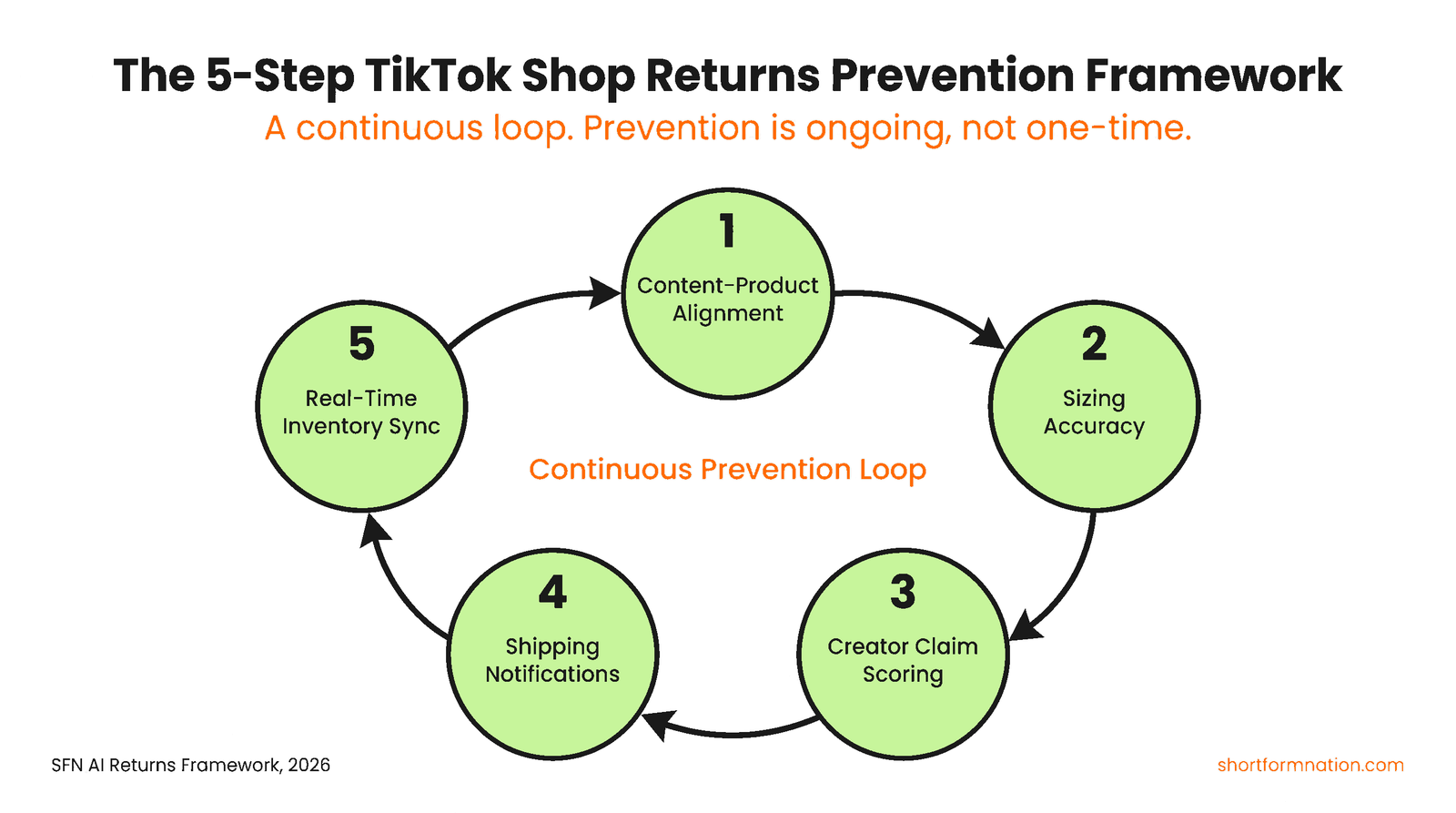
TikTok Shop returns are prevented upstream, not processed downstream. The 5-step prevention framework below is mapped to schema.org HowTo. Each step attacks one structural driver of return rate. Applied together, sellers typically see return rate reductions of 20-40% within 60-90 days.
Step 1: Audit Content-to-Product Alignment
Pull the top 20 creator videos currently driving sales for each hero SKU. Compare three variables against the actual product: visual representation, verbal claims, and demonstrated use.
Score each video on a simple pass/flag grid. Sizing shown? Pass or flag. Color accurate under natural light? Pass or flag. Actual use demonstrated? Pass or flag.
Any video with more than one flag is a return generator. It stays live only if the return rate on that video is below the category benchmark. Otherwise it gets replaced. This audit takes one afternoon per category. The return-rate signal it produces runs for months.
Step 2: Fix Sizing and Dimensional Accuracy
Fashion and home-goods returns collapse when the creator shows size context. Hand-for-scale. Side-by-side with a reference object. Standing next to a doorway. Holding against a standard piece of furniture.
The cost is 10 seconds of additional creator footage. The return-rate impact is meaningful... sellers running this discipline report fashion returns dropping from 22% to 14% within 90 days, though exact results vary by SKU and buyer demographics.
For home goods specifically, require a dimension callout in every video. Not just a verbal mention. A visible reference. Buyers who see a candle next to a coffee mug don't return candles for being smaller than expected.
Step 3: Score Creator Content for Claim Accuracy
Every creator video that promises something the product can't deliver is a return waiting to happen. For a 10-creator program this is manageable manually. Past 50 creators the content volume outpaces any manual review.
This is where Coherence Scoring becomes load-bearing. SFN AI's Coherence Scoring measures whether a creator video matches the brief the seller actually wrote... catching off-script claims, missing product demos, and overselling hooks before the content ships to a buyer who will mis-calibrate expectations and return.
The number we track internally: creators with 90%+ coherence average 6.9x higher earnings per video than creators running open-script. The return-rate side of that equation is the quiet part. Higher coherence means buyers arrive at delivery with calibrated expectations, and those buyers keep the product.
Sellers running fewer than 20 active creators can do this manually by reviewing every video against the brief before publish. The manual approach works. It just scales badly past that volume.
Step 4: Deploy Proactive Shipping Notifications
A 12-18% return rate reduction is available for free. Sellers who send delivery-window notifications, tracking updates, and arrival confirmations see that reduction versus sellers who rely on default TikTok notifications (source: hyperfocus.tech seller study).
The mechanism is delivery-anxiety reduction. Buyers who know exactly when a product is arriving don't feel out-of-control during the shipping window. They don't initiate "where is my order" support tickets that convert into cancellation requests. They don't file chargebacks out of impatience.
Most sellers treat shipping notifications as a customer-service line item. It's actually a return-rate intervention.
Step 5: Sync Inventory in Real Time
Orders placed against sold-out inventory get refunded, not fulfilled. That's a 12% return rate reduction opportunity per hyperfocus.tech data... and the fix is purely operational.
Real-time inventory sync between TikTok Shop and any secondary sales channel (Shopify, Amazon, direct) eliminates the "sold out during transit" refund path. Most sellers are running 6-hour batch syncs. The high-performers are on 15-minute syncs or real-time webhooks.
Cost of the fix: one-time integration setup with any modern commerce OMS. Return-rate upside: permanent.
How to Process Returns Without Killing SPS
Prevention is the primary lever. But once a return is initiated, the question shifts to damage control. The goal becomes protecting Shop Performance Score while minimizing cost. Four rules matter.
Respond within the 48-hour window, every time. Manual approval is always better than auto-approval. Even a decision to dispute (with documented evidence) preserves SPS better than letting the clock expire. Build a queue process that treats 48 hours as hard... not soft.
Dispute only when the evidence is bulletproof. Dispute arbitration sides with the buyer roughly 70% of the time. Sellers who dispute 100% of returns burn admin hours and lose the majority anyway. Dispute only when photo evidence of buyer-fault is clear (product damage during buyer use, fraudulent INAD ("item not as described") claims, wrong item returned, or suspected return fraud).
Use returnless refund for low-AOV, low-resale items. If the product costs less than the reverse logistics, don't ship it back. Pet products, low-AOV beauty, and impulse accessories are the usual candidates. Push the returnless refund threshold to $20-25 for these categories and watch per-return loss drop.
Track SPS sub-metrics weekly, not monthly. The 60-day rolling window means early detection matters. A return-rate spike that takes 30 days to notice is a return-rate spike that already cost settlement speed. Dashboard the six SPS sub-metrics weekly... Cancellation, Late Dispatch, IM Dissatisfaction, Negative Review, Valid Tracking, Order Fulfillment.
For the full SPS settlement tier operational detail, the how to sell on TikTok Shop guide breaks down the settlement speed tiers in full.
Seasonal Return Management (The Nov-Dec Spike)
TikTok Shop return rates hit 25-35% in November and December, based on seller-reported data across multiple community sources. Every seller scaling into Q4 needs a seasonal return playbook. Four components.
Cash flow buffer. Hold 20% of projected Q4 GMV as working capital reserve. Returns lag sales by 2-4 weeks, which means Q4 revenue shows up in Q1 cash flow as returns. Sellers who don't buffer get margin-called by their own success.
Inventory buffer. Resellable return items need warehouse space. Most sellers don't plan for it. Budget 15% additional warehouse capacity through January for returned-but-resellable inventory.
Customer service bench. The 48-hour SLA holds at 2x queue volume only if the bench scales. Hire seasonal CS capacity by October 15. Train them on the return queue workflow before Black Friday.
SPS protection. Q4 is the worst possible time to let SPS drop. Settlement speed matters most when cash flow is tightest. Q4 is not the time to reduce returnless refund thresholds, dispute aggressively, or test new creator content... it's the time to run the playbook that's already working.
The goal in Q4 isn't to minimize returns. It's to minimize SPS damage. Those are different optimization targets.
What Your Return Rate Is Actually Telling You
Returns are the most honest attribution signal on TikTok Shop. Every other metric lies. Impressions are inflated. Click-through rates are platform-fudged. Even GMV is gross, not net. Returns are net. They're the only number that tells the truth about whether the buyer kept the product.
That makes return rate a creative feedback loop, not a logistics metric. A high return rate on a specific SKU isn't a shipping issue. It's a message that the creator content driving that SKU is over-promising.
The sellers who compound on TikTok Shop aren't the ones with the lowest return rate. They're the ones who use return patterns to refine their creator briefs, their hero SKU selection, and their content guidelines.
Treat return rate as a creative feedback loop. The return rate on a SKU is the most honest review of the creator content driving it.
The second-order effect is bigger. Return rate is the metric that separates sellers who stay at $50K/mo from sellers who scale to $500K/mo. The scaled operators don't have fewer returns. They have a return-rate system that compounds their creator content quality over time. Every return becomes a data point that sharpens the next brief.
We're not guessing anymore. We're engineering. The brands that get to the other side of 2026 as TikTok Shop-native operators are the ones treating every return as a signal, not a cost.
The Upstream Fix
If returns trace back to content misalignment, prevention starts upstream of the return queue... inside the creator brief and the creator video itself.
SFN AI's Coherence Scoring measures whether creator videos match the brief. It catches off-script claims, missing product demos, and overselling hooks before they ship to a buyer who will mis-calibrate expectations and return. For brands running creator programs at scale, this is the control layer that keeps return rate tracking with content quality... not drifting against it.
Sellers running fewer than 20 active creators can do this manually. Review every video against the brief before publish. The approach works. It just takes time that doesn't scale past 20 creators.
For the brands scaling past that, the full TikTok Shop affiliate playbook connects creator intelligence, return-rate feedback loops, and the content control layer into one system. The walk is the only talk that matters.
Frequently Asked Questions
What is TikTok Shop's return policy?
TikTok Shop's 2026 return policy gives buyers 30 calendar days from delivery to initiate a return. Sellers have 48 hours to accept or dispute. Non-seller-fault returns use a 50/50 cost split between TikTok Shop and the seller; seller-fault returns are 100% seller-absorbed. Sizing-issue returns carry an additional SPS-tiered return shipping subsidy per the Jan 2026 Policy Pulse update... verify current rates in TikTok Seller University before pricing returns into your margin model.
How long does a TikTok Shop refund take?
TikTok Shop refunds process 3-10 business days after the return is received and inspected. Payment posts back to the buyer's original method within that window. For returnless refunds (orders under $10 by default), processing is typically 1-3 business days.
What is TikTok Shop's return rate?
TikTok Shop's platform average return rate runs 8-15%, according to third-party data from Dashboardly and Canopy Management. Category averages vary widely: fashion 18-25%, beauty 5-8%, home & garden 12-16%, electronics 8-12%, pet products 9-14%, food and consumables 3-6%. Seasonal spikes in November-December reach 25-35%.
Does TikTok Shop charge restocking fees?
TikTok Shop does not charge an official restocking fee to buyers. Sellers absorb inspection and restocking labor on their side. The Refund Admin Fee (May 2025+) of 20% of referral fee, capped at $5 per order, is separate from any restocking cost.
How do I reduce returns on TikTok Shop?
The highest-leverage prevention is upstream in the creator content. Five steps: audit content-to-product alignment on top creator videos; fix sizing and dimensional accuracy with on-camera reference; score creator content for claim accuracy before publish; deploy proactive shipping notifications (12-18% return reduction); sync inventory in real time (12% reduction). Sellers running this framework typically see 20-40% return-rate reductions within 60-90 days.
Founder of SFN AI. We watch TikTok Shop 24/7 so creators and the brands that run them get the playbook.