How to Manage Multiple TikTok Shop Clients: The Agency Operations Guide
How to manage multiple TikTok Shop clients: TSP tier thresholds, authorization expiry, cross-client creator conflicts, per-client attribution.

Managing Multiple TikTok Shop Clients Is a Different Job Than Running One Roster
Nearly every TikTok Shop operations guide we could find models one shop, one catalog, one roster, one P&L. Useful if you are the brand. Close to useless if you are the operator running the brand.
If you run an agency or a TikTok Shop Partner account, your unit of work is not the creator. It is the client shop. You do not have a roster, you have several. You do not have an attribution problem, you have one per client. Every authorization you hold runs on its own clock.
In 60 days we spoke with more than 20 agencies running multi-client TikTok Shop books, and one number explains the whole job: every client you hold feeds exactly one TSP tier score, computed monthly on daily GMV thresholds, with no appeal. Your worst client's churn is charged against your ability to win the next one.
What Actually Breaks, and What Each Break Costs You
Across those twenty-plus agencies the bottleneck was the same every time, and it sits in four places at once. Every one of the four ledgers fails silently. None of them throws an error, and all four fail in the client's favour before they fail in yours.
The authorization break is the cleanest. A TSP authorization runs a maximum of one year, and for US local and cross-border merchants only the partner can send the renewal link. Nobody sends it, the shop goes dark mid-campaign, and the client's first signal is a report that stops updating.
The tier break is charged twice. Losing a client removes its GMV from a score computed on daily thresholds and damages the merchant retention rate feeding the 20% quality input to that same score. No warning, just a recalculation between the 3rd and the 5th of the following month, with no appeal.
The calendar break is invisible from inside either account. Two managers book one creator for two client shops on the same Tuesday, both posts go out, both underperform. No conflict warning, no double-booking error, no flag anywhere, just soft reach on two accounts and two conversations about whether the creator is worth keeping.
The attribution break arrives last and costs the account. A GMV Max campaign runs inside a client's shop, absorbs the organic orders your creators produced, and the dashboard credits the ads. None of it surfaces until renewal, when the honest answer sits one filter deep in a report neither of you has opened.
Each break has an owner, and the owner is a ledger you keep per client shop.
Almost nothing about running one roster well tells you how to manage multiple TikTok Shop clients at once. Segmentation and manager ratios are covered in creator management at scale. Agency-versus-in-house math is settled in scaling an affiliate program without losing margin or control. The underlying mechanics are in the complete affiliate guide. None of it is repeated here.
The Four-Ledger Model
- The Authorization Ledger ... what you may touch inside that shop, and when the permission dies.
- The Tier Ledger ... what that client contributes to your TSP score, and what its exit costs.
- The Calendar Ledger ... which creator posts for which client, and when.
- The Attribution Ledger ... how much of that client's GMV you can actually defend.
Four ledgers, four silent failures. Which of them even applies to a given client depends on something you agreed before any of them existed: which rail that client signed onto.
TSP and TAP Are Two Rails, and Every Client Sits on One of Them
Partner Center does not treat "agency" as one thing. It treats TSP (TikTok Shop Partner) and US TikTok Shop Affiliate Partner (TAP) as separate partner types with separate finance tracks: settlement guidance lives in "[CAP/TAP] Finance guide (US only)" and "[US] Creator Matchmaking (TAP) Settlement report Guide," neither of which governs TSP service settlement. Reacher holds both statuses at once, proof these are two things you hold, not two names for one.
One line to memorize before you sign anything:
"The agency can only collect commission from the Seller. The agency cannot collect commission from the Creator, as this would be considered 'double dipping.'"
That is TikTok's US Seller University page on agency Partner Campaigns, knowledge_id 8874916770678574, page-dated 05/13/2026. Its changelog reads "Recent Updates as of February 2024," so treat the mechanics as long-standing rather than new.
The commission structure TikTok documents for agency Partner Campaigns runs in four steps.
| Step | What happens |
|---|---|
| Seller offers a total commission | For example, 30% |
| Agency sets the creator's rate | Any rate at or below 30%, say 15% |
| What the creator sees | 15% ... "the commission rate they are paid by the agency, not the Seller" |
| What the agency may never do | Take a second cut from the creator |
Demand exists: Modern Retail covered Project Horizon, TikTok incentivizing agencies to onboard brands already driving $10M+ on competing platforms (Modern Retail, March 2026). Ashley Wright's Summit LA recap on LinkedIn, April 2026, reported TSP-partnered brands growing 197% in 2025 against an 80% platform average, which is agency-reported, not confirmed in any TikTok disclosure.
Which rail each client sits on
The portfolio question is not which rail you are on, but which rail each client sits on, because one account holds both.
A client bound to you as a TSP service order contributes its shop GMV to your tier score and settles on the TSP track. A client run through TAP creator matchmaking settles on a different report and, on the counting basis TikTok documents for measured services, should be treated as contributing nothing to that score until your partner manager confirms otherwise. Identical work from your side, two finance tracks, one of them invisible to the number that decides how the platform treats you next. If half your book sits on TAP, half your revenue is doing nothing for your tier. Tag every client with its rail the day it signs.
One vendor note, because it governs what you can promise contractually: Euka, Reacher, Hubfluence and Kixmon hold official TikTok Shop App Store partner status, while Kalodata, FastMoss and EchoTik operate by scraping.
Which rail a client sits on decides how it settles. Which authorization it sits under decides whether you can touch it at all.
How Client Shops Actually Attach to Your Agency
Every client shop attaches through TikTok Shop Partner Center as a scoped, expiring authorization. Get this ledger wrong across ten clients and you lose a shop mid-campaign.
A TikTok Shop Partner authorization lasts up to one year. Sellers grant it at a named scope, it expires on its own start date, and for US local and cross-border merchants only the partner can send the renewal link. Renewal is therefore the agency's obligation, not the seller's.
The hard ceiling is one year. From TikTok's US guidance on authorizing partner services, knowledge_id 1777027175974698, dated 10/03/2025:
"you can authorize a TSP service for up to a year, with the option to renew the service by authorization link before the authorization expires."
"If you are a local merchant in the UK and US, or a cross-border merchant, you can only renew your authorization through an authorization link sent by TSP."
So for US local and cross-border clients, renewal is your job, not theirs. If nobody sends the link, the shop goes dark to you. Sellers only see services expiring within 15 days. We run the alert at 60 days out, per client.
Now multiply it. Ten clients means ten authorizations, ten start dates, ten expiry dates that do not line up, and ten renewal links only you can send. A single-client operator has one date to remember. At ten clients you run ten independent clocks, every one your obligation, every one silent until the shop goes dark and the client asks why the report stopped. Nothing in Partner Center rolls those dates into a portfolio view.
The "Closed" collision
"Closed" means two entirely different things depending on which status table you are reading.
| Where you read it | What "Closed" means |
|---|---|
| Authorization status | "The partner has been removed from the platform for violating platform policies. Your authorization with the partner has been deactivated." |
| Request status | "The assignment has been closed" |
On the request table it is housekeeping. On the authorization table a partner was removed for policy violations. Map both to one label in your client view and someone will eventually reassure a client about the wrong one.
Scope matters too. What a client actually hands you is Seller Center access at a named level. Per knowledge_id 6121689348146987, dated 07/16/2024, only the seller's main account can authorize TSP services, and sellers grant "full access or specific area access, such as product access and Ads manager access," plus a separate Data Analytics layer. That page is over two years old, so verify in the live console before writing it into an SLA.
The Authorization Ledger: one row per client shop with expiry date, renewal owner, granted scopes, main-account contact, and status from the correct table. Add the shop-health obligations you inherit on day one, in the seller handbook.
Access is what one client grants you. What every client you hold does to every other one runs through a single number.
The US TSP Tier Mechanism: How Your Whole Book of Clients Sets One Score
Your TSP tier is not per client. It is one number computed from every client you hold, and it decides how the platform treats the next client you try to win. Everything below comes from one partner-gated document, "[US] TikTok Shop Partner Tiering Mechanism," read logged-in inside TikTok Shop Partner Center on July 30, 2026.
Start with a correction. There is no publicly documented US TSP tier system. Every "Gold," "Platinum" or "Diamond" partner badge in English-language agency content traces to non-US programs: Malaysia, Indonesia (seller-id.tokopedia.com), and the UK's Creator Agency Partner Certification:
"Our Creator Agency Partner (CAP) Certification programme launched this August... With badges across key areas like LIVE, Short Video, and Creator Growth, as well as the TikTok Shop Diploma."
That is TikTok Shop's UK newsroom. Real programme, wrong country.
The tiers, the inputs and the thresholds
The mechanism runs V0 TSP → V1 Certified TSP → V2 Bronze → V3 Silver → V4 Gold → V5 Platinum, recalculated automatically between the 3rd and 5th of each month. Appeals are not supported.
| Input | Weight |
|---|---|
| GMV | 80% |
| Quality | 20% ... next-month retention of merchants and creators, quarterly platform satisfaction survey, creator renewal rate (coming) |
| SKM lead multiplier | 1.0 under two leads last month, 1.1 from two, 1.2 from five, 1.4 at ten or more, applied on top of the weighted score |
The US TikTok Shop Partner tier system runs six levels, V0 through V5, scored 80% on GMV and 20% on quality, recalculated between the 3rd and 5th of each month with no appeal.
| Tier | Title | Daily GMV | Retention / satisfaction | Score |
|---|---|---|---|---|
| V5 | Platinum | $300,000 | 100% | 100 |
| V4 | Gold | $100,000 | 80% | 80 |
| V3 | Silver | $30,000 | 60% | 60 |
| V2 | Bronze | $10,000 | 40% | 40 |
| V1 | Certified | > $0 | 20% | 20 |
| V0 | TSP | $0 | 0 | 0 |
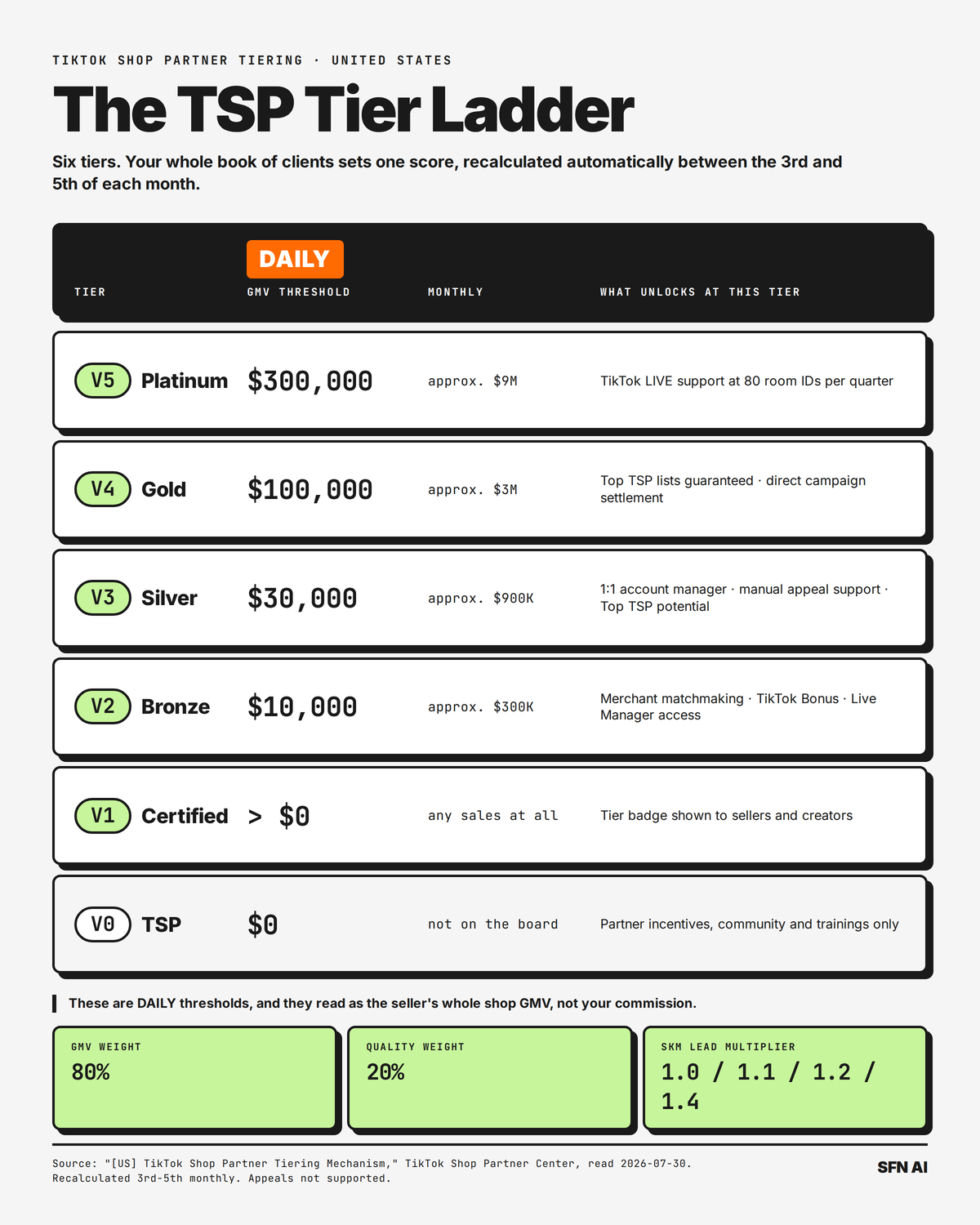
Those are daily thresholds reading as the seller's shop GMV, not your commission, so roughly: Bronze $300K a month, Silver $900K, Gold $3M, Platinum $9M. V1 Certified requires only GMV greater than zero, so one live client shop with any sales qualifies you for the badge tier, which makes V0 a strange place for an agency with live clients to be sitting.
Tier is a portfolio outcome. $10,000 a day for Bronze can be one anchor client or six small ones. Signing a single $30K-a-day client moves you two tiers; losing it drops you two and damages the merchant retention rate feeding the 20% quality input.
Watch the counting basis. Measured services are scoped to bound merchants: "we will track the seller's shop alliance GMV during the service period." The subject is the seller's whole shop, not your attributed links, so treat app-authorization-only and TAP-campaign-only work as not counting toward tier until you have confirmed otherwise with your partner manager.
The Tier Ledger: per client, daily shop GMV, contract window, whether the merchant is bound as a service order, and SKM leads sourced.
What Each TSP Tier Gives You Across Your Client Book
Tier is not a vanity badge. From V2 upward it becomes a client-acquisition channel, so your current book is what buys your next client.
| Benefit | Available from |
|---|---|
| Tier certification badge shown to sellers and creators, plus honor awards | V1 |
| Partner-Merchant Matchmaking (inbound lead pool) | V2 |
| TikTok Bonus during campaigns | V2 |
| Live Manager access (operate on behalf of linked creators) | V2 |
| TSP Campaign Settlement (online commission split) | V2 reviewed, V4 direct |
| Top TSP and Top Live TSP lists, in Seller Center, Partner Hub and the creator Affiliate Center | V3 potential, V4 guaranteed |
| 1:1 TikTok account manager, manual appeal support on takedowns, priority feature testing, offline matchmaking priority | V3 |
| TikTok LIVE support (20 / 50 / 80 room IDs per quarter) | V3 / V4 / V5 |
| Partner incentives, community, trainings, offline events | V0 |
V1 makes you legible, because "tiering badges are only displayed for V1-V5 partners." V2 is where the platform starts sending you clients. V3 and V4 add discovery on both sides, with the Top TSP list "displayed in the Partner Hub App, Partner Hub Web, TTS Seller Center."
Which produces the effect nobody prices in. Losing a client removes its revenue, lowers your quality input, can drop your tier, and can therefore remove you from the discovery surfaces you would use to replace it. Churn on a multi-client TSP book compounds. TSP tiers are unrelated to creator tiers inside each client's program, covered in how to build a tiered affiliate program.
So the fastest way to damage next year's client acquisition is to mishandle this year's roster. And the fastest way to mishandle a roster is to book one creator twice.
One Creator, Several Client Shops: The Conflict Rules Nobody Publishes
This is the section the rest of the guide exists for. Hold two clients in one category and a single creator can work for both, with TikTok deciding which commission wins.
Exclusive Collaboration overrides Target, and Target overrides Open, on the same product.
| Collaboration type | Precedence | Who chooses the creators |
|---|---|---|
| Open Collaboration | Lowest | Any eligible creator self-selects |
| Target Collaboration | Overrides Open on the same product | The seller or agency invites |
| Exclusive Collaboration | Overrides Target | TikTok Shop selects them |
Target always supersedes Open on the same product, and Exclusive then supersedes Target, per knowledge_id 2273960886011703, dated 05/13/2026:
"The Exclusive Collaboration rate takes priority. If your existing Target Plan commission is higher, it will override the invite rate. If it's lower, the new invite rate will replace it."
Now the part that bites an agency. Exclusive collaborations are invite-only, and asked whether a seller can choose the creators, TikTok answers: "No. TikTok Shop selects the creators." Free samples are mandatory, and once registered, products cannot be changed. TikTok overrides the client's rate, on products the agency did not choose, for creators it did not pick, beating whatever you set from TikTok Shop affiliate commission rates.
The overlap problem is smaller than the industry assumes
Most agency conflict policies fear two clients fighting over one creator. The data pushes back.
Across Medicube, Dr.Melaxin and SKIN1004, only 2 of the top 60 creators sell for more than one brand, and top-20 creators drive 39-50% of each brand's creator GMV.
That is Kalodata, July 2026, third-party rather than platform-confirmed, so directional. Top creators are effectively single-threaded per brand. The conflict you wrote a policy about is rare. The ones that happen have no policy at all.
The three conflicts that actually happen
1. Cadence, not commission. A creator posting five videos a week needs those posts spaced 48 hours apart to avoid the algorithmic view cap applied to one creator inside a 24-hour window. That rule is operator-observed rather than published by TikTok. Running the same product twice in one week costs it roughly 25% of its reach in our own campaign measurements, which are internal and not independently verified. Two managers booking that creator for two clients on one Tuesday suppress both.
2. Cross-agency commission splits. When your client's creator is managed by a different agency, "the agency that created the campaign... can decide how much of that commission to give to the Creator," and the remainder "is then split between the Creator and the agency that manages the Creator." So the number your client approved is not what the creator sees.
3. Disclosure. FTC staff guidance is explicit about what triggers the obligation:
"A 'material connection' to the brand includes a personal, family, or employment relationship or a financial relationship," the FTC writes, "such as the brand paying you or giving you free or discounted products or services."
It is equally clear on whose job it is: "As an influencer, it's your responsibility to make these disclosures." That page's body text dates to November 2019, so cite it as FTC staff guidance, never as current FTC rules.
Our deduction, marked as ours: the FTC page contains no rule about competing brands. What follows from the material-connection standard, in our reading, is that a creator working with two competing client shops has two independent material connections, each needing its own disclosure. Our reasoning, not an FTC requirement.
What you owe each client
Allocate on niche fit, not first call. A beauty creator selling beauty converts 2-5x better than the same creator outside their niche on agency-side reporting, directionally rather than precisely, so the tiebreak is which product that audience already buys. The bench is thin: only 71 creators have crossed $1M lifetime GMV against a median creator GMV of $0 (Cruva, July 2026, agency-reported). Building one is covered in how to recruit TikTok Shop creators at scale.
Do not build a book where creators belong to you and not to the client. Aggregated agency reporting puts churn at 58% on Open Collaboration, 34% on Target and 18% on exclusive contracts, which argues for depth. No single operator is named against those figures, so treat the ranking as the finding. Depth has a limit: an agency owning relationships so completely that no creator follows the brand out is a hard red flag in agency due diligence.
The Calendar Ledger: one row per creator per client with post dates, the 48-hour check, category, collaboration type, and which client holds the higher effective rate. Impossible to keep by hand past a handful of clients, which is the point at which every agency in this position either hires a coordinator or changes the operating model. Both answers appear later.
Proving It Was You: Per-Client Attribution That Survives a Review
You can run a flawless program and still lose the account, because the client's dashboards hand your GMV to something else. The largest cause is GMV Max.
Yes, GMV Max takes credit for organic sales. While a Product GMV Max campaign is running inside a client's shop, TikTok attributes all paid and organic orders for the products in that campaign to GMV Max, whether or not the buyer engaged with one of the ads.
From TikTok's GMV Max attribution page, last updated June 2026:
"When you create a Product GMV Max campaign, all paid and organic orders for the products you chose for your campaign will be attributed to GMV Max while the campaign is running... the order will be attributed to GMV Max whether or not they engaged with one of your ads."
Every affiliate video your creators posted for that client, in that window, on those SKUs, counts as ad-driven (TikTok Ads Help). The multi-client landmine is the LIVE variant. The same page confirms LIVE GMV Max attributes orders from all shops during the LIVE event, including shops not used to set up the campaign. Run LIVE for two clients in one category and one campaign absorbs the other's orders.
The two dashboards will never agree. From TikTok's Shop Ads attribution page, last updated August 2025 and unchanged since ... verify the window in Ads Manager before you write it into a client report:
"Note: Seller center reports sales that happen on the day, whereas TikTok Ads Manager reports sales that have happened within the 7-day attribution window."
Clicks attribute over 7 days, views over 1, and clicks take precedence (TikTok Ads Help). Across ten clients that is twenty numbers that cannot reconcile, so build the explanation into your multi-client reporting template once, not into ten conversations. The same page lists what Shop Ads attribution does not do: "We do not use a product ID for attribution · We do not consider format for attribution · We do not consider affiliate creator vs. non-affiliate creator · We do not consider placement."
One thing works in your favour. In Partner Campaigns, "sellers cannot see creator-specific performance data. Sellers are only able to view product-specific performance data." The creator-level view is yours by design, so make it the centerpiece.
The one native way to isolate affiliate GMV
There is exactly one first-party filter separating affiliate from self-selling, on knowledge_id 6077860360177451, dated 06/03/2026:
"In the data compass of the e-commerce center, you can filter All and Affiliate data: All: Merchant Self-Selling + Affiliate Promotion Affiliate: Affiliate promotion only"
That is the honest answer to "how do you prove it was us." Pair it with per-creator GMV from your Partner Campaign view and utm_content set to the creator handle for anything leaving TikTok, then state the gap in writing: agency-side cross-platform measurement, not any TikTok disclosure, puts 20-40% of TikTok-driven conversions outside TikTok Shop attribution, and the same operator reporting has native attribution closing at 28 days on in-app conversions only. Commission itself is (Revenue − Refunds) × Commission rate, paid 15 days after delivery, or later where the seller's own settlement terms are longer, with Open Collaboration rate edits effective 30 days later and Target edits 5 days later.
The Attribution Ledger: one row per client with the All-versus-Affiliate compass figure, per-creator GMV from your Partner Campaign view, whether a GMV Max campaign was live in the window, whether any LIVE GMV Max ran in the client's category, the utm_content handles in play, and the stated attribution gap you agreed at signature. Metric definitions sit in TikTok Shop affiliate analytics.
That is four ledgers on one client shop. Signing the next one does not add a fifth. It adds a full set, and takes something out of the ones you keep already.
Onboarding Client Seven Costs More Than Onboarding Client One
You can stand a client shop up in 30 days, and the client onboarding process barely changes between client one and client seven. What changes is what intake takes out of the book you already hold, and none of that appears in the plan you send the client. Three costs land the moment you sign.
Bench cannibalization at intake. The cross-client bench is what makes client seven cheap to launch, and spending it is what makes clients two through six harder to keep. The useful end of any category bench is small and already busy: the top 1,000 creators account for roughly 24.45% of creator-driven GMV and the top 100 for 6.41%, and the average creator fields 50 or more affiliate outreach messages a day (Cruva, July 2026, agency-reported). Seeding twenty proven category creators into a new launch is not spare capacity. It is capacity posting for someone else, and it collides with the 48-hour rule the first time both clients want a Tuesday.
Tier dilution during the ramp. A new shop sits near $0 a day while it finds its SKUs, and tier is computed on daily GMV at an 80% weight across the whole book, so an intake-heavy quarter holds your score flat while your revenue grows. The quality input is next-month merchant retention, so a client you onboard and lose inside its own ramp charges you twice for having signed it. No ramp allowance, no appeal.
Category conflict against the existing book. Before the contract, not after, run the new client's top SKUs against every category you already serve. Two clients in one category means shared creators, shared Exclusive Collaboration exposure on products TikTok picks, and a LIVE GMV Max risk where one client's event absorbs orders from shops never used to set up the campaign. Five minutes at intake, unwinnable at month four.
Only once those three clear does the sequence matter.
| Day / week | Action | What it proves | What it does not prove |
|---|---|---|---|
| Days 1-3 | Approval and authorization in parallel; US approval typically clears in 24-48 hours (Canopy Management) | Access and scope | Anything about demand |
| Week 1 | Open Collaboration live, no outreach spend | Which SKUs have organic creator pull | That they hold at volume |
| Week 2 | Bench activation in category, starting with creators who already convert in the vertical | The category bench transfers | That the creators are incremental, not moved |
| Week 3 | Target Collaborations: top 5 at 18-22%, 10-15 new creators in outreach, on our own campaign-setup benchmarks rather than a TikTok guideline | Rate elasticity on proven creators | Margin, which needs a settlement cycle |
| Week 4 | Paid readiness, not paid scale; GMV Max wants roughly 15-20 videos minimum and 50+ to run properly, on operator reporting rather than a published TikTok minimum | Enough creative to feed a campaign | That the campaign should run yet |
What does not fit inside 30 days belongs in the contract instead.
The new-seller algorithmic boost expires around 60-90 days, a pattern Janine Tejada calls the Month 3 cliff. On a multi-client book it arrives on a rolling basis: one cliff per client, 60 to 90 days after each start date, permanently staggered across the portfolio. Plan for the first bad month of each client to land there.
Julia Rubien's read is the honest line for the deck: no brand avoids negative profitability in the cold-start phase, realistically for at least six months. Commerce Social, reporting $80M across 100+ brands, runs a 90-day phased onboarding instead (Collin Cavanaugh). Takeovers move faster: one agency-reported Q1 takeover posted affiliate GMV +61% and conversion rate +68% (Ethan Kramer, TGTHR).
Draw the line between what travels and what does not. Category patterns travel between clients: which hooks convert, which price points stall, which cadence holds. Client shop data, creator contracts and rate cards do not. Setup mechanics sit in the complete TikTok Shop seller's guide.
Automate the part that travels, because it is identical work every time. Category pattern research done once and applied across nine clients costs a ninth of the same research done nine times, and it is the only line item in a multi-client book with that property.
That is the argument for centralizing. The harder question is what you must never share at all.
What to Centralize Across Clients vs What to Keep Per Client
The default failure mode is centralizing the wrong half. Agencies centralize reporting, which clients want customized, and silo intelligence, the one thing that improves when shared.
White label TikTok Shop management is the same decision wearing a different name: what you can put your own brand on is set by these three columns, and the "Never share at all" list is what makes white-labelling possible or impossible on a given client.
| Centralize across clients | Keep strictly per client | Never share at all |
|---|---|---|
| Category pattern research and hook formats | Commission rates and change schedules | Client shop data and Seller Center access |
| Creator vetting criteria and health checks | Creator contracts and payment terms | Product cost, margin and roadmap |
| Posting-cadence rules and the 48-hour check | Authorization scope, expiry, renewal owner | Any creator's rate under another client |
Why you cannot run this natively. TikTok Shop Creator Center is built for one shop looking at one creator at a time: no cross-creator roster view, no alert when a creator goes quiet, no portfolio rollup. That list is agency-side observation rather than a documented limitation, so re-check it against the live console before building around it. No TikTok Shop analytics product has official public API access either, and on the same operator reporting, Dashboardly and Kixmon connect through Seller Center and see your clients' shop data, not market data. Your agency tool stack gets assembled around those gaps, and the comparison sits in the definitive guide to TikTok Shop tools.
Then write the scope of work per client: acquisition targets, content minimums, response-time SLAs, who pays for tool access, content rights, and a 90-day termination clause. Settle creator payment structure in the same document, because whether a client's creators sit on a retainer, a commission share or a hybrid changes what you report every month and who carries the risk, and the trade-offs are laid out in retainer vs commission vs hybrid. Two multi-client books have reported what happens when that split holds.
Two Multi-Client Books, Before and After
Both halves below are agency-reported rather than platform-confirmed, so read them as shape rather than benchmark. The closest reported match to a multi-client TikTok Shop book is Baton Creative's 12-brand portfolio.
| Month 0 | Month 6 | Month 12 | |
|---|---|---|---|
| Creators | 150 | 320 across 12 brands | 500+ |
| Full-time managers | 3 | 3, no new hires | not disclosed |
| Revenue | $150K/mo | $380K/mo | $600K/mo |
| Net margin | not disclosed | 44% | not disclosed |
| Cost per creator | baseline | down 40% | not disclosed |
Month 0 is this article done by hand: 150 creators, three full-time managers, and 120 hours a week going into briefs. Not into allocation, not into conflict checks, not into attribution defence. Into briefs. Month 6 is the same three managers running 2.1x the creators across twelve brands at 44% net margin, with the technology paying for itself in 2.1 months.
The named levers matter more than the totals, because they map onto the ledgers: trend mining centralized across twelve brands so category research happens once, brief generation wired to it rather than typed, coherence-based filtering before a human reads a brief (25% out of approval time), and segmented support. Nothing on that list is a new creator source. All of it is the same book, operated differently.
That shape matches what we see directly. Media Labs, a Creator Agency Partner with 2,500+ in-house creators, went from 3 systems to 1, saved 6-8 hours a week, and took one manager from 40 creators to 200 without adding headcount. Brand Manager Hayden Coon: "The current floor is what the old ceiling used to be. And thanks to SFN, now it's just all the way up here because we can just handle so many more brands."
What makes that work is not another interface. Some agencies get there with a build-your-own stack on the Seller Center API, and a few of the largest run it on headcount. The third route is an operating layer that decides what to look at. That is SFN AI ... an AI-operated TikTok Shop campaign layer built for agencies running several client shops at once. Three parts of it map onto the ledgers.
Focus Feed surfaces only the creators and shops needing a decision today, which is the multi-client version of a morning check.
Alert Types fire when output drops instead of waiting for a monthly review, so a creator going quiet on client four surfaces before the client notices.
Coherence Score ... how closely a video matches the pattern already converting in that category ... filters upstream, and creators at 90%+ coherence average 6.9x higher earnings per video. The ownership line matters more to agencies than any feature: your account, your links, your margin. We never touch your clients. Agencies keep 100% of their own commission and are never charged a cut of it.
Frequently Asked Questions
How many TikTok Shop clients can one agency manage?
There is no platform cap. The limits are operational: one authorization per client shop with its own one-year expiry, one TSP tier score computed across all of them, and a posting calendar preventing one creator from posting for two clients inside 48 hours.
What is a TikTok Shop Partner (TSP)?
An approved service provider a seller authorizes to operate parts of their shop on their behalf. TikTok groups partner services into seller services, creator services, and creator matchmaking. TSP is a distinct partner type from the US TikTok Shop Affiliate Partner (TAP) programme, and an agency with a book of clients can sit on both rails at once.
Do US TikTok Shop Partners get Gold or Platinum badges?
Not publicly. TikTok does not publish a US TSP tier system anywhere a seller or an agency can read it. The Gold, Platinum and Diamond badges in most agency articles come from other markets: Malaysia, Indonesia, and the UK's Creator Agency Partner Certification programme. The US mechanism runs V0 to V5 inside partner-gated material.
Can the same creator promote two competing TikTok Shop clients?
Nothing in the platform mechanics prevents it, and Kalodata data from July 2026 suggests it is rarer than assumed: across three competing beauty brands, only 2 of the top 60 creators sold for more than one. The constraints are disclosure, category exclusivity terms, and 48-hour post spacing.
How do you prove affiliate GMV to a client when GMV Max is running?
Use the All versus Affiliate filter in the data compass of the e-commerce center, the one native split between merchant self-selling and affiliate promotion. Pair it with per-creator data from your Partner Campaign view, since TikTok documents that a running GMV Max campaign claims organic orders whether or not the buyer saw an ad.
How do you become a TikTok Shop Partner?
Registration runs through the TikTok Shop Partner portal in a fixed order:
- Choose your business category.
- Select the affiliate partner track.
- Pick your service types: Seller and Scalable Creator Match-Up.
- Complete the finance section, including a US W-9.
- Link the bank account that receives settlement.
TSP and TAP are separate partner types, and an agency can hold both.
The Operator's Version of the Job
Managing one TikTok Shop roster is a content and relationship problem. Learning how to manage multiple TikTok Shop clients is a systems problem, and the systems that matter are the four ledgers: authorization, tier, calendar, attribution.
None are visible in the interfaces TikTok gives you. The authorization clock expires silently. The tier is computed across your whole book on daily thresholds, with no appeal. The calendar conflict shows up as unexplained soft reach, not an error. And the attribution answer sits one filter deep in the data compass, while GMV Max claims the organic orders your creators produced.
You can keep all four by hand, and plenty of good agencies do until the fourth or fifth client. Past that, the choice is more coordinators or a different operating model. SFN AI runs it across the roster instead: you set the direction, it operates on its own. Either way, build the ledgers first, then the affiliate engine underneath them.
Founder of SFN AI. We watch TikTok Shop 24/7 so creators and the brands that run them get the playbook.